Question
  1. Describe the working principle of a solar cell. Mention three basic processes involved in the generation of emf.
  2. Why are Si and GaAs preferred materials for solar cells?

Answer

  1. When solar cell is illuminated with light photons of energy $(hv)$ greater than the energy gap $\text{E}_{\text{g}}$ of the semiconductor, then electron hole pairs are generated due to absorption of photons.

The three basic processes involved in the generation of emf:

  1. Generation of e-h pairs due to light with close to the junction.
  2. Separation of electrons and holes due to electric field of the depletion region.
  3. The electrons reaching the n side are collected by the front contact and holes reaching p side are collected by back contact.
  1. Solar radiation has maximum intensity of photons of energy = 1.5eV.

Hence semiconducting materials Si and GaAs, with band gap $\approx$ 1.5 eV, are preferred materials for solar cells.

Need a full question paper?

Generate a complete, print-ready paper with questions like this in minutes — across 16+ boards, with answer keys.

Start Generating Free

Similar questions

Two insulating small spheres are rubbed against each other and placed 1cm apart. If they attract each other with a force of 0.1N, how many electrons were transferred from one sphere to the other dunng rubbing?
The thickness of a glass plate is measured to be 2.17mm, 2.17mm and 2.18mm at three different places. Find the average thickness of the plate from this data.
An electric field of 20NC-1 exists along the x-axis in space. Calculate the potential difference VB - VA where the points A and B are given by,
  1. A = (0, 0); B = (4m, 2m)
  2. A = (4m, 2m); B = (6m, 5m)
  3. A = (0, 0); B = (6m, 5m)
Do you find any relation between the answers of parts (a), (b) and (c)?
In Bohr’s theory of hydrogen atom, calculate the energy of the photon emitted during a transition of the electron from the first excited state to the ground state. Write in which region of the electromagnetic spectrum this transition lies.
A point charge is moving along a straight line with a constant velocity u. Consider a small area A perpendicular to the direction of motion of the charge (El). Calculate the displacement current through the area when its distance from the charge is x. The value of x is not large so that the electric field at any instant is essentially given by Coulomb's law.

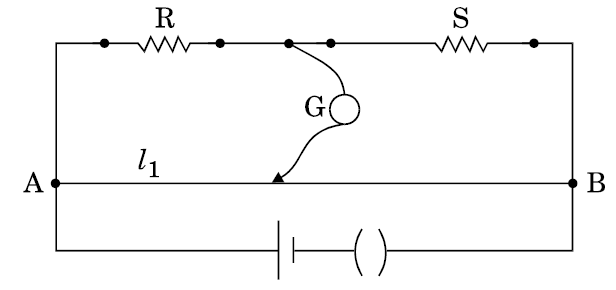
  1. Write the principle of working of a metre bridge.
  2. In a metre bridge, the balance point is found at a distance $l_1$ with resistances R and S as shown in the figure.

An unknown resistance X is now connected in parallel to the resistance S and the balance point is found at a distance $l_2$. Obtain a formula for X in terms of $l_1$, $l_2$ and S.
State Gauss᾿s theorem in electrostatics. Using this theorem, derive an expression for the electric field due to an infinitely long straight wire of linear charge density $\lambda$.
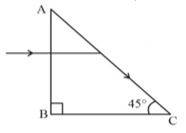
A light ray entering a right-angled prism undergoes refraction at the face AC as shown in Figure
(I) What is the refractive index of the material of the prism in Figure?

Image

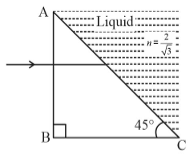
(II) (a) If the side AC of the above prism is now surrounded by a liquid of refractive index $\frac{2}{\sqrt{3}}$ as shown in Figure, determine if the light ray continues to graze along the interface AC or undergoes total internal reflection or undergoes refraction into the liquid.

Image

(b) Draw the ray diagram to represent the path followed by the incident ray with the corresponding angle values.
(Given, $\sin ^{-1}\left(\frac{\sqrt{2}}{\sqrt{3}}\right)=54.6^{\circ}$ )
An object is placed 15 cm in front of a convex lens of focal length 10 cm. Find the nature and position of the image formed. Where should a concave mirror of radius of curvature 20 cm be placed so that the final image is formed at the position of the object itself?
Two particles of masses m1 and m2 are joined by a light rigid rod of length r. The system rotates at an angular speed co about an axis through the centre of mass of the system and perpendicular to the rod. Show that the angular momentum of the system is $\text{L}=\mu\text{r}^2\omega$ where $\mu$ is the reduced mass of the system defined as $\mu=\frac{\text{m}_1\text{m}_2}{\text{m}_1+\text{m}_2}.$