Question
  1. Describe the working principle of a solar cell. Mention three basic processes involved in the generation of emf.
  2. Why are Si and GaAs preferred materials for solar cells?

Answer

  1. When solar cell is illuminated with light photons of energy $(hv)$ greater than the energy gap $\text{E}_{\text{g}}$ of the semiconductor, then electron hole pairs are generated due to absorption of photons.
The three basic processes involved in the generation of emf:
  1. Generation of e-h pairs due to light with close to the junction.
  2. Separation of electrons and holes due to electric field of the depletion region.
  3. The electrons reaching the n side are collected by the front contact and holes reaching p side are collected by back contact.
  1. Solar radiation has maximum intensity of photons of energy = 1.5eV.
Hence semiconducting materials Si and GaAs, with band gap $\approx$ 1.5 eV, are preferred materials for solar cells.

Need a full question paper?

Generate a complete, print-ready paper with questions like this in minutes — across 16+ boards, with answer keys.
Start Generating Free

Similar questions

Draw a labelled diagram of a full wave rectifier circuit. State its working principle. Show the input-output waveforms.
Explain the quantisation of angular momentum for an electron orbiting a nucleus.
$\#\#\#$ Write second postulate of Bohr's model and De$-$Broglie's explanation of it.
Explain, with the help of a circuit diagram, the working of a photo-diode. Write briefly how it is used to detect the optical signals.
State the law of radioactive decay.
Plot a graph showing the number (N) of undecayed nuclei as a function of time (t) for a given radioactive sample having half life $T_½.$
Depict in the plot the number of undecayed nuclei at (i) $t = 3 T_½$ and (ii) $t = 5 T_½.$
The moment of inertia of a uniform rod of mass 0.50kg and length 1m is $0.10kg-m^2$ about a line perpendicular to the rod. Find the distance of this line from the middle point of the rod.
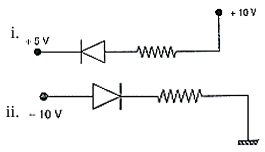
Explain, with the help of a circuit diagram, how the thickness of depletion layer in a p-n junction diode changes when it is forward biased. In the following circuits which one of the two diodes is forward biased and which is reverse biased?
Image
If a piece of paper is placed at the position of a virtual image of a strong light source, will the paper burn after sufficient time? What happens if the image is real? What happens if the image is real but the source is virtual?
A light ray, going through a prism with the angle of prism 60°, is found to deviate by 30°. What limit on the refractive index can be put from these data?
A jet plane is travelling towards west at a speed of 1800km/h. What is the voltage difference developed between the ends of the wing having a span of 25m, if the Earth’s magnetic field at the location has a magnitude of $5 × 10^{–4}T$ and the dip angle is 30°.
Sketch the graph showing variation of stopping potential with frequency of incident radiations for two photosensitive materials A and B having threshold frequencies $v_{A >}v_{B.}$​​​​​​​
  1. In which case is the stopping potential more and why?
  2. Does the slope of the graph depend on nature of the material used? Explain.