Question
  1. Despite having an aldehyde group, glucose does not give 2,4-DNP test. What does this indicate?
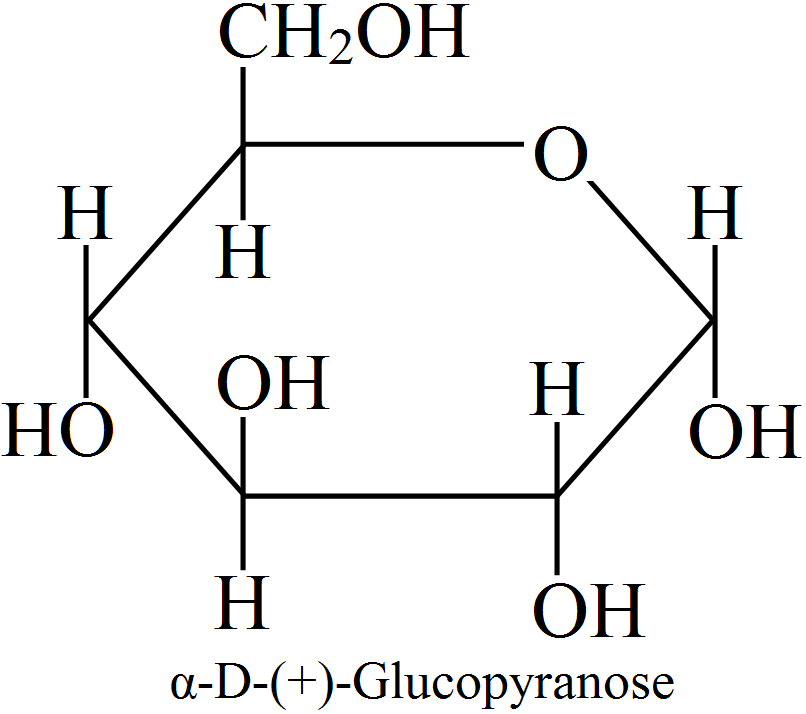
  2. Draw the Haworth structure of a-D-(+)-Glucopyranose.
  3. What is the significance of D and (+) here?
Answer

  1. This indicates that the aldehyde group in glucose is not free.
  2.  

  1. ‘D’ gives the configuration, i.e., the -OH group at C-5 is on the right hand side. (+) sign indicates that the isomer is dextrorotatory.

Need a full question paper?

Generate a complete, print-ready paper with questions like this in minutes — across 16+ boards, with answer keys.

Start Generating Free

Similar questions

  1. E0 value for the Mn3+/Mn2+ couple is positive (+ 1.5V) whereas that of Cr3+/Cr2+ is negative (-0.4 V). Why?
  2. Transition metals form coloured compounds. Why?
  3. Complete the following equation:

$\text{2MnO}^{-}_{4}+\text{16H}^{+}+\text{5C}_{2}\text{O}^{2-}_{4}\xrightarrow{\text{ }\ \ \ \ \ \ \ \ \ \ \ \ }$

Explain chemical properties of $KMnO _4$
Calculate the molarity of each of the following solutions:
  1. 30 g of Co(NO3)2. 6H2O in 4.3 L of solution.
  2. 30 mL of 0.5 M H2SO4 diluted to 500 mL.
Differentiate between order and molecularity of a reaction.
How will you bring about the following conversions?
Iso-propyl chloride to n-propyl chloride.
Aqueous copper sulphate solution and aqueous silver nitrate solution are electrolysed by 1 ampere current for 10 minutes in separate electrolytic cells. Will the mass of copper and silver deposited on the cathode be same or different? Explain your answer.
Calculate the temperature at which a solution containing 54 g of glucose. (C6H12O6), in 250 g of water will freeze. (Kf for water = 1.86 K mol–1 kg).
The reaction between A and B is first order with respect to A and zero order with respect to B. Fill in the blanks in the following table:
Experiment [A]/mol L-1 [B]/mol L-1 Initial rate/mol L-1 min-1
I 0.1 0.1 2.0 × 10-2
II - 0.2 4.0 × 10-2
III 0.4 0.4 -
IV - 0.2 2.0 × 10-2
Give the structural formula and IUPAC name of the following compounds:
  1. BHC
  2. DDT
Give reasons for the following:
  1. Acetylation of aniline reduces its activation effect.
  2. CH3NH2 is more basic than C6H5NH2.
  3. Although -NH2 is o/p directing group, yet aniline on nitration gives a significant amount of m-nitroaniline.