Question
DETERMINANTS: A determinant is a square array of numbers (written within a pair of vertical lines) which represents a certain sum of We can solve a system of equations using determinants, but it becomes very tedious for large systems. We will only do 2 × 2 and 3 × 3 systems using determinants. Using the properties of determinants solve the problem given below and answer the questions that follow:
Three shopkeepers Ram Lal, Shyam Lal, and Ghansham are using polythene bags, handmade bags (prepared by prisoners), and newspaper's envelope as carry bags. It is found that the shopkeepers Ram Lal, Shyam Lal, and Ghansham are using (20, 30, 40), (30, 40, 20), and (40, 20, 30) polythene bags, handmade bags, and newspapers envelopes respectively. The shopkeepers Ram Lal, Shyam Lal, and Ghansham spent ₹250, ₹270, and ₹200 on these carry bags respectively.
  1. What is the cost of one polythene bag?
  1. ₹ 1
  2. ₹ 2
  3. ₹ 3
  4. ₹ 5
  1. What is the cost of one handmade bag?
  1. ₹1
  2. ₹2
  3. ₹3
  4. ₹5
  1. What is the cost of one newspaper bag?
  1. ₹1
  2. ₹2
  3. ₹3
  4. ₹5
  1. Keeping in mind the social conditions, which shopkeeper is better?
  1. Ram Lal
  2. Shyam Lal
  3. Ghansham
  4. None of these
  1. Keeping in mind the environmental conditions, which shopkeeper is better?
  1. Ram Lal
  2. Shyam Lal
  3. Ghansham
  4. None of these

Answer

  1. (a) ₹1
  2. (b) ₹2
  3. (d) ₹5
  4. (b) Shyam Lal
  5. (a) Ram Lal

Need a full question paper?

Generate a complete, print-ready paper with questions like this in minutes — across 16+ boards, with answer keys.

Start Generating Free

Similar questions

Consider the curve $x^2+y^2=16$ and line $y = x$ in the first quadrant. Based on the above information, answer the following questions.
  1. Point of intersection of both the given curves is.
  1. $(0, 4)$
  2. $(0, 2\sqrt{2})$
  3. $(2\sqrt{ 2},2\sqrt{2})$
  4. $(2,\sqrt{2},4)$
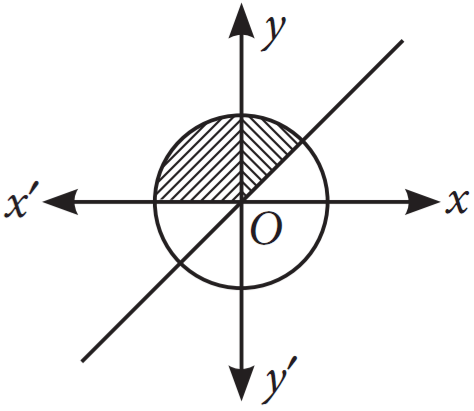
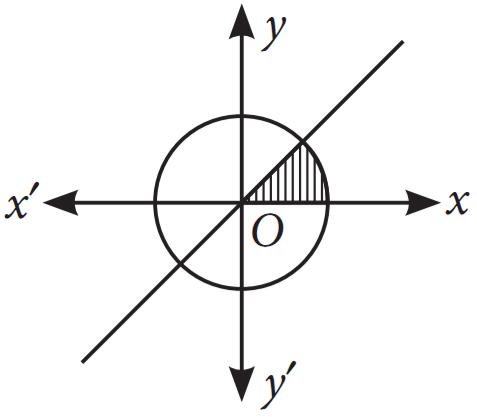
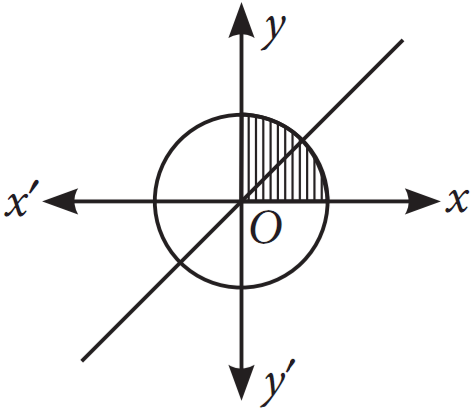
  1. Which of the following shaded portion represent the area bounded by given two curves?
  1. None of these
  1. The value of the integral $\int\limits_{0}^{2\sqrt{2}}\text{x}\text{dx}$ is.
  1. $0$
  2. $1$
  3. $2$
  4. $4$
  1. The value of the integral $\int\limits_{2\sqrt{2}}^{0}\sqrt{16-\text{x}^2}\text{ dx}$ is.
  1. $2(\pi-2)$
  2. $2(\pi-8)$
  3. $4(\pi-2)$
  4. $4(\pi+2)$
  1. Area bounded by the two given curves is.
  1. $3\pi\text{ sq.units}$
  2. $\frac{\pi}{2}\text{ sq.units}$
  3. $\pi\text{ sq.units}$
  4. $2\pi\text{ sq.units}$
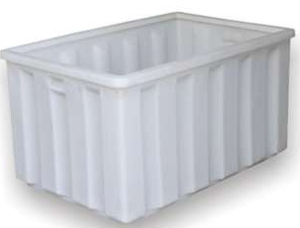
Ankit wants to construct a rectangular tank for his house that can hold $80 \mathrm{ft}^3$ of water. He wants to construct on one corner of terrace so that sufficient space is left after construction of tank. For that he has to keep width of tank constant $5 \mathrm{ft}$, but the length and heights are variables. The top of the tank is open. Building the tank cost ₹20 per sq. foot for the base and ₹10 per sq. foot for the side.

Image

(i) Express cost of tank as a function of height(h).

(ii) Verify by second derivative test that cost is minimum at critical point.

(iii) Find the value of $\mathrm{h}$ at which $\mathrm{c}(\mathrm{h})$ is minimum.

OR

Find the minimum cost of tank?

Read the following text carefully and answer the questions that follow:
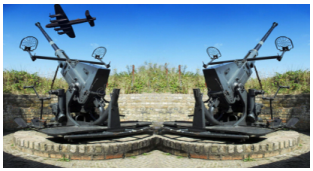
There are two antiaircraft guns, named as $ A $ and $B$. The probabilities that the shell fired from them hits an airplane are $0.3$ and $0.2$ respectively. Both of them fired one shell at an airplane at the same time.
Image
$i$. What is the probability that the shell fired from exactly one of them hit the plane?
$ii$. If it is known that the shell fired from exactly one of them hit the plane, then what is the probability that it was fired from $B$?
$iii$. What is the probability that the shell was fired from $A$?
OR
How many hypotheses are possible before the trial, with the guns operating independently? Write the conditions of these hypotheses.
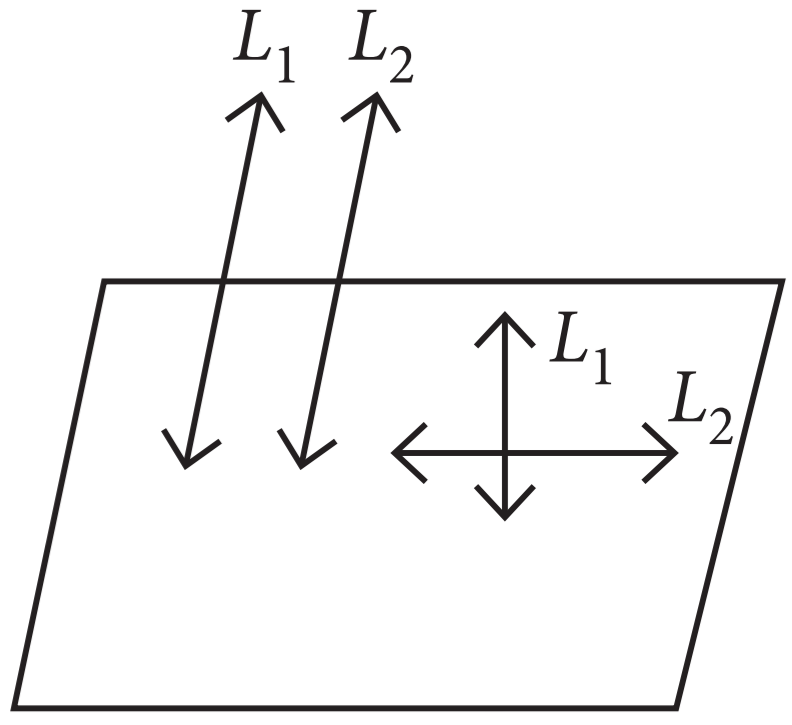
If $a_{1,} b_{1,} c_{1,}$ and $a_{2,}b_{2,} c_2$ are direction ratios of two lines say $L_1$ and $L_2$ respectively. Then $L_1 || L_2$ iff $\frac{\text{a}_1}{\text{a}_2}=\frac{\text{b}_1}{\text{b}_2}=\frac{\text{c}_1}{\text{c}_2}$ and $\text{L}_1\perp\text{L}_2$ iff $a_1a_2 + b_1b_2 + c_1c_2 = 0.$

 Based on the above information, answer the following questions.
  1. If $l_{1,} m_1, n_{1,}$ and $l_2, m_2, n_2$ are the direction cosines of $L_1$ and $L_2$ respectively, then $L_1$ will be perpendicular to $L_2$, iff:
  1. $l_1l_2 + m_1m_2 + n_1n_2 = 0$
  2. $l_1m_2 + m_1l_2 + n_1n_2 = 0$
  3. $\frac{\text{l}_1}{\text{l}_2}=\frac{\text{m}_1}{\text{m}_2}=\frac{\text{n}_1}{\text{n}_2}$
  4. None of these
  1. If $l_1, m_1, n_1$ and $l_2, m_2, n_2$ are direction cosines of $L_1$ and $L_2$ respectively, then $L_1$ will be parallel to $L_2,$ iff:
  1. $l_1l_2 + m_1m_2 + n_1n_2 = 0$
  2. $l_1m_2 + m_1l_2 + n_1n_2 = 0$
  3. $\frac{\text{l}_1}{\text{l}_2}=\frac{\text{m}_1}{\text{m}_2}=\frac{\text{n}_1}{\text{n}_2}$
  4. $m_1n_2 + m_2n_2 + l_1l_2 = 0$
  1. The coordinates of the foot of the perpendicular drawn from the point $A(1, 2, 1)$ to the line joining $B(1, 4, 6)$ and $C(5, 4, 4),$ are:
  1. $(1, 2, 1)$
  2. $(2, 4, 5)$
  3. $(3, 4, 5)$
  4. $(3, 4, 5)$
  1. The direction ratios of the line which is perpendicular to the lines with direction ratios proportional to $(1, -2, -2)$ and $(0, 2, 1)$ are:
  1. $< 1, 2, 1 >$
  2. $< 2,-1, 2 >$
  3. $< -1,2, 2 >$
  4. None of these
  1. The lines $\frac{\text{x}-2}{3}=\frac{\text{y}+1}{-2}=\frac{\text{z}-2}{0}$ and $\frac{\text{x}-1}{1}=\frac{\frac{\text{y}+3}{2}}{\frac{3}{2}}=\frac{\text{z}+5}{2}$ are:
  1. Parallel.
  2. Perpendicular.
  3. Skew lines.
  4. Non-intersecting.
Megha wants to prepare a handmade gift box for her friend's birthday at home. For making lower part of box, she takes a square piece of cardboard of side $20cm$.

Based on the above information, answer the following questions.
  1. If x cm be the length of each side of the square cardboard which is to be cut off from corners of the square piece of side 20cm, then possible value of x will be given by the interval.
  1. [0, 20]
  2. (0, 10)
  3. (0, 3)
  4. None of these
  1. Volume of the open box formed by folding up the cutting corner can be expressed as.
  1. $\text{V}=\text{x}(20-2\text{x})(20-2\text{x)}$
  2. $\text{V}=\frac{\text{x}}{2}(20+\text{x})(20-\text{x})$
  3. $\text{V}=\frac{\text{x}}{3}(20-\text{x})(20+\text{x})$
  4. $\text{V}=\text{x}(20-2\text{x})(20-\text{x)}$
  1. The values of x for which $\frac{\text{dV}}{\text{dX}}=0$, are.
  1. 3, 4
  2. $0,\frac{10}{3}$
  3. 0, 10
  4. $10,\frac{10}{3}$
  1. Megha is interested in maximizing the volume of the box. So, what should be the side of the square to be cut off so that the volume of the box is maximum?
  1. 12cm
  2. 8cm
  3. $\frac{10}{3}\text{cm}$
  4. 2cm
  1. The maximum value of the volume is.
  1. $\frac{17000}{27}\text{cm}^3$
  2. $\frac{11000}{27}\text{cm}^3$
  3. $\frac{8000}{27}\text{cm}^3$
  4. $\frac{16000}{27}\text{cm}^3$
Read the following text carefully and answer the questions that follow:
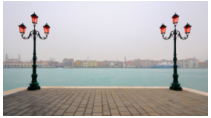
In a street two lamp posts are $600$ feet apart. The light intensity at a distance d from the first $($stronger$)$ lamp post.$\frac{1000}{d^2}$ the light intensity at distance d from the second $($weaker$)$ lamp post is $\frac{125}{d^2} \ ($in both cases the light intensity is inversely proportional to the square of the distance to the light source$)$. The combined light intensity is the sum of the two light intensities coming from both lamp posts.
Image
$i$. If $l(x)$ denotes the combined light intensity, then find the value of $x$ so that $I(x)$ is minimum.
$ii$. Find the darkest spot between the two lights.
$iii$. If you are in between the lamp posts, at distance $x$ feet from the stronger light, then write the combined light intensity coming from both lamp posts as function of $x$.
OR
Find the minimum combined light intensity?
Read the following text carefully and answer the questions that follow:
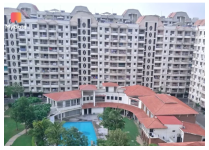
Mrs. Maya is the owner of a high-rise residential society having $50$ apartments. When he set rent at $₹ 10000 $ month, all apartments are rented. If he increases rent by $₹ 250$ / month, one fewer apartment is rented. The maintenance cost for each occupied unit is $₹ 500$ / month.

Image
$i.$ If $P$ is the rent price per apartment and $N$ is the number of rented apartments, then find the profit. $(1)$
$ii.$ If $x$ represents the number of apartments which are not rented, then express profit as a function of $x. (1)$
$iii.$ Find the number of apartments which are not rented so that profit is maximum. $(2)$
OR
Verify that profit is maximum at critical value of $x$ by second derivative test. $(2)$
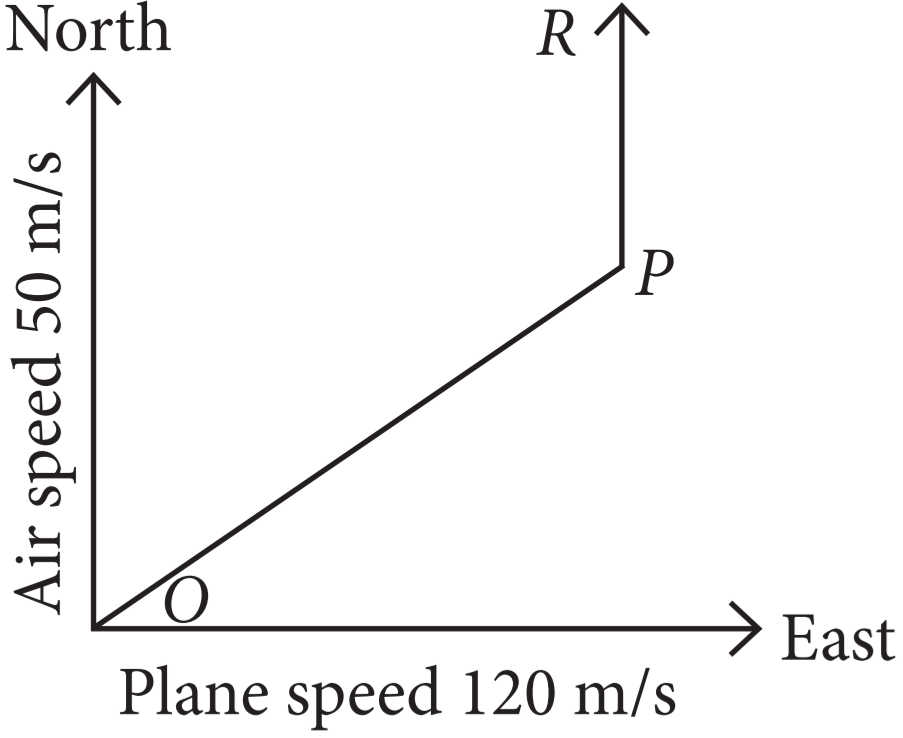
A plane started from airport situated at O with a velocity of 120m/s towards east. Air is blowing at a velocity of 50m/ s towards the north as shown in the figure.
The plane travelled 1hr in OP direction with the resultant velocity. From P to R the plane travelled 1hr keeping velocity of 120m/s and finally landed at R.

Based on the above information, answer the following questions.
  1. What is the resultant velocity from O to P?
  1. 100m/ s
  2. 130m/ s
  3. 126m/ s
  4. 180m/ s
  1. What is the direction of travel of plane from O to P with East?
  1. $\tan^{-1}\Big(\frac{5}{12}\Big)$
  2. $\tan^{-1}\Big(\frac{12}{3}\Big)$
  3. 50
  4. 80
  1. What is the displacement from O to P?
  1. 600km
  2. 468km
  3. 532km
  4. 500km
  1. What is the resultant velocity from P to R?
  1. 120m/ s
  2. 70m/ s
  3. 170m/ s
  4. 200m/ s
  1. What is the displacement from P to R?
  1. 450km
  2. 532km
  3. 610km
  4. 612km
If the equation is of the form $\frac{\text{dy}}{\text{dx}}=\frac{\text{f(x, y)}}{\text{g(x, y)}}$or $\frac{\text{dy}}{\text{dx}}=\text{F}\Big(\frac{\text{y}}{\text{x}}\Big),$ where f(x, y), g(x, y) are homogeneous functions of the same degree in x and y, then put y = vx and $\frac{\text{dy}}{\text{dx}}=\text{v+x}\Big(\frac{\text{dv}}{\text{dx}}\Big),$ so that the dependent variable y is changed to another variable v and then apply variable separable method.
Based on the above information, answer the following questions.
  1. The general solution of $\text{x}^2\frac{\text{dy}}{\text{dx}}=\text{x}^2+\text{xy}+\text{y}^2$ is:
  1. $\tan^{-1}\frac{\text{x}}{\text{y}}=\log|\text{x}|+\text{c}$
  2. $\tan^{-1}\frac{\text{y}}{\text{x}}=\log|\text{x}|+\text{c}$
  3. $\text{y}=\text{x}\log|\text{x}|+\text{c}$
  4. $\text{x}=\text{y}\log|\text{y}|+\text{c}$
  1. Solution of the differential equation $2\text{xy}\frac{\text{dy}}{\text{dx}}=\text{x}^2+3\text{y}^2$ is:
  1. $x^3 + y^2 = cx^2$
  2. $\frac{\text{x}^2}{2}+\frac{\text{y}^3}{3}=\text{y}^2+\text{c}$
  3. $x^2 + y^3 = cx^2$
  4. $x^2 + y^2 = cx^3$
  1. General solution of the differential equation ($x^2 + 3xy + y^2) dx - x^2 dy = 0$ is:
  1. $\frac{\text{x+y}}{\text{y}}-\log\text{x = c}$
  2. $\frac{\text{x+y}}{\text{y}}+\log\text{x = c}$
  3. $\frac{\text{x}}{\text{x+y}}-\log\text{x = c}$
  4. $\frac{\text{x}}{\text{x+y}}+\log\text{x = c}$
  1. General solution of the differential equation $\frac{\text{dy}}{\text{dx}}=\frac{\text{y}}{\text{x}}\bigg\{\log\Big(\frac{\text{y}}{\text{x}}\Big)+1\bigg\}$ is:
  1. $\log(\text{xy})=\text{c}$
  2. $\log\text{y}=\text{cx}$
  3. $\log\frac{\text{y}}{\text{x}}=\text{cx}$
  4. $\log\text{x}=\text{cy}$
  1. Solution of the differential equation $\Big(\text{x}\frac{\text{dy}}{\text{dx}}-\text{y}\Big)\text{e}^\frac{\text{y}}{\text{x}}=\text{x}^2\ \cos\text{x}$ is:
  1. $\text{e}^\frac{\text{y}}{\text{x}}-\sin\text{x = c}$
  2. $\text{e}^\frac{\text{y}}{\text{x}}+\sin\text{x = c}$
  3. $\text{e}^\frac{\text{-y}}{\text{x}}-\sin\text{x = c}$
  4. $\text{e}^\frac{\text{-y}}{\text{x}}+\sin\text{x = c}$
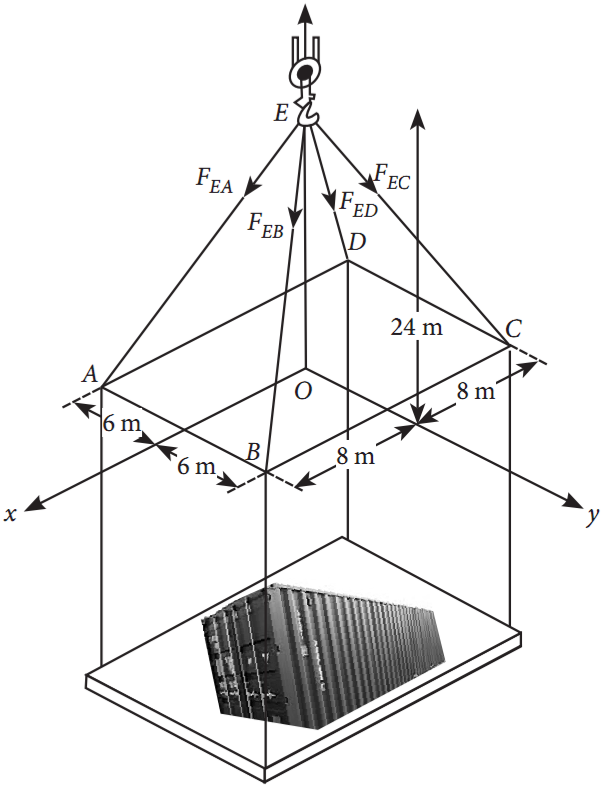
Consider the following diagram, where the forces in the cable are given. Based on the above information, answer the following questions.
  1. The cartesian equation of line along EA is:
  1. $\frac{\text{x}}{-4}=\frac{\text{y}}{3}=\frac{\text{z}}{12}$
  2. $\frac{\text{x}}{-4}=\frac{\text{y}}{3}=\frac{\text{z}-24}{12}$
  3. $\frac{\text{x}}{-3}=\frac{\text{y}}{3}=\frac{\text{z}-12}{12}$
  4. $\frac{\text{x}}{3}=\frac{\text{y}}{4}=\frac{\text{z}-24}{12}$
  1. The vector $\overline{\text{ED}}$ is:
  1. $8\hat{\text{i}}-6\hat{\text{j}}+24\hat{\text{k}}$
  2. $-8\hat{\text{i}}-6\hat{\text{j}}+24\hat{\text{k}}$
  3. $-8\hat{\text{i}}-6\hat{\text{j}}-24\hat{\text{k}}$
  4. $8\hat{\text{i}}+6\hat{\text{j}}+24\hat{\text{k}}$
  1. The length of the cable EB is:
  1. 24 units
  2. 26 units
  3. 27 units
  4. 25 units
  1. The length of cable EC is equal to the length of:
  1. EA
  2. EB
  3. ED
  4. All of these
  1. The sum of all vectors along the cables is:
  1. $96\hat{\text{i}}$
  2. $96\hat{\text{j}}$
  3. $-96\hat{\text{k}}$
  4. $96\hat{\text{k}}$