Question
Determine graphically the minimum value of the objective function Z = -50x + 20y subject to the constraints:
2x - y $\geq$ - 5
3x + y $\geq$ 3
2x - 3y $\leq$ 12
x $\geq$ 0, y $\geq$ 0
Answer

2x - y $\geq$ - 5
3x + y $\geq$ 3
2x - 3y $\leq$ 12
x $\geq$ 0, y $\geq$ 0
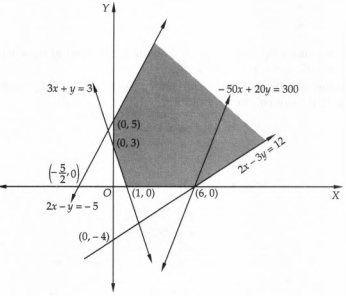
The feasible region of the system of inequations given in constraints is shown in a figure. We observe that the feasible region is unbounded.

The values of the objective function Z at the comer points are given in the following table:

Corner point (x, y) Value of the objective function Z = -50x + 20y
(0,5) Z = - 50 $\times$ 0 + 20 $\times$ 5 = 100
(0,3) Z = - 50 $\times$ 0 + 20 $\times$ 3 = 60
(1,0) Z = - 50 $\times$ 1 + 20 $\times$ 0 = - 50
(6,0) Z = -50 $\times$ 6 + 20 $\times$ 0 = - 300

Clearly, - 300 is the smallest value of Z at the corner point (6, 0). Since the feasible region is unbounded, therefore, to check whether - 300 is the minimum value of Z, we draw the line - 300 = -50x + 20y and check whether the open half plane -50 x + 20y < -300 has points in common with the feasible region or not. From Fig., we find that the open half plane represented by - 50 x + 20y < - 300 has points in common with the feasible region. Therefore, Z = - 50x + 20y has no minimum value subject to the given constraints.

Need a full question paper?

Generate a complete, print-ready paper with questions like this in minutes — across 16+ boards, with answer keys.

Start Generating Free

Similar questions

A manufacturer makes two types $A$ and $B$ of tea$-$cups. Three machines are needed for the manufacture and the time in minutes required for each cup on the machines is given below:
  Machines
$I$ $II$ $III$
$A$ $12$ $18$ $6$
$B$ $6$ $0$ $9$
Each machine is available for a maximum of $6$ hours per day. If the profit on each cup $A$ is $75$ paise and that on each cup $B$ is $50$ paise, show that $15$ tea$-$cups of type $A$ and $30$ of type $B$ should be manufactured in a day to get the maximum profit.
Evaluate the following:
$\begin{bmatrix}1&2&3\end{bmatrix}\begin{bmatrix}1&0&2\\2&0&1\\0&1&2\end{bmatrix}\begin{bmatrix}2\\4\\6\end{bmatrix}$
$\text{If (x}-\text{a})^2+(\text{y}-\text{b})^2=\text{c}^2,$  for some c > 0 , prove that
$\frac{\Big[1+\Big(\frac{\text{dy}}{\text{dx}}\Big)^2\Big]^{\frac{3}{2}}}{\frac{\text{d}^2\text{y}}{\text{dx}^2}}$
is a constant independent of a and b.
A coaching institute of English (subject) conducts classes in two batches I and II and fees for rich and poor children are different. In batch I, it has 20 poor and 5 rich children and total monthly collection is ₹ 9,000, whereas in batch II, it has 5 poor and 25 rich children and total monthly collection is ₹ 26,000. Using matrix method, find monthly fees paid by each child of two types. What values the coaching institute is inculcating in the society?
Show that f(x) = |x − 2| is continuous but not differentiable at x = 2.
Find the area enclosed by the curve $y = -x^2$ and the strainght line $x + y + 2 = 0.$
A wholesale dealer deals in two kinds, $A$ and $B ($say$)$ of mixture of nuts. Each $\ kg$ of mixture $A$ contains $60$ grams of almonds$, 30$ grams of cashew nuts and $30$ grams of hazel nuts. Each $\ kg$ of mixture $B$ contains $30$ grams of almonds, $60$ grams of cashew nuts and $180$ grams of hazel nuts. The remainder of both mixtures is per nuts. The dealer is contemplating to use mixtures $A$ and $B$ to make a bag which will contain at least $240$ grams of almonds, $300$ grams of cashew nuts and $540$ grams of hazel nuts. Mixture A costs $Rs. 8$ per $\ kg. $and mixture $B$ costs $Rs. 12$ per $\ kg.$ Assuming that mixtures $A$ and $B$ are uniform, use graphical method to determine the number of $\ kg.$ of each mixture which he should use to minimise the cost of the bag.
Evaluate the following integrals:
$\int\limits^{\text{b}}_{\text{a}}\frac{\text{x}^{\frac{1}{\text{n}}}}{\text{x}^\frac{1}{\text{n}}+\big(\text{a}+\text{b}-\text{x}\big)^{\frac{1}{\text{n}}}}\text{ dx},\text{ n}\in\text{N},\text{n}\leq2$
Radium decomposes at a rate proportional to the quantity of radium present. It is found that in 25 years, approximately 1.1% of a certain quantity of radium has decomposed. Determine approximately how long it will take for one-half of the original amount of radium to decompose?
Using properties of determinants, prove that:
$\begin{vmatrix} \text{1 + a } & \text{1} & \text{1} \\ \text{1} & \text{1 + b} & \text{1} \\\text{1} & 1 &\text{1 + c} \end{vmatrix}= \text{ abc + bc + ca + ab}$