Question
Determine. if 3 is a root of the equation given below:
$\sqrt{\text{x}^2-4\text{x}+3}+\sqrt{\text{x}^2-9}=\sqrt{4\text{x}^2-14\text{x}+16}$

Answer

$\sqrt{\text{x}^2-4\text{x}+3}+\sqrt{\text{x}^2-9}=\sqrt{4\text{x}^2-14\text{x}+16}$
If x = 3, then
L.H.S. $\sqrt{\text{x}^2-4\text{x}+3}+\sqrt{\text{x}^2-9}$
$=\sqrt{(3)^2-4\times3+3}+\sqrt{(3)^2-9}$
$=\sqrt{9-12+3}+\sqrt{9-9}$
$=\sqrt{0}+\sqrt{0}$
$=0$
R.H.S. $=\sqrt{4\text{x}^2-14\text{x}+16}$
$=\sqrt{4(3)^2-14\times3+16}$
$=\sqrt{4\times9-42+16}$
$=\sqrt{36+16-42}$
$=\sqrt{52-42}$
$=\sqrt{10}$
$\because$ L.H.S. $\neq$ R.H.S.

Need a full question paper?

Generate a complete, print-ready paper with questions like this in minutes — across 16+ boards, with answer keys.
Start Generating Free

Similar questions

The sum of first $q$ terms of an A.P. is $63 q-3 q^2$. If its $p^{\text {th }}$ term is -60 , find the value of $p$. Also, find the $11^{\text {th }}$ term of this A.P.
A box contains 90 discs which are numbered from 1 to 90. If one disc is drawn at random from the box, find the probability that it bears:
  1. A two-digit number.
  2. A perfect square number.
  3. A number divisible by 5.
If $3\tan\theta=4,$ find the value of $\frac{4\cos\theta-\sin\theta}{2\cos\theta+\sin\theta}.$
Use elimination method to find all possible solutions of the following pair of linear equations $a x+b y-a+b=0$ and $bx - ay - a - b =0$
If in two triangles, corresponding angles are equal, then their corresponding sides are in the same ratio (or proportion) and hence the two triangles are similar:
Point A lies on the line segment PQ joinning P(6, -6) and Q(-4, -1) in such a way that $\frac{\text{PA}}{\text{PQ}}=\frac{2}{5}.$ If the point A also lies on the line 3x + k(y + 1) = 0, find the value of k.
Find the number of terms of the $A.P. 18,15 \frac{1}{2}, 13, \ldots \ldots \ldots . .,-49 \frac{1}{2}$ and find the sum of all its terms.
All kings, queens and aces are removed from a pack of 52 cards. The remaining cards are well shuffled and then a card is drawn from it. Find the probability that the drawn card is
(i) A black face card
(ii) A red card
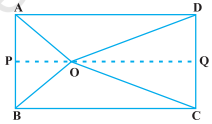
O is any point inside a rectangle ABCD see Fig. Prove that $OB^2 + OD^2 = OA^2 + OC^2$
.
Find the point on the x-axis which is equidistant from $(2, -5)$ and $(-2, 9).$