Question
Determine. if 3 is a root of the equation given below:
$\sqrt{\text{x}^2-4\text{x}+3}+\sqrt{\text{x}^2-9}=\sqrt{4\text{x}^2-14\text{x}+16}$

Answer

$\sqrt{\text{x}^2-4\text{x}+3}+\sqrt{\text{x}^2-9}=\sqrt{4\text{x}^2-14\text{x}+16}$
If x = 3, then
L.H.S. $\sqrt{\text{x}^2-4\text{x}+3}+\sqrt{\text{x}^2-9}$
$=\sqrt{(3)^2-4\times3+3}+\sqrt{(3)^2-9}$
$=\sqrt{9-12+3}+\sqrt{9-9}$
$=\sqrt{0}+\sqrt{0}$
$=0$
R.H.S. $=\sqrt{4\text{x}^2-14\text{x}+16}$
$=\sqrt{4(3)^2-14\times3+16}$
$=\sqrt{4\times9-42+16}$
$=\sqrt{36+16-42}$
$=\sqrt{52-42}$
$=\sqrt{10}$
$\because$ L.H.S. $\neq$ R.H.S.

Need a full question paper?

Generate a complete, print-ready paper with questions like this in minutes — across 16+ boards, with answer keys.
Start Generating Free

Similar questions

Solve the following quadratic equation by completing the square method.
x2 + x – 20 = 0
Solve : $\frac{1}{3} x+5 y=13 ; 2 x+\frac{1}{2} y=19$
If $\tan\theta=\frac{24}{7},$ find that $\sin\theta+\cos\theta.$
Prove : $\cos ^2 \theta+\frac{1}{1+\cot ^2 \theta}=1$
Find the coordinate of the point which divides the join of $A(-1, 7)$ and $B(4, -3)$ in the ratio $2 : 3$.
Ayush starts walking from his house to office. Instead of going to the office directly, he goes to a bank first, from there to his daughter’s school and then reaches the office. What is the extra distance travelled by Ayush in reaching the office? (Assume that all distance covered are in straight lines). If the house is situated at (2, 4), bank at (5, 8), school at (13, 14) and office at (13, 26) and coordinates are in kilometers.
If $r_1$​​​​​​​ and $r_2​​​​​​​$​​​​​​​ denote the radii of the circular bases of the frustum of a cone such that $r_1 > r_2$​​​​​​​, then write the ratio of the height of the cone of which the frustum is a part to the height fo the frustum.
Let there be an A.P. with first term $'a'$, common difference ' $d$ '. If $a_n$ denotes in $n^{\text {th }}$ term and $S_n$ the sum of first $n$ terms,
find. a , if $a _{ n }=28, S_{ n }=144$ and $n =9$.
Prove : $\frac{\cos ^2 \theta}{1-\tan \theta}+\frac{\sin ^3 \theta}{\sin \theta-\cos \theta}==1+\sin \theta$
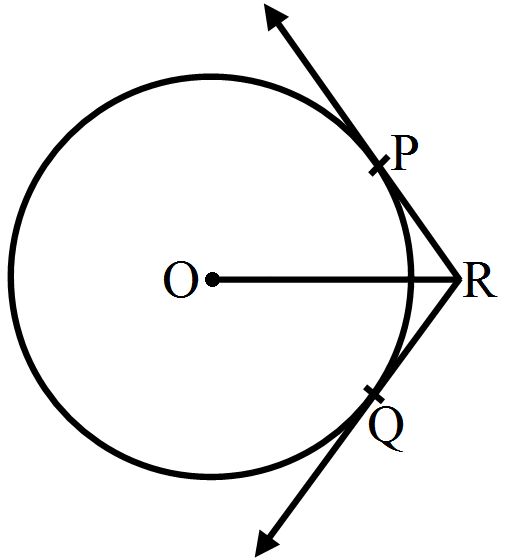
In the given figure, two tangents RQ and RP are drawn from an external point R to the circle with centre O. If $\angle\text{PRQ} = 120^\circ$ then prove that OR = PR + RQ.