Question
Determine k if
$
f(x)=\left\{\begin{array}{ll}
k e^{-\theta x} & \text { for } 0 \leq x<\infty, \theta>0 \\
0 & \text { otherwise }
\end{array}\right.
$
is the p.d.f. of the r.v. $X$. Also find $P\left(X>\frac{1}{\theta}\right)$. Find $M$ if $P(0 < X < M)$=$\frac{1}{2}$
Answer

Get the step-by-step solution for this question inside the Vidyadip app.

Get the answer in the app

Need a full question paper?

Generate a complete, print-ready paper with questions like this in minutes — across 16+ boards, with answer keys.

Start Generating Free

Similar questions

The equations of the two lines of regression are $6x + y − 31 = 0$ and $3x + 2y – 26 = 0.$ Find the value of the correlation coefficient
Solve $\frac{d y}{d x}=\frac{x+y+1}{x+y-1}$ when $x =\frac{2}{3}$ and $y =\frac{1}{3}$.
For each of the following differential equations find the particular solution : $\frac{d y}{d x}=4 x + y +1$, when $y =1, x =0$
Use the method of least squares to fit a trend line to the data given below. Also, obtain the trend value for the year $1975$.
Year 1962 1963 1964 1965 1966 1967 1968 1969
Production
(million barrels)
0 0 1 1 2 3 4 5
Year 1970 1971 1972 1973 1974 1975 1976  
Production
(million barrels)
6 8 9 9 8 7 10  
It is known that, in a certain area of a large city, the average number of rats per bungalow is five. Assuming that the number of rats follows Poisson distribution, find the probability that a randomly selected bungalow has between $5$ and $7$ rats inclusive. Given $e ^{-5}=0.0067$
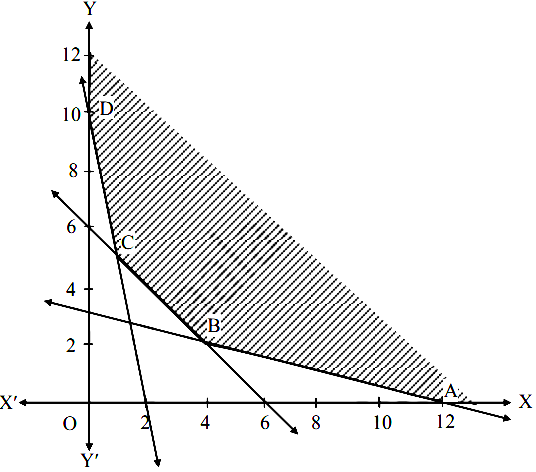
Solve the LPP graphically:
Minimize Z = 4x + 5y
Subject to the constraints 5x + y ≥ 10, x + y ≥ 6, x + 4y ≥ 12, x, y ≥ 0

Solution: Convert the constraints into equations and find the intercept made by each one of it.
Inequations Equations X intercept Y intercept Region
5x + y ≥ 10 5x + y = 10 ( ___, 0) (0, 10) Away from origin
x + y ≥ 6 x + y = 6 (6, 0) (0, ___ ) Away from origin
x + 4y ≥ 12 x + 4y = 12 (12, 0) (0, 3) Away from origin
x, y ≥ 0 x = 0, y = 0 x = 0 y = 0 $1^{st}$ quadrant
∵ Origin has not satisfied the inequations.
∴ Solution of the inequations is away from origin.

The feasible region is unbounded area which is satisfied by all constraints.
In the figure, ABCD represents
The set of the feasible solution where
A(12, 0), B( ___, ___ ), C ( ___, ___ ) and D(0, 10).
The coordinates of B are obtained by solving equations
x + 4y = 12 and x + y = 6
The coordinates of C are obtained by solving equations
5x + y = 10 and x + y = 6
Hence the optimum solution lies at the extreme points.

The optimal solution is in the following table:
Point Coordinates Z = 4x + 5y Values Remark
A (12, 0) 4(12) + 5(0) 48  
B ( ___, ___ ) 4( ___) + 5(___ ) ______ ______
C ( ___, ___ ) 4( ___) + 5(___ ) ______  
D (0, 10) 4(0) + 5(10) 50  
∴ Z is minimum at ___ ( ___, ___ ) with the value ___
Solve the following differential equation
$x^2 \frac{d y}{d x}=x^2+x y-y^2$
The p.d.f. of a continuous r.v. $X$ is
$
f(x)=\left\{\begin{array}{ll}
\frac{3 x^2}{8} & 00 & \text { otherwise }
\end{array}\right.
$
Determine the c.d.f. of $X$ and hence find $P(X<-2)$
Solve $(x+y) d y=a^2 d x$
Find $MPC, MPS, APC$ and $APS$, if the expenditure $E_c$​​​​​​​ of a person with income I is given as $E_c = (0.0003) I^2 + (0.075)$ I When$ I = 1000$