Question
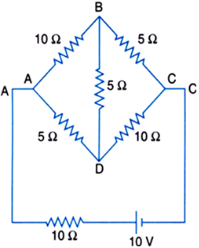
Determine the current in each branch of the network shown in Fig.:

Answer

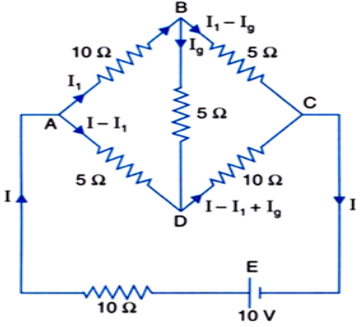
Consider the mesh $\text{ABDA},$
Now, Applying Kirchhoff's loop rule we get $, -10\text{I}_1-5\text{I}_\text{g}+(\text{I}-\text{I}_1)5=0$
$\Rightarrow\ \ 3\text{I}_1-\text{I}+\text{I}_\text{g}=0\ \ ...\text{(i)}$
Consider the mesh $\text{BDCB},$
Again, applying Kirchhoff's loop rule we get $, -5\text{I}_\text{g}-10(1-\text{I}_\text{l}+\text{I}_\text{g})+5(\text{I}_\text{I}-\text{I}_\text{g})=0$
$\Rightarrow\ \ 3\text{I}_1-2\text{I}-4\text{I}_\text{g}=0\ \ ...\text{(ii)}$
Applying Kirchhoff's loop rule to the mesh $\text{ ABCE}, -10\text{I}_1-5(\text{I}_1-\text{I}_\text{g})-10\text{I}+10=0$
or $\ \ 3\text{I}_1+2\text{I}-\text{I}_\text{g}=2\ \ ...{(\text{iii})}$ Equations $(i), (ii)$ and $(iii)$ are simultaneous equations.
On solving these equations, we will find the unknown values of current. Adding $(i)$ and $(iii),$ we get $6\text{I}_\text{1}+\text{I}=2\ \ ...(\text{iv})$ Multiplying $(i)$ by $4$ and adding in $(ii),$ we get $15\text{I}_\text{1}-6\text{I}0=0\ \ ...\text{(v)}$ Solving equations $(iv)$ and $(v),$ we get $\text{I}_1=\frac{4}{17}\text{A}=0.235\ \text{A}$
So, current in branch $AB$ is $0.235 A$. Putting the value of $I_1$ in equation $(v)$ and simplifying, we get Total current, $\text{I}=\frac{10}{17}=0.588\ \text{A}$ Putting the values of $I$ and $I_1$ in equation $(iii)$ and simplifying, we get $\text{I}_\text{g}=\frac{2}{17}\text{A}=-0.118\ \text{A}$ The negative sign indicates that the direction of current is opposite to that shown in Fig. above.
So, current in branch $BD$ is $-0.118 A$.
Current in branch $BC$ is $(\text{I}_1-\text{I}_\text{g})$ i.e. $,\frac{4}{17}-\Big(-\frac{2}{17}\Big)$
i.e.,$\frac{6}{17}$ or $\ 0.353\ \text{A}.$ Current in branch $AD$ is $(I - I_1)$
i.e., $\Big(\frac{10}{17}-\frac{4}{17}\Big)\text{A}$ i.e.,$\ \frac{6}{17}\text{A }$ or $\ 0.353\ \text{A}$ Current in branch $DC$ is $(I_1 - I_1 + I_g) $ i.e., $\frac{6}{17}+\Big(-\frac{2}{17}\Big)​​\text{A }$ or $\ \frac{4}{17}\text{A}$ or $\ 0.235\ \text{A}.$

Need a full question paper?

Generate a complete, print-ready paper with questions like this in minutes — across 16+ boards, with answer keys.
Start Generating Free

Similar questions

What is nature of electromagnetic waves? Explain propagation of wave with the help of a diagram and explain their characteristics in detail.
A capacitor of capacitance $5.00\mu\text{F}$ is charged to $24.0V$ and another capacitor of capacitance $6.0\mu\text{F}$ is charged to $12.0V$ :
  1. Find the energy stored in each capacitor.
  2. The positive plate of the first capacitor is now connected to the negative plate of the second and vice versa. Find the new charges on the capacitors.
  3. Find the loss of electrostatic energy during the process.
  4. Where does this energy go?
  1. A point object is placed on the principal axis of a convex spherical surface of radius of curvature $R,$ which separates the two media of refractive indices $n_1$ and $n_{2 }(n_2 > n_1)$. Draw the ray diagram and deduce the relation between the object distance $(u),$ image distance $(v)$ and the radius of curvature $(R)$ for refraction to take place at the convex spherical surface from rarer to denser medium.
  2. A converging lens has a focal length of $20 \ cm$ in air. It is made of a material of refractive index $1.6$. If it is immersed in a liquid of refractive index $1.3,$ find its new focal length.
A car moving at a speed of 36 km/hr is taking a turn on a circular road of radius 50m. A small wooden plate is kept on the seat with its plane perpendicular to the radius of the circular road (figure In). A small block of mass 100g is kept on the seat which rests against the plate. The friction coefficient between the block and the plate is $\mu=0.58.$
  1. Find the normal contact force exerted by the plate on the block.
  2. The plate is slowly turned so that the angle between the normal to the plate and the radius of the road slowly increases. Find the angle at which the block will just start sliding on the plate.
A current of 2A enters at the corner d of a square frame abcd of side 20cm and leaves at the opposite corner b. A magnetic field B = 0.1 T exists in the space in a direction perpendicular to the plane of the frame, as shown in the figure. Find the magnitude and direction of the magnetic forces on the four sides of the frame.
(II) (a) With the help of a diagram, explain the principle of a device which changes a low ac voltage into a high voltage . Deduce the expression for the ratio of secondary voltage to the primary voltage in terms of the ratio of the number of turns of primary and secondary winding. For an ideal transformer, obtain the ratio of primary and secondary currents in terms of the ratio of the voltages in the secondary and primary coils.
(b) Write any two sources of the energy losses which occur in actual transformers.
(c) A step-up transformer converts a low input voltage into a high output voltage. Does it violate law of conservation of energy? Explain.
A current of 2A enters at the corner d of a square frame abcd of side 20cm and leaves at the opposite corner b. A magnetic field B = 0.1 T exists in the space in a direction perpendicular to the plane of the frame, as shown in the figure. Find the magnitude and direction of the magnetic forces on the four sides of the frame.
What is an ammeter? How can we convert any galvanometer into an ammeter of given range? Explain.###Describe briefly that how and when any galvanometer is converted into an ammeter?
A capacitor having a capacitance of $100\mu\text{F}$ is charged to a potential difference of $50V$.
  1. What is the magnitude of the charge on each plate?
  2. The charging battery is disconnected and a dielectric of dielectric constant $2.5$ is inserted. Calculate the new potential difference between the plates.
  3. What charge would have produced this potential difference in absence of the dielectric slab.
  4. Find the charge induced at a surface of the dielectric slab.
In many experimental set-ups the source and screen are fixed at a distance say D and the lens is movable. Show that there are two positions for the lens for which an image is formed on the screen. Find the distance between these points and the ratio of the image sizes for these two points.