Question
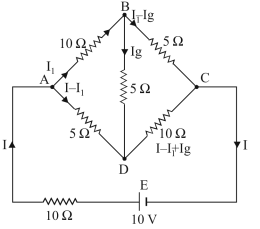
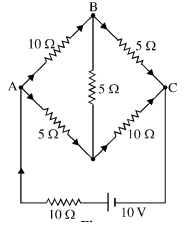
Determine the current in each branch of the network shown in Fig.:
Image

Answer

Applying Kirchoff's second law in the branch ABCD
$\Rightarrow \quad-10 I _1-5 Ig +\left( I - I _1\right) 5=0$
$\Rightarrow \quad-10 I _1-5 Ig +5 I -5 I _1=0$
$\Rightarrow \quad-15 I _1-5 I g+5 I =0$
$3 I _1- I + I g=0$$\quad$.....(1)
Again, applying Kirchoff's second rule in the branch BDCB
$-5 Ig -10\left( I - I _1+ Ig \right)+5\left( I _1- Ig \right)=0$
$\Rightarrow \quad-5 Ig -10 I +10 I _1-10 Ig +5 I _1-5 Ig =0$
$\Rightarrow \quad 15 I _1-10 I -20 Ig =0$
or $\quad 3 I _1-2 I -4 Ig =0$$\quad$.....(2)
Image
Applying Kirchhoff"s second rule in branch ABCEA
$-10 I _1-5\left( I _1- Ig \right)-10 I +10=0$
$\Rightarrow \quad-10 I _1-5 I _1+5 Ig -10 I +10=0$
$\Rightarrow \quad-15 I_1-10 I+5 \lg =-10$
$\Rightarrow \quad 3 I _1+2 I - Ig =2$.....(3)
Adding equations (1) and (3).
$6 I_1+I=2$....(4)
Multiplying equation (1) by 4 and then on adding to equation (2)
$15 I_1-6 I=0$....(5)
On solving equations (4) and (5)
$I_1=\frac{4}{17} A$
Magnitude of current in $ABI ,=\frac{4}{17} A$
Putting value of $I_1$ in equation (5)
$15 \times \frac{4}{17}-6 I=0$
or$6 I=\frac{15 \times 4}{17}$
or$I=\frac{15 \times 4}{17 \times 6}=\frac{60}{102}=\frac{10}{7} A$
Putting the value of I and $I _1$ in equation (3)
$3 I _1+2 I - Ig =2$
$\Rightarrow \quad 3 \times \frac{4}{17}+\frac{2 \times 60}{102}- Ig =2$
$\Rightarrow \quad \frac{12}{17}+\frac{120}{102}- Ig =2$
$\Rightarrow \quad Ig =\frac{12}{17}+\frac{120}{102}-2$
$\Rightarrow \quad I _g=\frac{72+120-204}{102}$
$=\frac{-12}{102}=-\frac{2}{17} A$
Negative sign indicates that the direction of current is shown in opposite in the figure.
Therefore, direction of current in $BD = Ig =\frac{-2}{17} A$
Magnitude of current in $AB = I _1=\frac{4}{17} A$
Magnitude of current in $BC = I _1- Ig$
$=\frac{4}{17}-\left(\frac{-2}{17}\right)$
$=\frac{6}{17} A$
Magnitude of current in $AD = I - I _1$
$=\frac{10}{17}-\frac{4}{17}=\frac{6}{17} A$
Magnitude of current in $DC = I - I _1+ Ig$
$=\frac{16}{17}+\left(\frac{-2}{17}\right) A$ or $\frac{4}{17} A$
If DC is written as CD , then magnitude of current will be
$=-\frac{4}{17} A$
Total current $I=\frac{4}{17}+\frac{6}{17}=\frac{10}{17} A$

Need a full question paper?

Generate a complete, print-ready paper with questions like this in minutes — across 16+ boards, with answer keys.
Start Generating Free

Similar questions

The conduction band of a solid is partially filled at 0K. Will it be a conductor, a semiconductor or an insulator?
Consider a situation similar to that of the previous problem except that the ends of the rod slide on a pair of thick metallic rails laid parallel to the wire. At one end the rails are connected by resistor of resistance R.
  1. What force is needed to keep the rod sliding at a constant speed v?
  2. In this situation what is the current in the resistance R?
  3. Find the rate of heat developed in the resistor.
  4. Find the power delivered by external agent exerting the force on the rod.
An $\text{X-OR}$ gate has following truth table:
$A$ $B$ $Y$
$0$ $0$ $0$
$0$ $1$ $1$
$1$ $0$ $1$
$1$ $1$ $0$
It is represented by following logic relation
$\text{Y}=\bar{\text{A}}.\text{B}+\text{A}.\bar{\text{B}}$
Build this gate using $\ce{AND, OR}$ and $\text{NOT}$ gates.
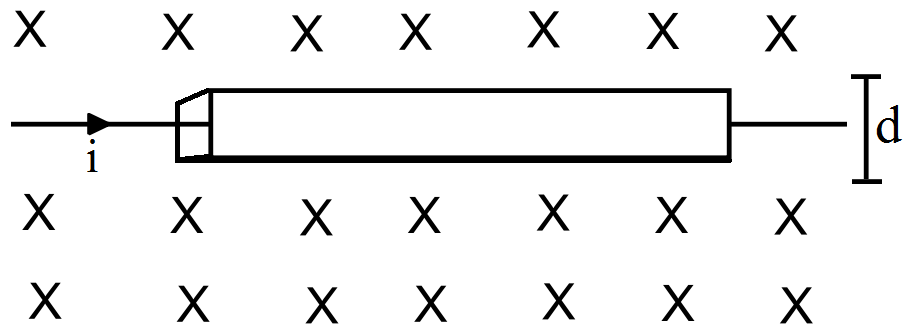
A current i is passed through a silver strip of width d and area of cross-section A. The number of free electrons per unit volume is n.
  1. Find the drift velocity v of the electrons.
  2. If a magnetic field B exists in the region, as shown in the figure, what is the average magnetic force on the free electrons?
  3. Due to the magnetic force, the free electrons get accumulated on one side of the conductor along its length. This produces a transverse electric field in the conductor, which opposes the magnetic force on the electrons. Find the magnitude of the electric field which will stop further accumulation of electrons.
  4. What will be the potential difference developed across the width of the conductor due to the electron-accumulation? The appearance of a transverse emf, when a current-carrying wire is placed in a magnetic field, is called Hall effect.
The heavier block in an Atwood machine has a mass twice that of the lighter one. The tension in the string is 16.0N when the system is set into motion. Find the decrease in the gravitational potential energy during the first second after the system is released from rest.
Draw a neat and labelled diagram of a cyclotron. State the underlying principle and explain how a positively charged particle gets accelerated in this machine. Show mathematically that the cyclotron frequency does not depend upon the speed of the particle.
Find the reading of the spring balance shown in figure. The elevator is going up with an acceleration of $\frac{\text{g}}{10},$ the pulley and the string are light and the pulley is smooth.
An inductor-coil of resistance $10\Omega$ and induetanes 120mH is connected across a battery of emf 6V and Internal resistance $2\Omega.$ Find the charge which flows through the inductor in:
  1. 10ms
  2. 20ms
  3. 100 ms after the connections are made.
An electrical technician requires a capacitance of $2\mu F$ in a circuitacross a potential difference of $1kV. A$ large number of $1\mu F$ capacitors are available to him each of which can withstand a potential difference of not more than $400V$. Suggest a possible arrangement that requires the minimum number of capacitors.
A long, straight wire carries a current i. Let $B_1$, be the magnetic field at a point Pat a distance d from the wire. Consider a section of length l of this wire such that the point $P$ lies on a perpendicular bisector of the section. Let $B2$ be the magnetic field at this point due to this section only. Find the value of $\frac{\text{d}}{\text{l}}$ so that $B_2$_ differs from $B_1$, by $1\%.$