Question
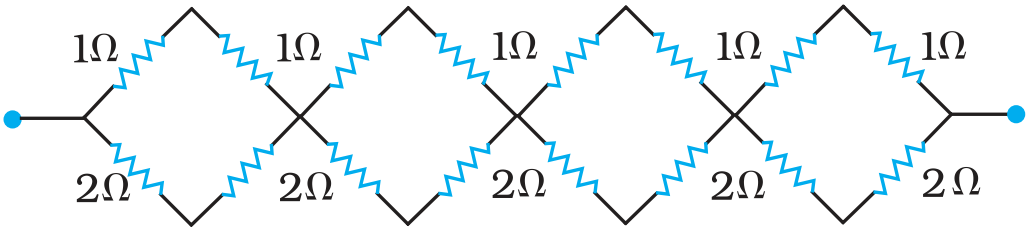
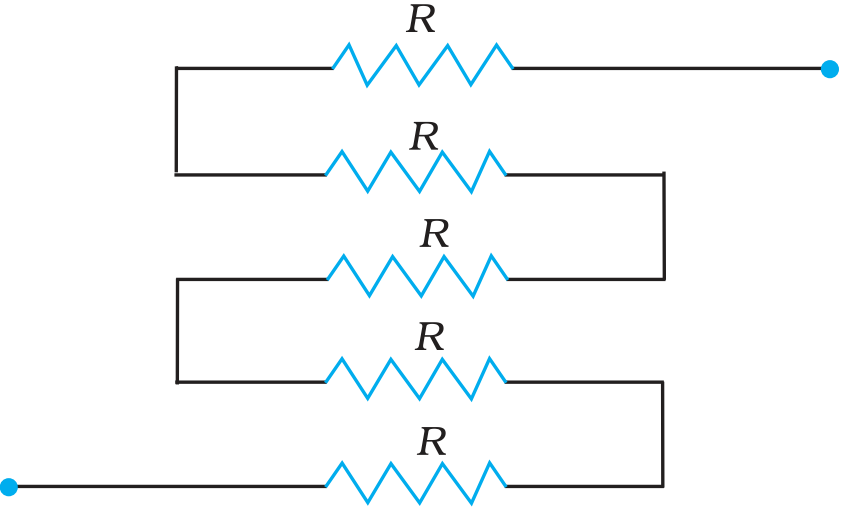
Determine the equivalent resistance of networks shown in Fig.

Answer

  1. It can be observed from the given circuit that in the first small loop, two resistors of resistance $1\ \Omega$ each are connected in series.
Hence, their equivalent resistance $=(1+1)=2\ \Omega$
It can also be observed that two resistors of resistance $2\ \Omega$ each are connected in series.
Hence, their equivalent resistance $=(2+2)=4\ \Omega$
Therefore, the circuit can be redrawn as

It can be observed that $2\ \Omega\ \text{and}\ 4\ \Omega$ resistors are connected in parallel in all the four loops. Hence, equivalent resistance (R') of each loop is given by,
$\text{R}=\frac{2\times4}{2+4}=\frac{8}{6}=\frac{4}{3}\Omega$
The circuit reduces to,

All the four resistors are connected in series.
Hence, equivalent resistance of the given circuit is $\frac{4}{3}\times4=\frac{16}{3}\Omega$
  1. It can be observed from the given circuit that five resistors of resistance R each are connected in series.
Hence, equivalent resistance of the circuit = R + R + R + R + R
= 5 R

Need a full question paper?

Generate a complete, print-ready paper with questions like this in minutes — across 16+ boards, with answer keys.
Start Generating Free

Similar questions

Consider the arrangement shown in figure (17-E4). The distance D is large compared to the separation d between the slits.
  1. Find the minimum value of d so that there is a dark fringe at 0.
  2. Suppose d has this value. Find the distance x at which the next bright fringe is formed.
  3. Find the fringe-width.
A train starts from rest and moves with a constant acceleration of $2.0m/s^2$ for half a minute. The brakes are then applied and the train comes to rest in one minute. Find:
  1. The total distance moved by the train.
  2. The maximum speed attained by the train.
  3. The position $(s)$ of the train at half the maximum speed.
A train running at 108km/h towards east whistles at a dominant frequency of 500Hz. Speed of sound in air is 340m/s.
  1. What frequency will a passenger sitting near the open window hear?
  2. What frequency will a person standing near the track hear whom the train has just passed?
  3. A wind starts blowing towards east at a speed f 36km/h. Calculate the frequencies heard by the passenger in the train and by the person standing near the track.
  1. Draw a ray diagram to show refraction of a ray of monochromatic light passing through a glass prism.
  1. Deduce the expression for the refractive index of glass in terms of angle of prism and angle of minimum deviation.
  2. Explain briefly how the phenomenon of total internal reflection is used in fibre optics.
A parallel-plate capacitor of plate area A and plate separation d is charged to a potential difference V and then the battery is disconnected. A slab of dielectric constant K is then inserted between the plates of the capacitor so as to fill the space between the plates. Find the work done on the system in the process of inserting the slab.
$4 \times 10^{23}$ tritium atoms are contained in a vessel. The half-life of decay tritium nuclei is $12.3y.$ Find:
  1. The activity of the sample.
  2. The number of decay in the next $10$ hours.
  3. The number of decays in the next $6.15y.$
Consider a metal ring kept on top of a fixed solenoid (say on a carboard) (Fig). The centre of the ring coincides with the axis of the solenoid. If the current is suddenly switched on, the metal ring jumps up. Explain.
Continuous $X-$rays are made to strike a tissue paper soaked with polluted water. The incoming $X-$rays excite the atoms of the sample by knocking out the electrons from the inner shells. Characteristic $X-$rays are analysed and the intensity is plotted against the wavelength. Assuming that only $\text{K}_\alpha$ intensities are detected, list the elements present in the sample from the plot. Use Moseley's equation $v - (25 \times 10^{14}Hz)(Z - 1)^2.$​​​​​​​
The temperature and pressure at Simla are $15.0^\circ C$ and $72.0\ cm$ of mercury and at Kalka these are $35.0^\circ C$ and $76.0\ cm$ of mercury. Find the ratio of air density at Kalka to the air density at Simla.
If the outer coil of the previous problem is rotated through 90° about a diameter, what would be the magnitude of the magnetic field B at the centre?