Question
  1. Determine the value of phase difference between the current and the voltage in the given series LCR circuit.
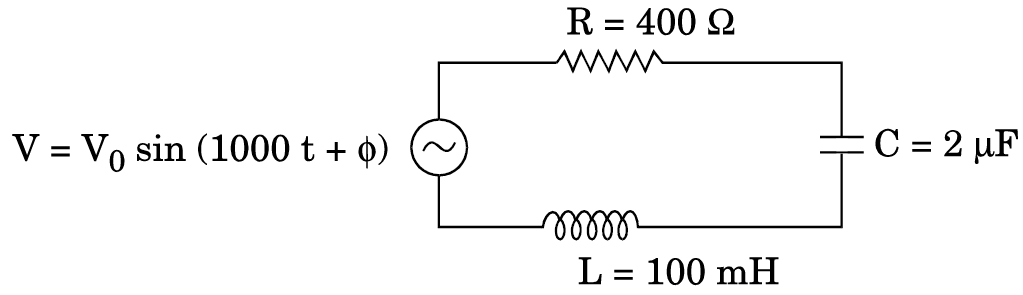
  1. Calculate the value of the additional capacitor which may be joined suitably to the capacitor C that would make the power factor of the circuit unity.
Answer

  1. In LCR circuit: $\tan\varphi= \frac{\text{X}_{L} - \text{X}_{c}}{\text{R}} = \frac{\text{wL} - \frac{1}{\text{wC}}}{\text{R}}$
Now $\text{X}_{L} = \text{wL} = ( 1000\times100\times10^{-3})\Omega$
$= 100\Omega$
and $\text{X}_{c} = \frac{1}{\text{wc}} = \bigg(\frac{1}{100\times2\times10^{-6}}\bigg)\Omega$
$\therefore\text{X}_{c} = 500 \Omega$
$\therefore\tan\varphi = \frac{500 - 100}{400} = 1 $
$\tan\varphi = 1 $
$\varphi = 45^{o}$
  1. Power Factor:
When power factor = 1, we have $X_L=X_C$
$\therefore\text{X'}_{c} = \frac{1}{\omega\text{C}'} = 100 \Omega$
This gives $\text{C'} = \frac{1}{100\omega} = 10 \mu\text{F}$
We, therefore, need to add a capacitor of capacitance (10-2) μF = 8μF in parallel with the given capacitor.
Alternate Answer
Let addition capacitance $C_1$ be connected:
$\text{X}'_{c} = \frac{1}{1000(2 + \text{C}_{1})\times10^{-6}}$
$\therefore100 = \frac{1}{1000(2 + \text{C}_{1})\times10^{-6}}$
$\therefore2 + \text{C}_{1} = 10 $
$\text{C}_{1} = 8 \mu\text{F}$.

Need a full question paper?

Generate a complete, print-ready paper with questions like this in minutes — across 16+ boards, with answer keys.

Start Generating Free

Similar questions

A charge is distributed uniformly over a ring of radius ‘a’. Obtain an expression for the electric intensity E at a point on the axis of the ring. Hence show that for points at large distances from the ring, it behaves like a point charge.
In a series LCR circuit, $\text{R = 1k}\Omega,\text{C}=2\mu\text{F}$ and voltage across R is 100V. The resonant frequency of the circuit $\omega$ is 200 rad $s^{-1}$. Calculate the value of voltage across L at resonance.
(a) A closed loop is held stationary in the magnetic field between the north and south poles of two permanent magnets held fixed. Can we hope to generate current in the loop by using very strong magnets?
(b) A closed loop moves normal to the constant electric field between the plates of a large capacitor. Is a current induced in the loop (i) when it is wholly inside the region between the capacitor plates (ii) when it is partially outside the plates of the capacitor? The electric field is normal to the plane of the loop.
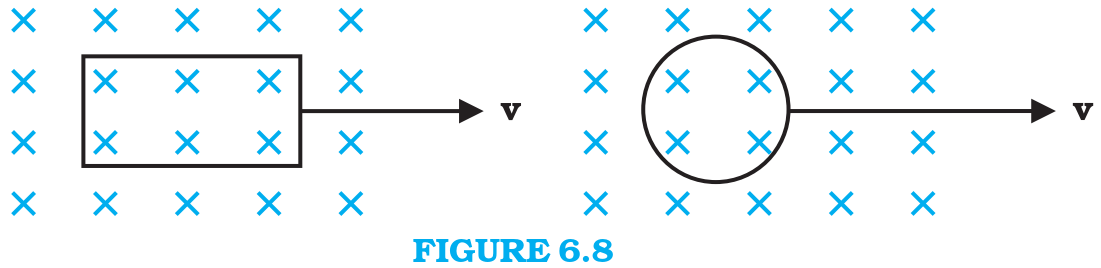
(c) A rectangular loop and a circular loop are moving out of a uniform magnetic field region (Fig. 6.8) to a field-free region with a constant velocity $v$. In which loop do you expect the induced emf to be constant during the passage out of the field region? The field is normal to the loops.
Image
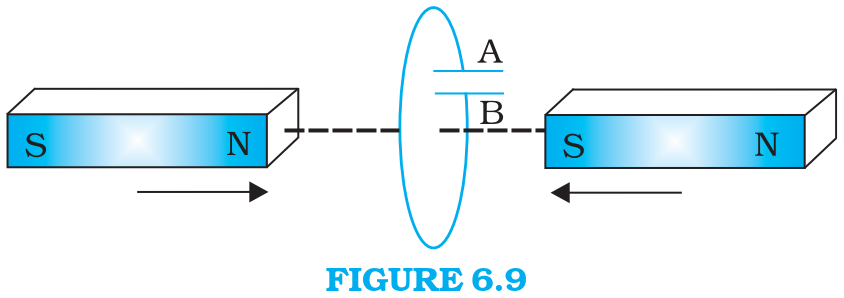
(d) Predict the polarity of the capacitor in the situation described by Fig. 6.9.

Image
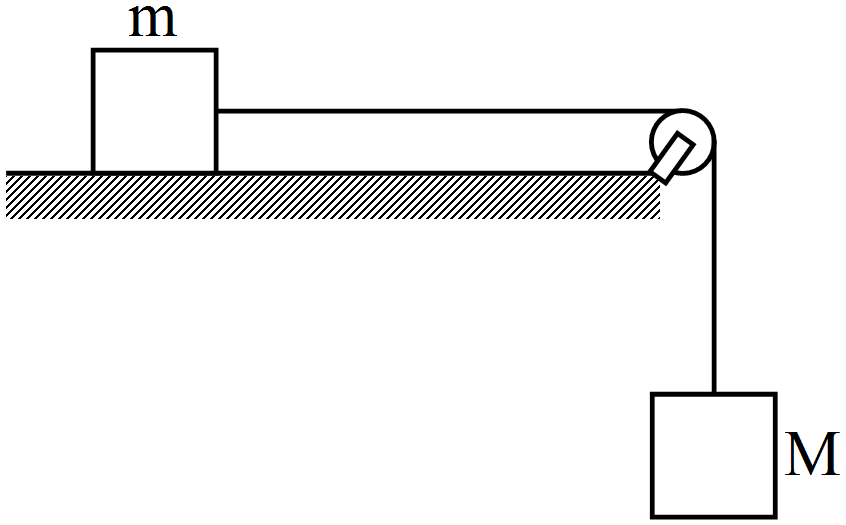
Figure shows two blocks of masses m and M connected by a string passing over a pulley. The horizontal table over which the mass m slides is smooth. The pulley has a radius r and moment of inertia I about its axis and it can freely rotate about this axis. Find the acceleration of the mass M assuming that the string does not slip on the pulley.
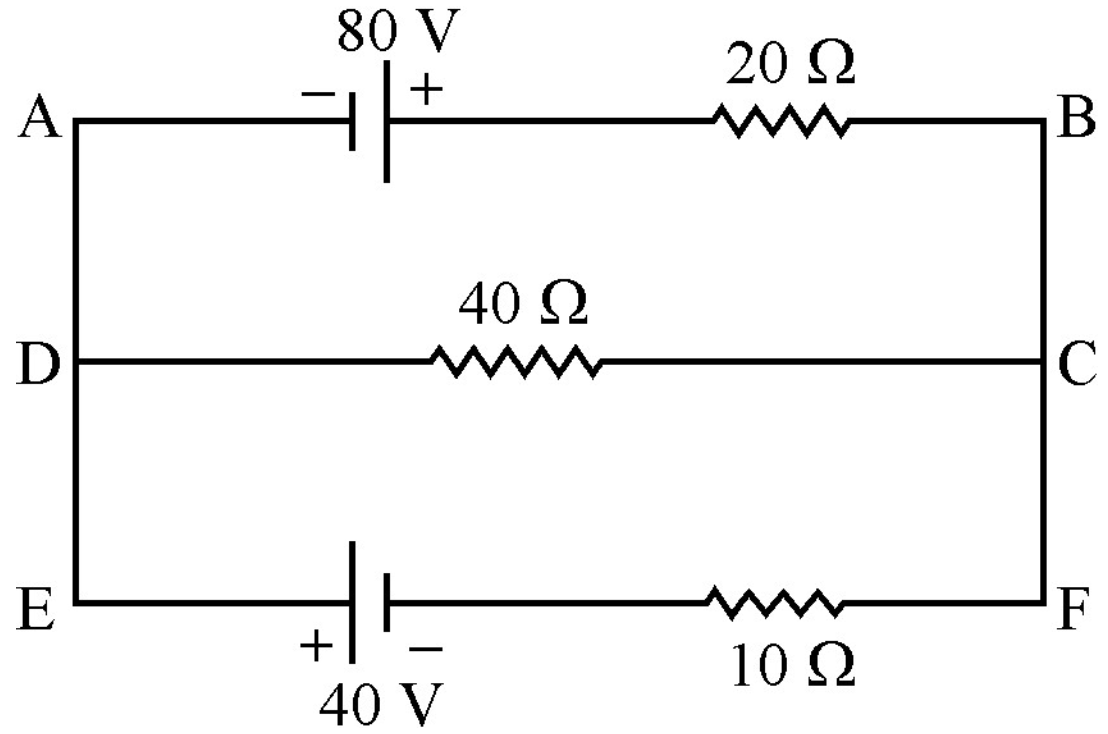
Using Kirchhoff’s rules, calculate the current through the $40\Omega$ and $20\Omega$ resistors in the following circuit:
A body stretches a spring by a particular length at the earth's surface at equator. At what height above the south pole will it stretch the same spring by the same length? Assume the earth to be spherical.
Radiation from hydrogen discharge tube falls on a cesium plate. Find the maximum possible kinetic energy of the photoelectrons. Work function of cesium is 1.9eV.
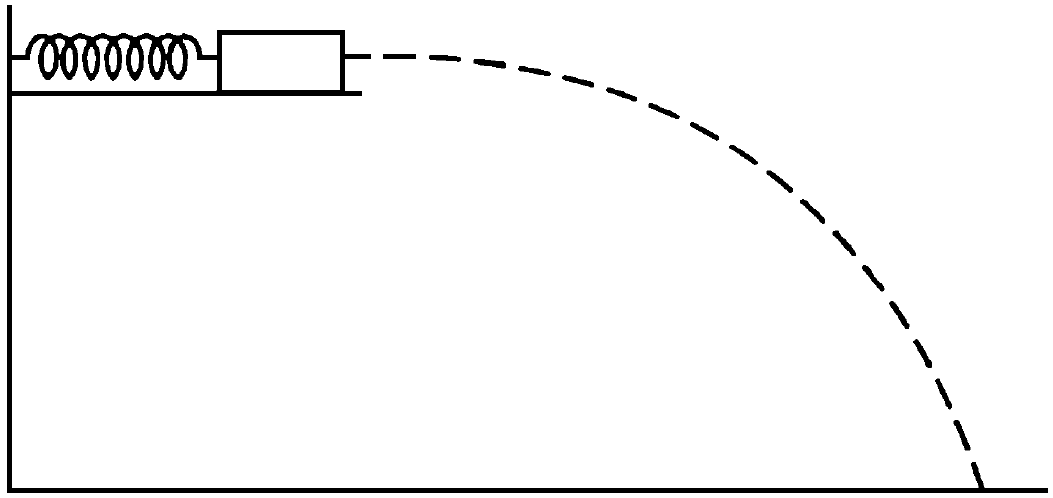
A small block of mass 100g is pressed against a horizontal spring fixed at one end to compress the spring through 5.0cm (figure). The spring constant is 100N/m. When released, the block moves horizontally till it leaves the spring. Where will it hit the ground 2m below the spring?
  1. A giant refracting telescope has an objective lens of focal length 15 m. If an eye piece of focal length 1.0 cm is used, what is the angular magnification of the telescope?
  2. If this telescope is used to view the moon, what is the diameter of the image of the moon formed by the objective lens? The diameter of the moon is 3.48 × 10⁶ m and the radius of lunar orbit is 3.8 x 10⁸ m.
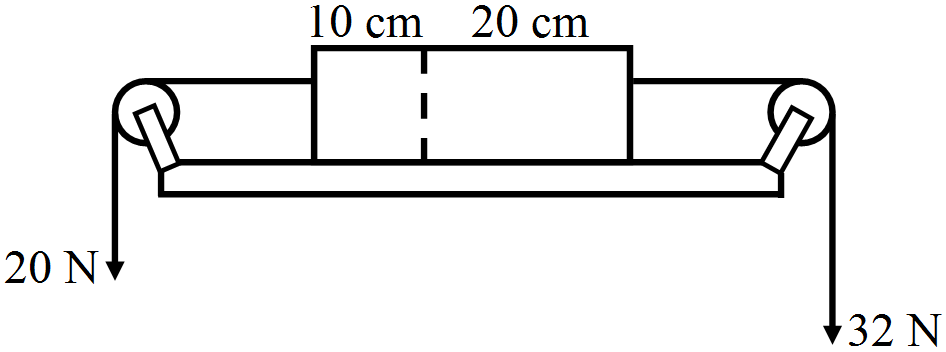
Figure shows a uniform rod of length 30cm having a mass of 3.0kg. The strings shown in the figure are pulled by constant forces of 20N and 32N. Find the force exerted by the 20cm part of the rod on the 10cm part. All the surfaces are smooth and the strings and the pulleys are light.