Question
Determine the value of the constant k so that the function
$\text{f}\text{(x)}=\begin{cases}\frac{\text{x}^2-3\text{x}+2}{\text{x}-1}, &\text{if}\text{ x}\neq1\\\text{k}, &\text{if}\text{ x}=1\end{cases}$ is continuous at x = 1
Answer

We have that the function is continuous at x = 1
$\therefore$ LHL = RHL = f(1) ....(1)
Now,
$\text{LHL}=\lim\limits_{\text{x} \rightarrow 1^-}\text{f}\text{(x)}=\lim\limits_{\text{h} \rightarrow 0}\text{f}(1-\text{h)}=\lim\limits_{\text{h} \rightarrow 0}\frac{(1-\text{h})^2-3(1-\text{h})+2}{(1-\text{h})-1}$
$\lim\limits_{\text{h} \rightarrow 0}\frac{\text{h}^2+\text{h}}{-\text{h}}=\lim\limits_{\text{h} \rightarrow 0}-\text{h}-1=-1$
$\text{f}(1)=\text{k}$
from (1), We get,
k = -1

Need a full question paper?

Generate a complete, print-ready paper with questions like this in minutes — across 16+ boards, with answer keys.

Start Generating Free

Similar questions

In the following, determine the values of constants involved in the definition so that the given function is continuous:
$\text{f(x)}=\begin{cases}\text{kx}+5,&\text{if }\text{ x}\leq2\\\text{x}-1,&\text{if }\text{ x}>2\end{cases}$
If $y=e^{m \tan ^{-1} x}$, then show that $\left(1+x^2\right) \frac{d^2 y}{d x^2}+(2 x-m) \frac{d y}{d x}=0$
Find the volume of a tetrahedron whose vertices are A( -1, 2, 3) B(3, -2, 1), C (2, 1, 3) and D(-1, -2, 4).
Let $A = R - {3}$ and $B = R - {1}$. Consider the function $f : A \rightarrow B$ defined by $\text{f(x)}=\frac{\text{x}-2}{\text{x}-3}.$ Show that f is one-one and onto and hence find $f^{-1}$​​​​​​​.
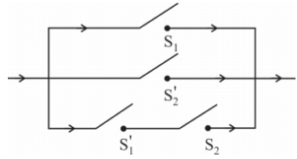
Write the symbolic form of the following switching circuits construct its switching table and interpret it.
Image
Evaluate the following integrals:$\int^\limits{\frac{\pi}{2}}_{\frac{-\pi}{2}}\big\{\sin|\text{x}|+\cos|\text{x}|\big\}\text{dx}$
If $|\vec{\text{a}}|=2,\big|\vec{\text{b}}\big|=7$ and $\vec{\text{a}}\times\vec{\text{b}}=3\hat{\text{i}}+2\hat{\text{j}}+6\hat{\text{k}},$ find the angle between $\vec{\text{a}}$ and $\vec{\text{b}}.$
Find the angle between the line $\frac{\text{x}+1}{2}=\frac{\text{y}}{3}=\frac{\text{z}-3}{6}$ and the plane 10x + 2y - 11z = 3.
An examination consists of $10$ multiple choice questions, in each of which a candidate has to deduce which one of five suggested answers is correct. A completely unprepared student guesses each answer completely randomly. What is the probability that this student gets $8$ or more questions correct? Draw the appropriate moral.
Differentiate the following functions with respect to x:
$\cos(\log\text{ x})^2$