Question
Determine the volume contraction of a solid copper cube, $10cm$ on an edge, when subjected to a hydraulic pressure of $7.0 \times 10^6 Pa$.

Answer

Given: L = 10cm = 0.1m K = bulk modulus of $Cu = 140 \times 10^9Pa P = 7 \times 10^6 Pa \Delta\text{V}=$ Volume contraction of solid copper cube = ? $\therefore V = L^3 = (0.1)^3 = 0.001m^3$. Using formula, $\text{K}-\frac{\text{P}}{\big(\frac{\Delta\text{V}}{\text{V}}\big)}$ We get $\Delta\text{V}=-\frac{\text{PV}}{\text{K}}=\frac{7\times10^6\times0.001}{140\times10^9}\text{m}^3$
$=-\frac{1}{20}\times10^{-6}\text{m}^3$
$=-0.05\times10^{-6}\text{m}^3$
$=-5\times10^{-2}\text{cm}^3$ Here negative sign shows volume contraction.

Need a full question paper?

Generate a complete, print-ready paper with questions like this in minutes — across 16+ boards, with answer keys.
Start Generating Free

Similar questions

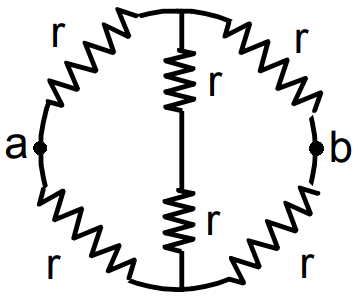
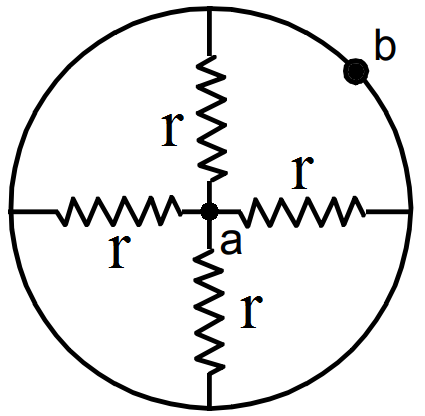
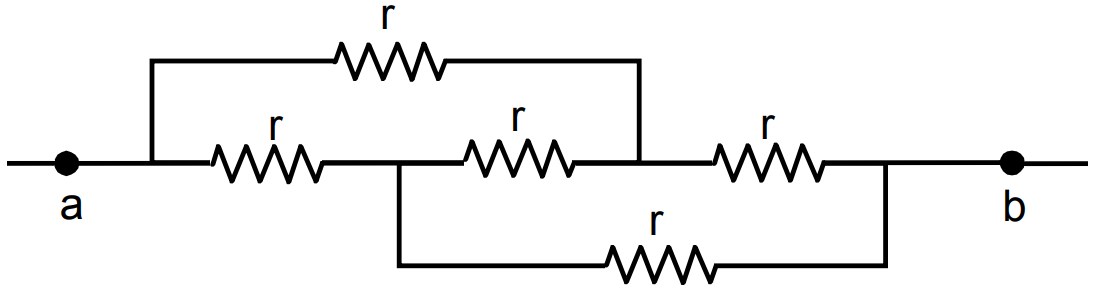
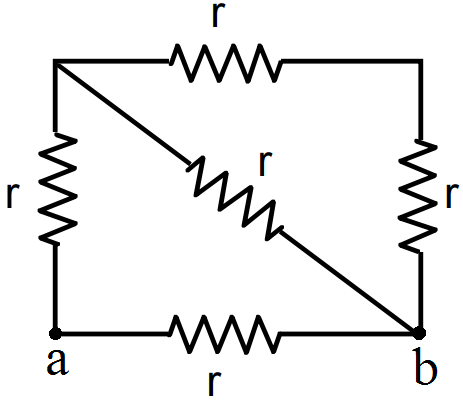
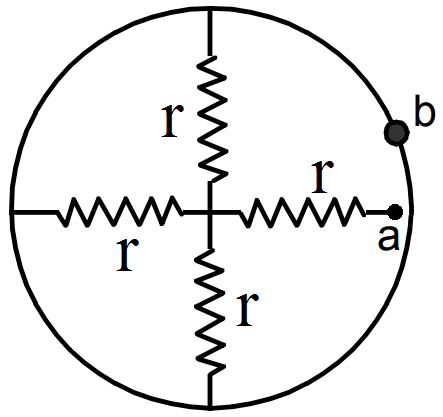
Find the equivalent resistances of the networks shown in the figure. between the points $a$ and $b.$
  1.  
  1.  
  1.  
  1.  
  1.  
Consider the wave $\text{y}(\text{x, t})=2.2\cos(300\text{t}-0.24\text{x}).$ If the units for $y, t$ and $x$ are $mm, s$ and $m$ respectively, deduce:
  1. The amplitude.
  2. The frequency.
  3. The wavelength.
  4. The wave velocity.
  5. The amplitude of particle velocity.
Two bodies are thrown with the same initial velocity at angles $\alpha$ and $(90^\circ-\alpha)$ with and is of horizontal. What will be the ratio of (i) maximum heights attained by them and (ii) of horizontal ranges?
Whenever a photon is emitted by hydrogen in Balmer series, it is followed by another photon in Lyman series. What wavelength does this latter photon correspond to?
Given a + b + c + d = 0, which of the following statements are correct: The magnitude of a can never be greater than the sum of the magnitudes of b, c, and d.
A solid sphere of radius 10 cm is subjected to a uniform pressure equal to $5 \times 10^8 \mathrm{Nm}^{-2}$. Calculate the change in volume. Bulk modulus of the material of the sphere is $3.14 \times 10^{11} \mathrm{Nm}^{-2}$.
A hydraulic automobile lift is designed to lift cars with a maximum mass of $3000kg$. The area of cross-section of the piston carrying the load is $425cm^2$. What maximum pressure would the smaller piston have to bear?
The density p of a piece of metal of a mass m and volume V is given by the formula = $\frac{\text{M}}{\text{V}}.,$ If $\text{m} = 375.32  \pm0.01\text{g},$ and $\text{V} = 136.41\pm  0.01\text{cm}^3$ Find % error in $\rho$
A U-tube contains water and methylated spirit separated by mercury. The mercury columns in the two arms are in level with $10.0cm$ of water in one arm and $12.5cm$ of spirit in the other. What is the specific gravity of spirit?
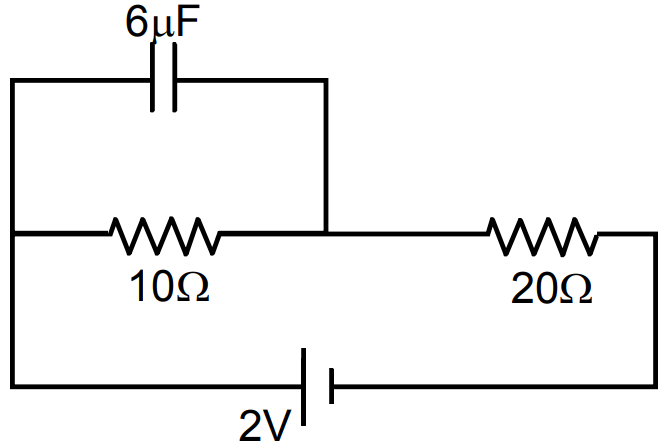
Find the charge on the capacitor shown in figure.