Question
Determine whether the following pair of lines intersect or not:
$\frac{\text{x}-5}{4}=\frac{\text{y}-7}{4}=\frac{\text{z}+3}{-5}$ and $\frac{\text{x}-8}{7}=\frac{\text{y}-4}{1}=\frac{3-5}{3}$
Answer

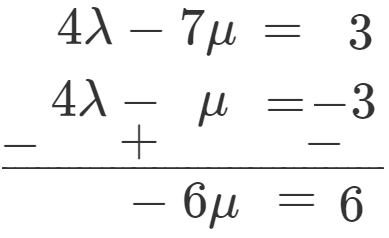
Given, equation of line is $\frac{\text{x}-5}{4}=\frac{\text{y}-7}{4}=\frac{\text{z}+3}{-5}=\lambda\text{ (say) }\dots(1)$ General point on line (1) is, $\big(4\lambda+5,4\lambda+7,-5\lambda-3\big)$ Another equation of line is, $\frac{\text{x}-8}{7}=\frac{\text{y}-4}{1}=\frac{3-5}{3}=\mu\text{ (say) }\dots(2)$ General point on line (2) is $\big(7\mu+8,\mu+4,3\mu+5\big)$ If line (1) and (2) intersecting, then there must have some common point to them, so, we must have value of $\lambda$ and $\mu$ such that $4\lambda+5=7\mu+8\Rightarrow4\lambda-7\mu=3\dots(3)$ $4\lambda+5=\mu+4\Rightarrow4\lambda-\mu=-3\dots(4)$ $-5\lambda-3=3\mu+5\Rightarrow-5\lambda-3\mu=8\dots(5)$ Solving equation (3) and (4) to find $\lambda$ and $\mu,$
$\mu=-1$ Put value of $\lambda$ in equation (3), $4\lambda-7\mu=3$ $4\lambda-7(-1)=3$ $4\lambda=3-7$ $\lambda=-1$ Put the value of $\lambda$ and $\mu$ in equation (5), $-5\lambda-3\mu=8$ $-5(-1)-3(-1)=8$ $5+3=8$ $\text{LHS = RHS}$

Need a full question paper?

Generate a complete, print-ready paper with questions like this in minutes — across 16+ boards, with answer keys.

Start Generating Free

Similar questions

For the following matrices verify the distributivity of matrix, multiplication over matrix addtion i.e., A(B + C) = AB + AC.
$\text{A}=\begin{bmatrix}2&-1\\1&1\\-1&2\end{bmatrix},\text{B}=\begin{bmatrix}0&1\\1&1\end{bmatrix}$ and $\text{C}=\begin{bmatrix}1&-1\\0&1\end{bmatrix}$
Maximize : z = 10x + 25y subject to 0 ≤ x ≤ 3, 0 ≤ y ≤ 3, x + y ≤ 5 also find maximum value of z.
Using differentials, find the approximate values of the following:
$\sqrt{0.082}$
Evaluate the following integrals:$\int^\limits{\text{a}}_{-\text{a}}\sqrt{\frac{\text{a}-\text{x}}{\text{a}+\text{x}}}\text{ dx}$
Explain if Rolle's theorem is applicable to any one of the following functions.
  1. $\text{f}(\text{x})=[\text{x}]\text{ on }\text{x}\in[5,9]$
  2. $\text{f}(\text{x})=[\text{x}]\text{ on }\text{x}\in[-2,2]$
Can you say something about the converse of Rolle's Theorem from these functions?
Evaluate the following definite integrals:$\int_{1}^\limits{2}\frac{\text{x}}{(\text{x}+1)(\text{x}+2)}\text{ dx}$
Solve the following differential equations:(9x + 5y) dy + (15x + 11y) dx = 0
Find the inverse of the matrix $\text{A}=\begin{bmatrix}\text{a} & \text{b} \\ \text{c} & \frac{1+\text{bc}}{\text{a}} \end{bmatrix}$ ans show that $aA^{-1} = (a^2 + bc + 1) I - aA.$
From a lot of 15 bulbs which include 5 defective, a sample of 4 bulbs is drawn one by one with replacement. Find the probability distribution of number of defective bulbs. Hence, find the mean of the distribution.
Find the coordinates of a point on the parabola $y=x^2+7 x+2$ which is closest to the strainght line $y=3 x-3$.