Question
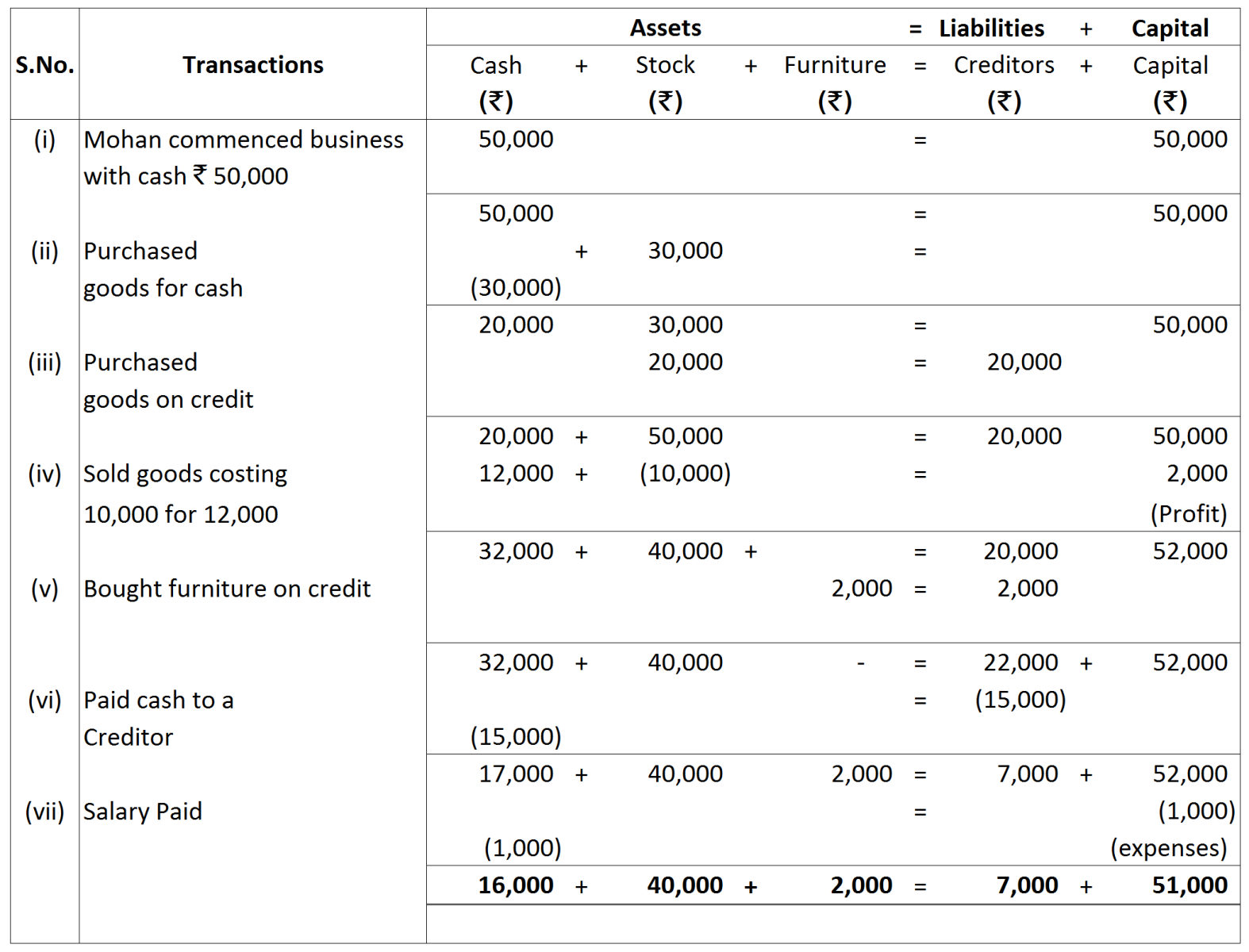
Develop an Accounting Equation from the following transactions:
S.no  
(i) Mohan commenced business with cash 50,000
(ii) Purchased goods for cash 30,000
(iii) Purchased goods on credit 20,000
(iv) Sold goods (costing ₹ 10,000) for 12,000
(v) Bought furniture on credit 2,000
(vi) Paid cash to a creditor 15,000
(vii) Salary paid 1,000

Answer


Assets = 16,000 + 40,000 + 2,000 = ₹ 58,000
Liabilities = ₹ 7,000
Capital = ₹ 51,000

Need a full question paper?

Generate a complete, print-ready paper with questions like this in minutes — across 16+ boards, with answer keys.

Start Generating Free

Similar questions

Raghunath had the following transactions in an accounting year:
  1. Commenced business with cash ₹ 50,000.
  2. Paid into bank ₹ 10,000.
  3. Purchased goods for cash ₹ 20,000 and credit ₹ 30,000.
  4. Sold goods for cash ₹ 40,000 costing ₹ 30,000.
  5. Rent paid ₹ 500.
  6. Rent outstanding ₹ 100.
  7. Bought furniture ₹ 5,000 on credit.
  8. Bought refrigerator for personal use ₹ 5,000.
  9. Purchased motorcycle for cash ₹ 20,000.
Create an Accounting Equation to show the effect of the above and also show his Balance Sheet.
Following balances appeared in the books of Ram & Shyam on January 1, 2017:
Assets: Cash in hand ₹ 30,000; Stock ₹ 36,000; Lal Chand ₹ 7,600; Mukesh Khanna ₹ 16,200; Furniture ₹ 8,000.
Liabilities: Ghanshyam ₹ 6,000; Vinod ₹ 8,000.
Following transactions took place during Jan. 2017:
2017
 
Jan. 2
Purchased Typewriter for ₹ 7,500
Jan. 4
Sold goods for Cash of the list price of ₹ 25,000 at 20% trade discount and 5% Cash discount
Jan. 6
Sold goods to Gopal Seth for ₹ 10,000
Jan. 8
Gopal Seth returned goods for ₹ 1,500
Jan. 12
Purchased goods from Arun ₹ 12,000, and from varun ₹ 15,000
Jan. 13
Settled Arun's account in full after deducting 5% for cash discount
Jan. 14
Paid cash to Ghanshyam in full settlement of his account
Jan. 16
Received ₹ 7,500 from Lal Chand in full settlement of his account
Jan. 17
Purchased a Scooter for office use ₹ 18,000
Jan. 20
Sold goods for cash 20,000
Jan. 22
Received from Gopal Seth ₹ 4,850 and discount allowed ₹ 150
Jan 27
Paid for Wages ₹ 7,000 and Salaries ₹ 3,000.
Jan. 28
Withdrew goods for ₹ 2,000 and Cash ₹ 1,500 for private use
Jan. 29
Paid for Life Insurance Premium of the Proprietor ₹ 1,600
Journalise the above transactions, post them into Ledger, balance them and prepare a Trial Balance.
On $1^{\text {st }}$ July, 2020, X Ltd. purchased a machinery for ₹ $15,00,000$. Depreciation is provided @ 20\% p.a. on the original cost of the machinery and books are closed on $31^{\text {st }}$ March each year. On $31^{\text {st }}$ May, 2022, a part of this machine purchased on $1^{\text {st }}$ July 2020 for ₹ $3,60,000$ was sold for ₹ $2,40,000$ and on the same date new machinery was purchased for $₹  4,20,000$. You are required to prepare:
a. Machinery Account,
b. Provision for Depreciation Account, and
c. Machinery Disposal Account
On 1st May, 2019 Merchant & Co. sold goods to AB & Co. valued at ₹ 500 and drew upon them a bill at 3 months for the amount. AB & Co. accepted the draft on presentation. When the bill was about to mature. AB & Co. expressed their inability to meet it, and offered to pay Merchant & Co. ₹ 200 in cash and to accept a fresh bill for the balance plus interest at 6% p.a. for 3 months. Merchant & Co. agreed to the proposal and bill was renewed. On maturity, the bill was duly met.
Make the entries in the books of both the parties to record the above transactions.
Pass Journal entries in the books of Puneet, Delhi for the following:
  1. Received an order from Karan & Co. for supply of goods of ₹ 50,000.
  2. Received an order from AK & Co. for goods of ₹ 1,00,000 along with a cheque for ₹ 25,000 as advance.
  3. Paid to staff ₹ 40,000 against outstanding salary of ₹ 60,000.
  4. Sold goods to Bharat, Kaithal (Haryana) of ₹ 10,000 plus IGST @ 12% out of which 1/5th were returned being defective.
  5. Cheque of ₹ 20,000 issued by Feroz was dishonoured.
  6. Received 40 paise in a rupee from Feroz against the above dues.
  7. Received a cheque of ₹ 25,000 from Mohan after banking hours.
  8. Purchased goods from Barun of Chandigarh of ₹ 10,000 plus IGST @ 12% and sold them to Arun of Shimla (HP) at ₹ 22,400, including IGST @ 12%.
  9. Arun returned goods of ₹ 6,720, including IGST which were returned to Barun.
  10. ABC & Co. purchased 10 TV sets @ ₹ 20,000 per set and paid IGST @ 12%. It sold all the sets @ ₹ 25,000 per set plus CGST and SGST @ 6% each.
  11. Paid insurance of ₹ 12,000 plus CGST and SGST @ 6% each for a period of one year.
  12. Sold personal car for ₹ 1,00,000 and invested the amount in the firm.
  13. Goods costing ₹ 1,00,000 were destroyed in fire. Insurance company admitted the claim for ₹ 75,000. These goods were purchased within Delhi.
  14. Purchased machinery for ₹ 56,000 including IGST of ₹ 6,000 and paid cartage thereon ₹ 5,000 and installation charges ₹ 10,000.
  15. Goods costing ₹ 40,000 sold to Mr. X at a profit of 20% on sales less 10% Trade Discount plus CGST and SGST @ 6% each and received a cheque under 2% cash discount.
  16. Purchased machinery from New Machinery House for ₹ 50,000 and paid it by means of a bank draft purchased from bank. Paid charges ​₹ 500.
Draw Bank Reconciliation Statement showing adjustment between your Cash Book and Pass Book as on 31st March, 2011.
  1. On 31st March, 2011 your pass book showed a balance of ₹ 6,000 to your credit.
  2. Before that date, you had issued cheques amounting to ₹ 1,500 of which cheques of ₹ 900 have been presented for payment.
  3. A cheque of ₹ 800 paid by you into the bank on 29th March, 2011 is not yet credited in pass book.
  4. There was a credit of ₹ 85 for interest on Current Account in the pass book.
  5. On 31st March, 2011 a cheque for ₹ 510 received by you and was paid into bank but the same was omitted to be entered in cash book.
Pass journal entries for the following:
Jan. 5
Purchased goods for Cash ₹ 10,000 and spent ₹ 200 for their carriage.
Jan. 10
Purchased machinery for Cash ₹ 50,000 and spent ₹ 500 for its carriage.
Jan. 15
Paid ₹ 20,000 for cement, ₹ 10,000 for timber and ₹ 5,000 as wages for the construction of building.
Jan. 17
Purchased an old machinery for ₹ 20,000 and spent ₹ 2,500 on its immediate repairs.
Jan. 20
Paid ₹ 500 for repairing some other machinery.
What Journal entry will be passed in the books of drawer (X) and drawee (Y) at the time of dishonour of bill in the following cases:
  1. If bill of ₹ 50,000 was discounted from bank and noting charges paid by the bank was ₹ 600.
  2. If B/R of ₹ 50,000 was endorsed in favour of Z. Noting charges paid by Z ₹ 600.
  3. If B/R is returned with drawer and noting charges were ₹ 600.
Prepare the Vouchers:
2019
Particular
Jan-5
Received cash from Wahi & Co. on account vide cash receipt No. 551
10,000
Jan-10
Commission received vide cash receipt No. 520*
10,000
Jan-15
Sold leather purses for cash vide Cash Memo Nos. 307-310*
6,000
Jan-24
Sold two old machines vide Cash Memo No. 1560*
3,000
Transactions marked with * are subject to levy of CGST and SGST @ 6% each.
On July 01, 2011 Ashwani purchased a machine for ₹ 2,00,000 on credit. Installation expenses ₹ 25,000 are paid by cheque. The estimated life is 5 years and its scrap value after 5 years will be ₹ 20,000. Depreciation is to be charged on straight line basis. Show the journal entry for the year 2011 and prepare necessary ledger accounts for first three years.