MCQ
Developed photography film is due to:
  • A
    AgBr
  • B
    [Ag(​S2O3​)2​]3+
  • C
    Ag
  • D
    Ag2​O

Answer

  1. Ag

Explanation:

The developed photography film is due to Ag.

The treatment of the exposed photgraphic film with reducing agent is called developing of the film.

A developer is usually an alkaline solution of hydroquinone or alkaline solution of pyrogallol.

The pairs activated by light are reduced to deposit more of black silver.

Need a full question paper?

Generate a complete, print-ready paper with questions like this in minutes — across 16+ boards, with answer keys.

Start Generating Free

Similar questions

$Xe$ has max. $EN$ in
We have three aqueous solutions of NaCl labelled as ‘A’, ‘B’ and ‘C’ with concentrations 0.1M, 0.01M and 0.001M, respectively. The value of van’t Hoff factor for these solutions will be in the order ____________.
The standard electrode potential for the following reaction is $+1.33\,V.$  What is the potential at $pH = 2.0$ ............ $\mathrm{V}$

$Cr_2O_7^{2-}$ ( $aq$  $1\,M$ ) $+ 14H^+(aq) + 6e^-$ $\rightarrow 2Cr^{+3} (aq,\,1\,M) + 7H_2O (l)$
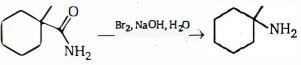
Which of the following species would not be involved in the Hoffmann  rearrangement shown below ?
In the diazotization of aryl amines with sodium nitrite and hydrochloric acid, an excess of hydrochloric acid is used primarily to :
When $20 \mathrm{~g}$ of naphthoic acid $\left(\mathrm{C}_{11} \mathrm{H}_8 \mathrm{O}_2\right)$ is dissolved in $50 \mathrm{~g}$ of benzene $\left(\mathrm{K}_{\mathrm{f}}=1.72 \mathrm{~K} \mathrm{~kg} \mathrm{~mol}^{-1}\right)$, a freezing point depression of $2 \mathrm{~K}$ is observed. The van't Hoff factor $(i)$ is
Number of complexes which show optical isomerism among the following is_____.

$\operatorname{cis}-\left[\mathrm{Cr}(\mathrm{ox})_2 \mathrm{Cl}_2\right]^{3-},\left[\mathrm{Co}(\mathrm{en})_3\right]^{3+}$

$\operatorname{cis}-\left[\mathrm{Pt}(\mathrm{en})_2 \mathrm{Cl}_2\right]^{2+}, \text { cis }-\left[\mathrm{Co}(\mathrm{en})_2 \mathrm{Cl}_2\right]^{+}$

$\text {trans }-\left[\mathrm{Pt}(\mathrm{en})_2 \mathrm{Cl}_2\right]^{2+}, \text { trans }-\left[\mathrm{Cr}(\mathrm{ox})_2 \mathrm{Cl}_2\right]^{3-}$

$C _{6} H _{6}$ freezes at $5.5^{\circ} C$. The temperature at which a solution $10\, g$ of $C _{4} H _{10}$ in $200\, g$ of $C _{6} H _{6}$ freeze is ...... ${ }^{\circ} C$. (The molal freezing point depression constant of $C _{6} H _{6}$ is $5.12\,{ }^{\circ} C / m .$ )
Chloroform for anesthetic purposes is tested for its purity with the reagent
Ethyl benzoate reacts with $PC{l_5}$ to give