MCQ
Developing embryo (in vitro) shows
- AGeometric growth
- BArithmetic growth
- ✓Geometric and arithmetic growth
- DNone of the above
Arithmetic Growth Rate The expression of arithmetic growth is exemplified by roots (or organ) elongating at constant rate. On plotting the length of an organ against time, a linear curve is obtained. Mathematically it is expressed as
Constant linear growth, a plot of length L against time
$L_{t}=L_{0}+r t$
$L_{t}=$ Length of time ' $t$ '
$L_{0}=$ Length of time to
$r=$ Growth rate or elongation per unit time
Geometrical Growth In most system the initial growth is slow (lag phase), and it increases there after at a exponential rate (log or exponential phase). Both the progeny cells following mitotic cell division retains the ability to divide and continue to do so. However due to the limited nutrient supply, the growth slows down leading to stationary phase. If we plot the parameter of growth against time, a typical sigmoid curve is obtained.
It has following stages
$1.$ During lag phase, organism adapt themselves to growth conditions. It is the period where the individual organism are maturing and not yet able to divide. During the lag phases of the bacterial growth cycle, synthesis of $RNA$, enzyme and other molecules occurs
$2.$ The log phase (sometimes called the logarithmic phase or the exponential phase) is a period characterised by cell doubling. The number of new organism appering per unit time is proportional to the present population.
$3.$ The stationary phase is often due to a growth-limiting factor such as the depletion of an essential nutrient, and/or the formation of an inhibitory product such as an organic acid. Stationary phase results from a situation in which growth rate and death rate are equal
$4.$ Death phase, organism run out of nutrients and die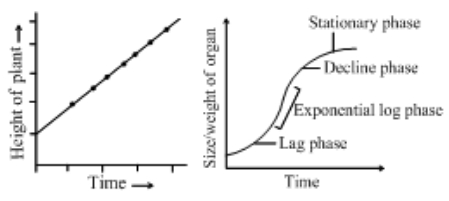
Generate a complete, print-ready paper with questions like this in minutes — across 16+ boards, with answer keys.
| $List-I$ | $List - II$ |
| $(a)$ Spirogyra | $(i)$ Dominant diploid sporophyte vascular plant, with highly reduced male or female gametophyte |
| $(b)$ Fern | $(ii)$ Dominant haploid free-living gametophyte |
| $(c)$ Funaria | $(iii)$ Dominant diploid sporophyte alternating with reduced gametophyte called prothallus |
| $(d)$ Cycas | $(iv)$ Dominant haploid leafy gametophyte alternating with partially dependent |
Choose the correct answer from the options given below:
| $(A)$ Glycolysis | $(a)$ Mitochondria |
| $(B)$ Kreb's cycle | $(b)$ Cytoplasmic matrix |
| $(C)$ Electron transport chain |
$I$. They reproduce asexually by non-motile spores and sexually by non-motile gametes
$II$. In this class, sexual reproduction is oogamous and accompanied by complex post-fertilisation developments
$III$. The common members are Polysiphonia, Porphyra, Gracilaria and Gelidium
The above characteristics are belongs to which class of algae