MCQ
Diagonals necessarily bisect opposite angles in a:
- ARectangle
- BIsosceles trapezium
- ✓Square
- DParallelogram
From the given choices, only in a square the diagonals bisect the opposite angles.
Let us prove it.
Take the following square $ABCD$ with diagonal $AD.$
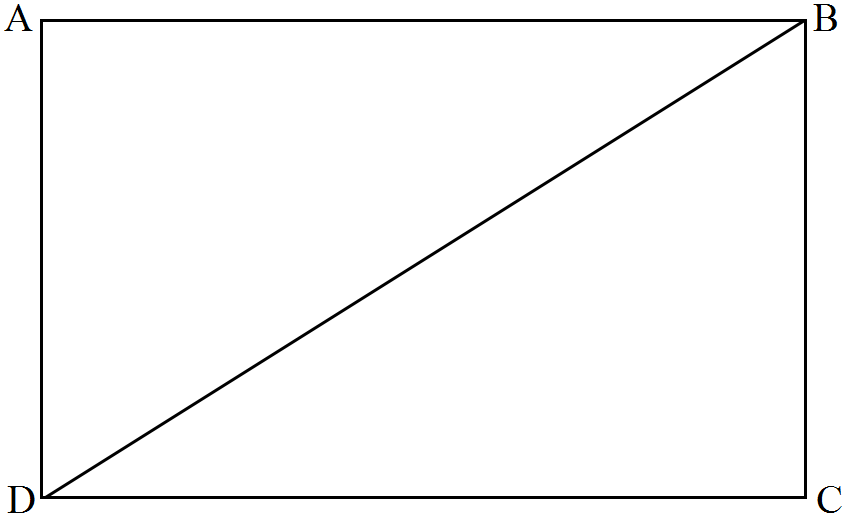
In $\triangle\text{ABD}$ and $\triangle\text{CBD},$
$AD = BC$ (Opposite sides of a square are equal.)
$BD = BD$ (Common)
$AB = DC$ (Opposite sides of a square are equal.)
Thus.
$\triangle\text{ABD≅ΔCBD}$ (By $SSS$ Congruence Rule)
By Corresponging parts of congruent triangle property,
we have:
$\angle\text{ABD} =\angle\text{CBD}$
$\angle\text{ADB} =\angle\text{CDB}$
Therefore, in a square the diagonals bisect the opposite angles.
Generate a complete, print-ready paper with questions like this in minutes — across 16+ boards, with answer keys.