Diabetes in humans is caused by faulty functioning of pancreas. It is not able to produce insulin adequately. Defective functioning of pancreas results in excess sugar in the body and inability to control the sugar level in the blood. Its only treatment is possible through insulin.
Insulin, used to treat diabetes patients, was extracted from the pancreas of animals and pigs by killing them Insulin derived from animals has caused allergies or other reactions to foreign proteins in some patients. Insulin is made up of two short polypeptide chains, Chain 'A' and Chain 'B'. These chains are connected to each other by disulfide bonds. Insulin pro-hormone is synthesized in mammals including humans. Like pro-enzyme, pro-hormone also needs to be processed before becoming a fully mature and functional hormone. This synthesized insulin hormone has an additional stretch called peptide 'C'. This 'C' peptide gets separated from insulin during maturation, hence the 'C' peptide is absent in mature insulin (Fig. 10.3).
The main challenge in producing insulin using recombinant DNA technologies (r.DNA) is to assemble and prepare the insulin in its mature form In 1983, an American company named Eli Lilly prepared DNA sequences that correspond to chains 'A' and 'B' of human insulin, which were inserted into the plasmid of E. coli and produced insulin chains. Chains A and B were produced separately, extracted and combined by creating disulfide bonds to form human insulin.
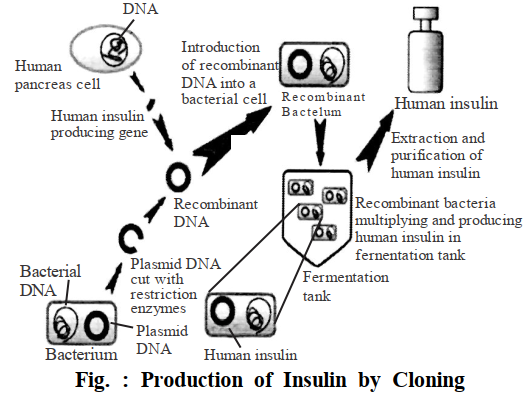
'C' peptide contains 35 amino acids and it has been observed that 6 amino acids of 'C' peptide are capable of binding function. The insulin producing gene was cloned in bacteria and used for the synthesis of insulin. The work of gene cloning of insulin was done by Dr. Saran Narang of Indian origin who was working in Ottawa, Canada. This insulin has been named Humiline and it is being sold in the markets.
By this technology, Human Growth Hormone (HGH) protopin has been manufactured in 1986. It is used for the treatment of dwarfism.