MCQ
Dielectrics are _____________?
- AConducting substances.
- BNon-conducting substances.
- CSemi-conducting substances.
- DNone of the option.
Explanation:
Dielectrics are non-conducting substances.
Generate a complete, print-ready paper with questions like this in minutes — across 16+ boards, with answer keys.
The inductance of a coil is 60μH. A current in this coil increases from 1.0 A to 1.5 A in 0.1 second. The magnitude of the induced e.m.f. is
|
(a) 60 |
(b) 300 |
(c) 30 |
(d) 3 |
The production of e.m.f. by maintaining a difference of temperature between the two junctions of two different metals is known as
|
(a) Joule effect |
(b) Seebeck effect |
(c) Peltier effect |
(d) Thomson effect |
The work function of a metal is
|
(a) The energy for the electron to enter into the metal |
|
(b) The energy for producing X-ray |
|
(c) The energy for the electron to come out from metal surface |
|
(d) None of these |
Three bulbs of 40W, 60W and 100W are arranged in series with 220V. Which bulb has minimum resistance
|
(a) 40W |
(b) 60W |
(c) 100W |
(d) Equal in all bulbs |
The given figure represents a material which is

|
(a) Paramagnetic |
(b) Diamagnetic |
(c) Ferromagnetic |
(d) None of these |
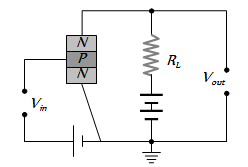
An NPN-transistor circuit is arranged as shown in figure. It is
|
(a) A common base amplifier circuit |
(b) A common emitter amplifier circuit |
|
(c) A common collector amplifier circuit |
(d) Neither of the above |

