MCQ
Diffraction of light can be explained by the following:
  • A
    Quantum nature of light
  • Wave nature of light
  • C
    Newton's corpuscular theory for light
  • D
    None of the above

Answer

Correct option: B.
Wave nature of light
(B) - Wave nature of light

Need a full question paper?

Generate a complete, print-ready paper with questions like this in minutes — across 16+ boards, with answer keys.
Start Generating Free

Similar questions

In a cyclotron, a charged particle
In a $LR$ circuit connected to a battery the rate at which energy is stored in the inductor is plotted against time during the growth of current in the circuit. Which of the following best represents the resulting curve ?
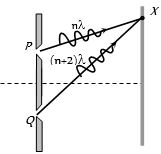
The figure shows a double slit experiment $P$ and $Q$ are the slits. The path lengths $PX $ and $ QX $ are $n\lambda $ and $(n + 2)\lambda $ respectively, where $n $ is a whole number and $\lambda $ is the wavelength. Taking the central fringe as zero, what is formed at $X$
A wire of diameter $0.02$ metre contains $10^{28}$ free electrons per cubic metre. For an electrical current of $100 \ A$ , the drift velocity of the free electrons in the wire is nearly
A capacitor of $1\,\mu F$ initially charged to $10\,V$ is connected across an ideal inductor of $0.1\,mH$. The maximum current in the circuit is.....$A$
An alternating voltage $V = 300\sqrt 2 sin(100t)$ is connected to a $1\ \mu F$ capacitor through an $AC$ ammeter. The reading of the ammeter will be.....$mA$
Two conductors of the same shape and size. One of copper and the other of aluminium (less conducting) are placed in a uniform electric field. the charge induced in alumnium.
The short range attractive nuclear forces that are responsible for the binding of nucleons in a nucleus are supposed to be caused by the role played by the particles called:
Two sources of light of wavelengths $2500\,\mathop A\limits^o $ and $3500\,\mathop A\limits^o $ are used in Young's double slit experiment simultaneously. Which orders of fringes of two wavelength patterns coincide
A particle $A$ of mass $m$ and initial velocity $v$ collides with a particle $B$ of mass $\frac{m}{2}$ which is at rest. The collision is head on, and elastic. The ratio of the de-Broglie wavelengths $\lambda_A$ and $\lambda_B$ after the collision is