MCQ
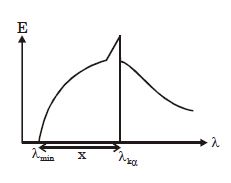
Difference between $\lambda _{k_{\alpha}}$ and $\lambda _{min}$ become twice if accelerating potential changes from $3100\ volt$ to $12400\ volt$ . Find $\lambda _{k_{\alpha} }$ ........$\mathop A\limits^o $ (Given $hc = 12400\ eVÅ$ ) 
  • A
    $6$
  • B
    $5$
  • $7$
  • D
    $5.5$

Answer

Correct option: C.
$7$
c

Need a full question paper?

Generate a complete, print-ready paper with questions like this in minutes — across 16+ boards, with answer keys.

Start Generating Free

Similar questions

The image of an object, formed by a plano-convex lens at a distance of $8 \ m$ behind the lens, is real and is one-third the size of the object. The wavelength of light inside the lens is $\frac{2}{3}$ times the wavelength in free space. The radius of the curved surface of the lens is :
If the refractive index of a material of equilateral prism is $\sqrt 3 $, then angle of minimum deviation of the prism is......$^o$
Assertion : The 200 W bulbs glows with more brightness then 100 W bulbs.
Reason : A 100 W bulb has more resistance than a 200 W bulb.
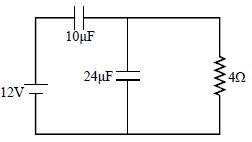
The charge on the capacitors of capacitance $10\,\mu F$ and $24\,\mu F$ steady state will be
Assertion : The resistivity of a semi-conductor increases with temperature.
Reason : The atoms of semi-conductor vibrate with larger amplitude at higher temperatures thereby increasing its resistivity
How many meters of a thin wire are required to design a solenoid of length $1m$ and $L = 1\ mH$? Assume cross$-$sectional diameter is very small.
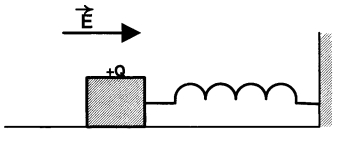
A wooden block performs $SHM$ on a frictionless surface with frequency, $v_0$. The block carries a charge $+Q$ on its surface. If now a uniform electric field $\vec{E}$ is switched-on as shown, then the $SHM$ of the block will be
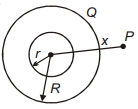
Two concentric hollow conducting spheres of radius $r$ and $R$ are shown. The charge on outer shell is $Q$. What charge should be given to inner sphere so that the potential at any point $P$ outside the outer sphere is zero?
An electron is accelerated through a p.d. of 45.5 volt. The velocity acquired by it is (in $\mathrm{ms}^{-1}$)
The magnitude of the de-Broglie wavelength $(\lambda)$ of electron $(e)$, proton $(p)$, neutron $(n)$ and $\alpha-$ particle $(\alpha)$ all having the same energy of $1\,MeV$, in the increasing order will follow the sequence