MCQ
Different minerals are being mined from within the earth and multi-storeyed complexes are being constructed. Due to this activity theoretically
  • A
    Angular speed of earth would increase
  • B
    Angular momentum would increase
  • C
    Time period of earth would decrease
  • Length of day would increase

Answer

Correct option: D.
Length of day would increase
d
(d)

Consider the problem,

In the case of mineral, coverage area (r) increases

Therefore, Inertia $I = Mr ^2$

If $r$ increases, then $I$ increases

and, also $L = I \omega$

$L$ is conserved, then if $I$ increases, $\omega$ decreases.

And also, $\omega=\frac{2 \pi}{T}$

If $\omega$ decreases, then Time period ( $T$ ) increases.

Therefore, length of the day increases.

Need a full question paper?

Generate a complete, print-ready paper with questions like this in minutes — across 16+ boards, with answer keys.

Start Generating Free

Similar questions

$A$ particle of mass $m$ is rotating in a plane is $a$ circular path of radius $r$, its angular momentum is $L$. The centripital force acting on the particle is :
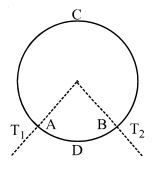
Aring consisting of two parts $ADB$ and $ACB$ of same conductivity $k$ carries an amount of heat $H$. The $ADB$ part is now replaced with another metal keeping the temperatures $T_1$ and $T_2$ constant. The heat carried increases to $2H$. What $ACB$ should be the conductivity of the new$ADB$ part? Given $\frac{{ACB}}{{ADB}}= 3$
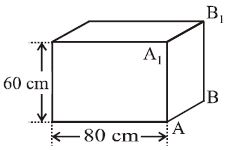
Calculate the minimum amount of work necessary to over-turn a crate of weight $100 \ kg$, first about edge $AB$, then about edge $A_1B_1$. The dimensions of the crate are given in the figure ............... $\mathrm{J}$
A capillary tube made of glass of radius $0.15\, mm$ is dipped vertically in a beaker filled with methylene iodide (surface tension $=0.05\, Nm ^{-1},$ density $\left.=667\, kg m ^{-3}\right)$ which rises to height $h$ in the tube. It is observed that the two tangents drawn from liquid-glass interfaces (from opp. sides of the capillary) make an angle of $60^{\circ}$ with one another. Then $h$ is close to $......m$

$\left(g=10\, ms ^{-2}\right)$

The position vector of $1\,kg$ object is $\overrightarrow{ r }=(3 \hat{ i }-\hat{ j })\,m$ and its velocity $\overrightarrow{ v }=(3 \hat{ j }+ k )\,ms ^{-1}$. The magnitude of its angular momentum is $\sqrt{ x } Nm$ where $x$ is
It is known that wax contracts on solidification. If molten wax is taken in a large vessel and it is allowed to cool slowly, then
A wave travels in a medium according to the equation of displacement given by $y(x,\,t) = 0.03\sin \pi (2t - 0.01x)$ where $y$ and $x$ are in metres and $t$ in seconds. The wavelength of the wave is  .... $m$
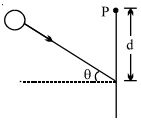
$A$ ball of mass $m$ moving with velocity $v$, collide with the wall elastically as shown in the figure.After impact the change in angular momentum about $P$ is:
Two discs of moment of inertia $I_1$ and $I_2$ and angular speeds ${\omega _1}\,{\rm{and }}{\omega _2}$ are rotating along collinear axes passing through their centre of mass and perpendicular to their plane. If the two are made to rotate together along the same axis the rotational $KE$ of system will be 
A car is moving along a straight line, say $OP$ in given figure. It moves from $O$ to $P$ in $18\; s$ and returns from $P$ to $\mathrm{Q}$ in $6.0\; s$. What are the average velocity and average speed of the car in going from $O$ to $P$?