Question
Differential between voluntanry and involuntary muscls. Given one example of type.

Answer

 
Voluntary muscles
 
Involuntary muscles
i.
Their action is under our concious control.
i.
Their action is not under our conscious control.
ii.
Cells are multinu cleate.
ii.
Cells are un inucleate.
iii.
Skeletal muscles.
iii.
Smooth muscle.

Need a full question paper?

Generate a complete, print-ready paper with questions like this in minutes — across 16+ boards, with answer keys.
Start Generating Free

Similar questions

The density of turpentine is $840\ kg/m^3.$ What will be its relative density? $($Density of water $= 1000\ kg/m^3)$
Explain, how sonic booms are produced?
What is Brownian motion? Draw a diagram to show the movement of a particle (like a pollen grain) during Brownian motion.
A student placed a gas jar containing air in the upside down position over a gas jar full of red-brown bromine vapours. He observed that the red brown colour spread upwards into the jar containing air. Based on this observation, the student concluded that it is only the bromine vapour which moves up and diffuses into air in the upper jar, the air from the upper jar does not move down by diffusion into the lower jar containing bromine vapours. Do you agree with this conclusion of the student? Give reason for your answer.
What are tissues? Give importance of tissue.
Find the ratio of weights of a body on the earth and jupiter, given g on jupiter is 2.5 times that on the earth.
How many joules of energy are consumed by a $1000W$ heater used for $2h$?
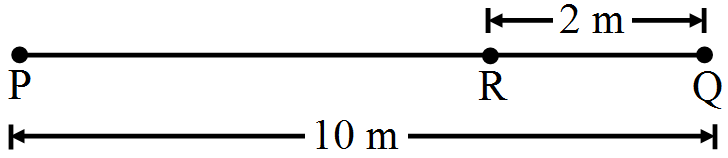
After studying the motion of a ball rolling on a straight line as shown in the figure.

Find its distance and displacement covered.
  1. When it rolls from P to Q.
  2. Finally comes back to P (i.e., P to P)(take, P as reference point).
What is leucocyte count of normal humans?
Avinash can run with a speed of $8\ ms^{-1}$ against the frictional force of $10N,$ and Kapil can move with a speed of $3\ ms^{-1}$ against the frictional force of $25N$. Who is more powerful and why?