Question
Differentiate between axon and dendron.

Answer

 
Axon
 
Dendron
$1.$
An axon is a longest tubular process of the cyton.
$1.$
These are many short processes which arise from the cyton.
$2.$
It is efferent process as it carries impulses away from the cell body.
$2.$
These are afferent processes as they carry impulses towards the cell body.
$3.$
Nissl’s granules are absent.
$3.$
Nissl’s granules are present.
$4.$
End of each axon breaks into fine branches called telodendria.
$4.$
End of each dendron breaks into fine branches called dendrites.

Need a full question paper?

Generate a complete, print-ready paper with questions like this in minutes — across 16+ boards, with answer keys.
Start Generating Free

Similar questions

Explain the objectives of mixed cropping. How are crops selected for mixed cropping.
Write down disadvantages of crop rotation.
Why does dehydration set in during diarrhoea? How can the former be prevented.
The scientists now say that there are actually five states of matter $A, B, C, D$ and $E.$ The state $A$ has a fixed volume but no fixed shape. The state $B$ can be compressed very easily by applying pressure and state $C$ has a fixed shape as well as a fixed volume. The state $D$ is mixture of free electrons and ions whereas state $E$ is named after an Indian scientist and a famous physicist.
  1. Name the physical states $(i) A (ii) B (iii) C (iv) D$, and $(v) E.$
  2. Name one substance belonging to state $C$ which can directly change into vapours on heating. What is this process known as?
  3. Name one substance which normally belongs to state $B$ but whose solid form changes directly into gaseous state.
  4. Name the most common substance belonging to state $A.$
  5. Which state of matter makes the sum and other stars to glow.
Write down the differences between diffusion and osmosis.
What is humus? What are its functions?
Name two factors that help in soil formation.
How do organisms contribute in the formation of soil?
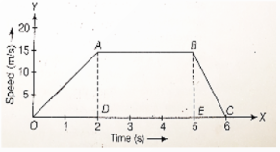
The speed-time graph of a car is given. The car weighs 1000 kg .
i. What is the distance travelled by car in the first 2 s ?
ii. What is the braking force applied at the end of 5 s to bring the car to stop within one second?
Image
A cyclist is travelling at $15ms^{-1}. $She applies brakes so that she does not collide with a wall $18\ m$ away. What deceleration must she have?