Question
Differentiate between following.

Answer

(a) Grazing food chain and Detritus food chain
Grazing food chainDetritus food chain
It starts from green plants-producers which are placed at first trophic level.It starts with the decomposers which degrade detritus like dead animals or fallen leaves etc.
In this food chain energy is obtained directly from sun light.In this food chain energy is derived from the decomposition of detritus material.
It is controlled by higher organisms.This is controlled by microbes.
The rate of energy flow is less.The rate of energy flow is high.
(b) Production and Decomposition
ProductionDecomposition
The food which is produced in the form of organic matter by producers is called production.Organic matter is decomposed by decomposers is called decomposition.
It depends on the photosynthesis of plants.It depends on the rate of decomposition by decomposers.
e.g. Plantse.g bacteria, fungi, earthworm
(c) Upright pyramid and Inverted pyramid
Upright pyramidInverted pyramid
In this type of pyramid, the number, biomass, energy level and productivity is higher which decreases in successive trophic level.In this type of pyramid, the number, biomass and productivity is less but at other trophic level increases.
Pyramid of energy is always upright.Pyramid of number and biomass can be inverted. e.g. dessert and polar region
At the base of pyramid there is always producers.At the base of this pyramid, the producers numbers are less.
(d) Food chain and Food web
Food chainFood web
It is the linear sequence of organisms.It forms by linkage of many food chain.
Energy flow can be easily understood.To understand energy flow is complex.
Organisms from higher trophic level only consumes one organism.One organism has many options for food.
It has simple structure.It is more complex structure.
(e) Litter and Detritus
LitterDetritus
Litter contains bio-degradable and non bio degradable things.Detritus contains only degradable matter.
e.g. leaves, metal, plastic things.Dead body or organs of organism.
(f) Primary productivity and Secondary productivity
Primary productivitySecondary productivity
Primary production is defined as the amount of biomass or organic matter produced per unit area over a time period by plants during photosynthesis.Secondary productivity is defined as the rate of formation of new organic matter by consumers.
It depends upon green plants.It depends upon heterotrophs
It has two types: gross primary productivity and net primary productivityIt has no types.
It is in a large amount.It is in a small amount.

Need a full question paper?

Generate a complete, print-ready paper with questions like this in minutes — across 16+ boards, with answer keys.

Start Generating Free

Similar questions

Read the following and answer any four questions from (i) to (v) given below:

In today's world, more than 25% of human population is suffering from hunger and malnutrition. Scientists have developed techniques where microbes are grown on industrial scale as a source of good protein which can be grown from waste water, animal manure and even sewage. Single cell proteins are such products. TI1e biomass or protein is extracted from pure or mixed cultures of algae, yeasts, fungi or bacteria. These are a very good source of food for human consumption.

  1. Why the name single cell protein is applied?
  1. It contains only one type of protein.
  2. It is obtained from unicellular edible microbes.
  3. It contains only one type of microorganism.
  4. All of these.
  1. Which of the following is considered under single cell protein?
  1. Algae.
  2. Fungi.
  3. Cyanobacteria.
  4. All of these.
  1. Microorganisms can be a useful food resource for increasing human population because:
  1. These are easy to harvest.
  2. These can grow in water system.
  3. They have a high rate of multiplication thus producing huge biomass.
  4. They have high level of nucleic acid.
  1. Single cell protein can be grown from:
  1. Waste water.
  2. Animal manure.
  3. Sewage.
  4. All of these.
  1. Assertion: Production of single cell protein reduces pollution.

Reason: Single cell protein can be grown from waste water and even sewage.
  1. Both assertion and reason are true and reason is the correct explanation of assertion.
  2. Both assertion and reason are true but reason is not the correct explanation of assertion.
  3. Assertion is true but reason is false.
  4. Both assertion and reason are false.
Loss of habitat and fragmentation leads to loss in biodiversity. Explain with example.
Write a note Lac operon
Read the following and answer any four questions from (i) to (v) given below:

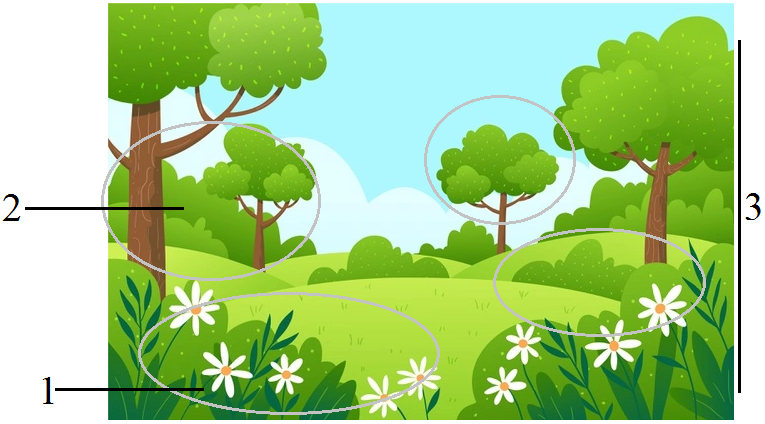
Ecosystem diversity is the variety of forms in the ecosystem due to diversity of niches, trophic levels and ecological processes like nutrient recycling, food webs, energy flow, etc. Study the given figure.

  1. Identify different types of diversity denoted by 1, 2 and 3 in the given figure.
 
1
2
3
(a)
Alpha diversity
Beta diversity
Gamma diversity
(b)
Gamma diversity
Alpha diversity
Beta diversity
(c)
Gamma diversity
Beta diversity
Alpha diversity
(d)
Beta diversity
Alpha diversity
Gamma diversity
  1. Alpha diversity is biodiversity present.
  1. Within conununity.
  2. Between conununities.
  3. In ranges of communities.
  4. None of these.
  1. Diversity represented by diversity of habitats over a total landscape area is:
  1. $\alpha-\text{diversity}$

  2. $\gamma-\text{diversity}$

  3. $\beta-\text{diversity}$

  4. $\delta-\text{diversity}$

  1. Concept of three types of ecological diversity was given by:
  1. Elton
  2. Odum
  3. Edward Wilson
  4. Whittaker
  1. The diversity of organisms sharing the same habitat or conununity is termed as:
  1. Alpha diversity.
  2. beta diversity.
  3. gamma diversity.
  4. delta diversity.
Read the following and answer any four questions from (i) to (v) given below:

Discovery of penicillin by Alexander Fleming in 1928 marked the beginning of the remarkable era in medical field. Penicillin was the first antibiotic extracted from Penicillium notatum. Antibiotics are used to treat bacterial diseases. These can be broad spectrum which can kill diverse group of disease causing bacteria and narrow spectrum which is effective only against one group of pathogenic strain. Antibiotics can act as bactericides or bacteriostatic. Bactericidal antibiotics kill bacteria by - disruption of cell wall synthesis (e.g., penicillin, cephalosporin, etc.), inhibition of SOS ribosome function (e.g.; erythromycin), inhibition of 30S ribosome function (e.g., streptomycin, neomycin), inhibition of amino acid-tRNA binding to ribosome (e.g., tetracyline). etc. Bacteriostatic antibiotics do not kill the bacteria rather they restrict the growth of bacteria. Penicillin belongs to $\beta$-lactum group of antibiotics and it inhibits bacterial cell wall synthesis by binding and inactivating protein. It inhibits transpeptidation of reaction and blocks cross-linking of the cell wall. It is used to treat tonsilitis, sore throat, gonorrhoea, rheumatic fever and some pneumonia types.

  1. The first antibiotic was extracted from a:
  1. Lichen.
  2. Fungus.
  3. Eubacteria.
  4. Acti-nomycetes.
  1. Which of the following kills bacteria by interfering SOS ribosome function?
  1. Cephalosporin.
  2. Erythromycin.
  3. Streptomycin.
  4. Neomycin.
  1. $\beta$-lactum group of antibiotics kill the bacterial pathogen by:
  1. Disruption of plasma membrane.
  2. Inhibition of translation of mRNA.
  3. Inhibition of translation of mRNA
  4. Inhibition of transcription of mRNA.
  1. Penicillin is not used to treat.
  1. Pneumonia.
  2. Tonsilitis.
  3. Rheumatic fever.
  4. Candidiasis.
  1. Assertion: Cephalosporins act by disruption of bacterial cell wall synthesis mechanism.

Reason: Cephalosporins are bacteriostatic antibiotics.

  1. Both assertion and reason are true and reason is the correct explanation of assertion.
  2. Both assertion and reason are true but reason is not the correct explanation of assertion.
  3. Assertion is true but reason is false.
  4. Both assertion and reason are false.
How is a transgenic tobacco plant protected against Meloidogyne incognita? Explain the procedure.
Write a self-explanatory note on biopatent.
  1. What are the three options that can be thought of, to increase food production?
  2. Mention the reasons for the success of Green Revolution in increasing food production.
  3. Why do we still search for other alternatives to increase food production?
With labeled diagrams describe the mechanism of Pollen-pistil Interaction.
Read the following and answer any four questions from (i) to (v) given below:

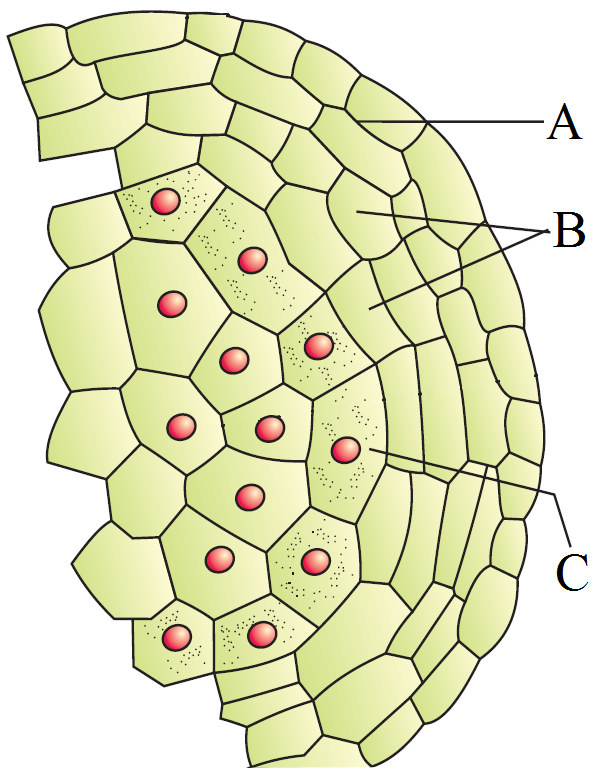
The anther is a four-sided structure consisting of four microsporangia located at the corners, two in each lobe. TI1e microsporangia develop further and become pollen sacs. In a transverse section, a typical microsporangium appears near circular in outline. It is generally surrounded by four wall layers-the epidermis, endothecium, middle layers and the tapetum.

  1. A dithecous another consists of (A) microsporangia, (B) in each lobe.

Select the option that correctly fills the blanks.

S. No
A
B
(a)
Four
Two
(b)
Two
One
(c)
Two
Two
(d)
Four
One
  1. The given diagram shows microsporangium of a mature anther. Identify A, B and C.

(a)
A-Middle layer
B-Endothecium
C-Tapetum
(b)
A-Endothecium
B-Tapetum
C- Middle layer
(c)
A-Endothecium
B-Middle layer
C-Tapetum
(d)
A-Tapetum
B-Middle layer
C-Endothecium
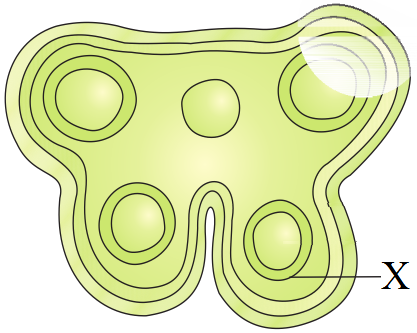
  1. The function of labelled part X is:

  1. Dehiscence.
  2. Mechanical.
  3. Nutrition.
  4. Protection.
  1. Select the incorrect statement.
  1. Microsporangium is generally surrounded by four wall layers-epidermis, endothecium, middle layers and tapetum.
  2. Outer three layers perform functions of protection and dehiscence of anthers.
  3. Cells of tapetum possess dense cytoplasm and generally have more than one nucleus.
  4. Cells of tapetum undergo meiosis and produce microspore tetrads.
  1. Which function oftapetum is correct?
  1. Helps in pollen wall formation.
  2. Transportation of nutrients to inner side of another.
  3. Synthesis of callase enzyme for separation of microspore tetrads.
  4. All of these.