Question
Differentiate between heat capacity and specific heat capacity.

Answer

Heat capacity of the body is the amount of heat required to raise the temperature of (whole) body
by $1^{\circ} C$ whereas specific heat capacity is the amount of heat required to raise the temperature of unit mass of the body by $1^{\circ} C$.
Heat capacity of a substance depends upon the material and mass of the body. Specific heat
capacity of a substance does not depend on the mass of the body.
S.I. unit of heat capacity is $J K^{-1}$ and S.I. unit of specific heat capacity is $J k g^{-1} K^{-1}$.

Need a full question paper?

Generate a complete, print-ready paper with questions like this in minutes — across 16+ boards, with answer keys.

Start Generating Free

Similar questions

Describe how you would determine the focal length of a converging lens, using a plane mirror and one pin. Draw a ray diagram to illustrate your answer.
The frequency of the stretched string of a fixed length is f when it is plucked in the middle. Where should it be plucked so that string vibrates with frequency (i) 2f, (ii) 3f?
Draw diagrams to show these vibrations and name them.
What is meant by the ‘loudness’ of a sound? How is it related to the intensity?
In an experiment, $17 g$ of ice is used to bring down the temperature of $40 g$ of water at $34^{\circ} C$ to its freezing temperature. The specific heat capacity of water is $4.2 Jkg ^{-1} K ^{-1}$. Calculate the specific latent heat of ice. State one important assumption made in the above calculation.
$1.0 kg$ of water is container in a $1.25 kW$ kettle. Calculate the time taken for the temperature of water to rise from $25^{\circ} C$ to its boiling point $100^{\circ} C$. Specific heat capacity of water $=4.2 J g ^{-1} K ^{-1}$.
Why is less effort needed to lift a load over an inclined plane as compared to lifting the load directly?
Two sets A and B of four bulbs each are glowing in two separate rooms. When one of the bulbs in set A is fused, the other three bulbs also cease to glow. But in set B, when one bulb fuses the other bulbs continue to glow. Explain the difference.
A certain nucleus X has a mass number 15 and atomic number 7. Find the number of neutrons. The nucleus X losses one proton and Express the change and write the symbol of the new nucleus.
A body of mass m is moving with a uniform velocity u. A force is applied on the body due to
which its velocity changes from u to v. How much work is being done by the force.
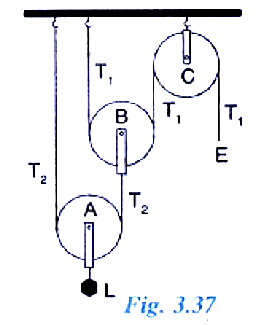
The Diagram alongside shows an arrangement of three pulleys A, B, and C. The load is marked as L and the effort as E.
(a) Name the Pulleys A, B, and C.
(b) Mark in the diagram the directions of load (L), effort (E) and tension T1 and T2 in the two strings.
(c) How are the magnitudes of L and E related to the tension T1?
(d) Calculate the mechanical advantage and velocity ratio of the arrangement.
(e) What assumptions have you made in parts (c) and (d)?