Question
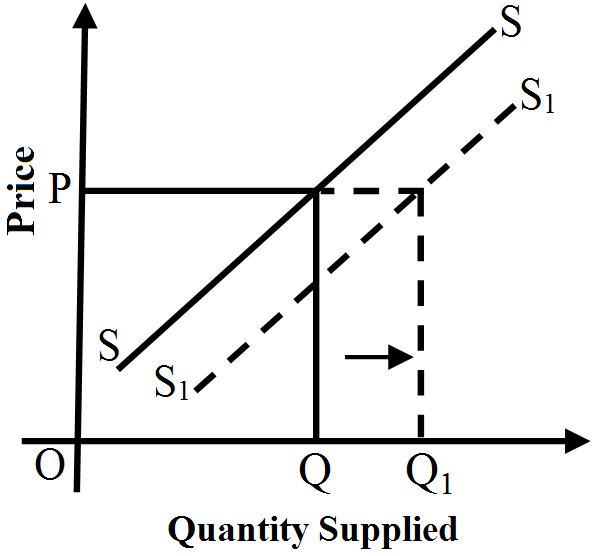
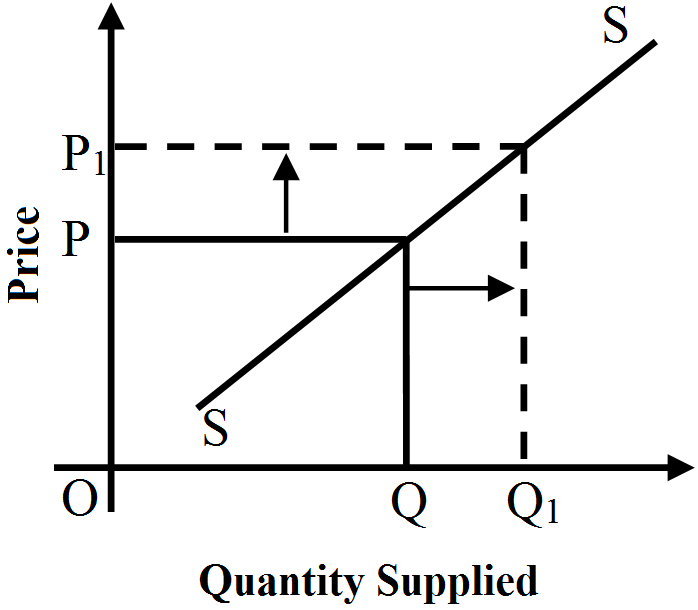
Differentiate between increase in supply and expansion in supply [increase in quantity supplied).

Answer

S. No.
Basis
Increase in Supply
Expansion in Supply
1.
Meaning 
An increase in supply means that producers now supply more at a given price level.
It states that rise in quantity supplied due to the rise in price of the commodity.
2.
Cause
(i) Fall in the price of remuneration of factors of production.
It is caused by rise in price of the commodity.
 
(ii) Fall in the prices of other goods
(iii) Improvement in technology.
(iv) Change in objective of producer (increase the supply at the same rate).
(v) Taxation policy of government falls.
3.
Schedule
Price
Supply
4
4
8
10
 
Price
Supply
1
2
8
10
 
4.
Diagram

Need a full question paper?

Generate a complete, print-ready paper with questions like this in minutes — across 16+ boards, with answer keys.

Start Generating Free

Similar questions

Why a firm's demand curve indeterminates under oligopoly?
Differentiate between APC and MPC.
A consumer spends continues to spend ₹ 1000 on a good priced at ₹ 8 per unit. When price rises by 25 percent, the consumer ₹ 1000 on the good. Calculate price elasticity of demand by percentage method.
Suppose that TFC is ₹ 120, find out (i) TC and TVC (ü) MC from the following data:
Output (units) 1 2 3 4 5
ATC (₹) 240 160 140 160 180
Explain the working of investment multiplier with the help of an example.
Calculate investment expenditure from the following data about an economy which is in equilibrium:
National income = 1000
Marginal propensity to save = 0.25
Autonomous consumption expenditure = 200
Differentiate between quantitative and qualitative instruments of credit control.Differentiate between quantitative and qualitative instruments of credit control.
Suppose the demand and supply equations of a commodity X in a perfectly competitive market are given by:
Qd = 1700 - 2P
Qs = 1300 + 3P
Calculate the value of equilibrium price and equilibrium quantity of the commodity X.
As a result of increase in investment by ₹ 125 crore national income increases by ₹ 500 crore. Calculate marginal propensity to consume.
Read the passage given below and answer the following questions from 1 to 4.
In the Government of India's budget for the year 2013 - 14, the Finance Minister proposed to raise the Goods and Services Tax (GST) on cigarettes. He also proposed to increase income tax on individual earning more than rupee one crore per annum.
  1. Identify the taxes proposed to be increased by the Budget 2013 - 14. The taxes proposed are:
  1. Goods and Services tax on cigarettes.
  2. Income tax on individuals earning Rs. 1 crore or above.
  3. Both [a] and [b]
  4. None of the above
  1. What was the objective(s) behind the proposals put forth in the Budget 2013 - 14?
  1. Revenue generation
  2. Social welfare
  3. Both [a] and [b]
  4. None of these
  1. What welfare objective the government wishes to achieve by increasing GST on cigarettes?
  1. This will discourage their cigarettes
  2. This will encourage their cigarettes
  3. Both [a] and [b]
  4. None of the above
  1. What would be the effect of increase in direct tax on the rich?
  1. It will reduce the gap between rich and the poor, thereby reducing inequalities in income
  2. It will increase the gap between rich and the poor
  3. Both [a] and [b]
  4. None of the above