Question
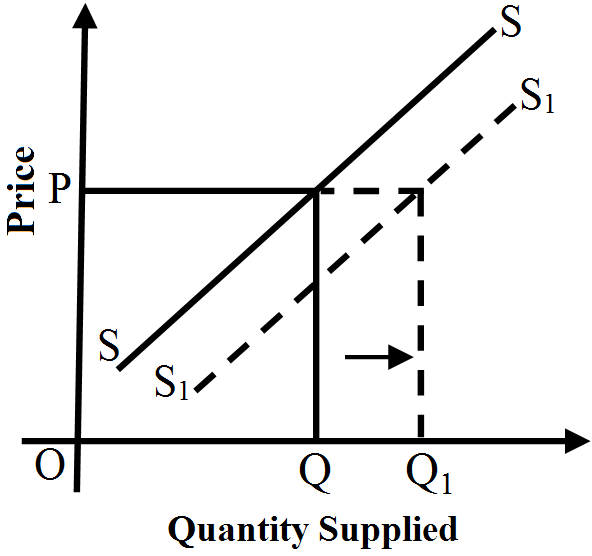
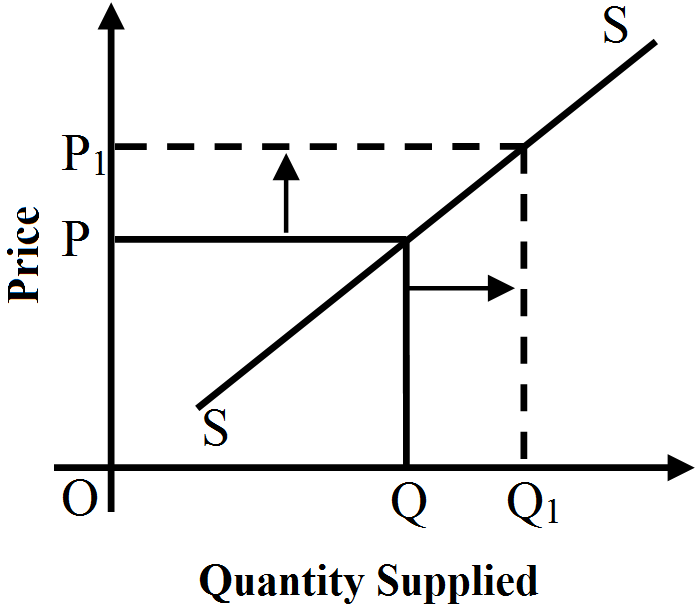
Differentiate between increase in supply and expansion in supply [increase in quantity supplied).

Answer

S. No.
Basis
Increase in Supply
Expansion in Supply
1.
Meaning
An increase in supply means that producers now supply more at a given price level.
It states that rise in quantity supplied due to the rise in price of the commodity.
2.
Cause
(i) Fall in the price of remuneration of factors of production.
It is caused by rise in price of the commodity.
 
(ii) Fall in the prices of other goods
(iii) Improvement in technology.
(iv) Change in objective of producer (increase the supply at the same rate).
(v) Taxation policy of government falls.
3.
Schedule
Price
Supply
4
4
8
10
 
Price
Supply
1
2
8
10
 
4.
Diagram

Need a full question paper?

Generate a complete, print-ready paper with questions like this in minutes — across 16+ boards, with answer keys.

Start Generating Free

Similar questions

Why is Production Possibilities Curve concave? Explain.
A consumer buys $20$ units of a good at a price of ₹ $5$ per unit. He incurs an expenditure of ₹ $120$ when he buys $24$ units. Calculate price elasticity of demand using the percentage method. Comment upon the likely shape of demand curve based on this information.
What is shown on X-axis and Y-axis of a graph?
Explain the effect of change in prices of the related goods on demand for the given good.
Commodities X and Y have equal price elasticity of supply. The supply of X rises from 400 units to 500 units due to a 20 percent rise in its price. Calculate the percentage fall in supply of Y if its price falls by 8 percent.
Assuming that no resource is equally efficient in production of all goods, name the curve which shows production potential of the economy. Explain, giving reasons, its properties.
Draw a production possibility curve. What does a point below this curve indicate? Explain.
The following table gives the marginal product schedule of labour. It is also given that total product of labour is zero at zero level of employment. Calculate the total and average product schedules of labour.
$L$
$MP_L$
1
2
3
4
5
6
3
5
7
5
3
1
Draw the average revenue curve of a firm under (1) monopoly and (2) perfect competition. Explain the difference in these curves, if any.
Explain the distinction between change in demand and change in quantity demanded of a commodity.
OR
Explain the distinction between a shift in demand curve and a movement along the demand curve. Use diagram.