Question
Differentiate between Normal Goods and Inferior Goods.
| S. No. | Basis | Normal Goods | Inferior Goods | ||||
| 1. | Meaning | Normal goods are those in which quantity demanded varies directly with the consumer's income. | Inferior goods are those in which quantity demanded varies inversely with a consumer's income. | ||||
| 2. | Schedule | Price of Normal good | Quantity demanded of normal good when Income of a consumer is ₹ 5000 | Quantity demanded good of normal good when Income of a consumer is ₹ 6000 | Price of Inferior Goods | Quantity demanded of Inferior goods when Income of a consumer is ₹ 5000 | Quantity demanded of Inferior goods when Income of a consumer is ₹ 6000 |
| 3. | | 150 | 20 | 25 | 150 | 20 | 18 |
| 4. | | 170 | 18 | 21 | 170 | 18 | 15 |
| 5. | Curve | 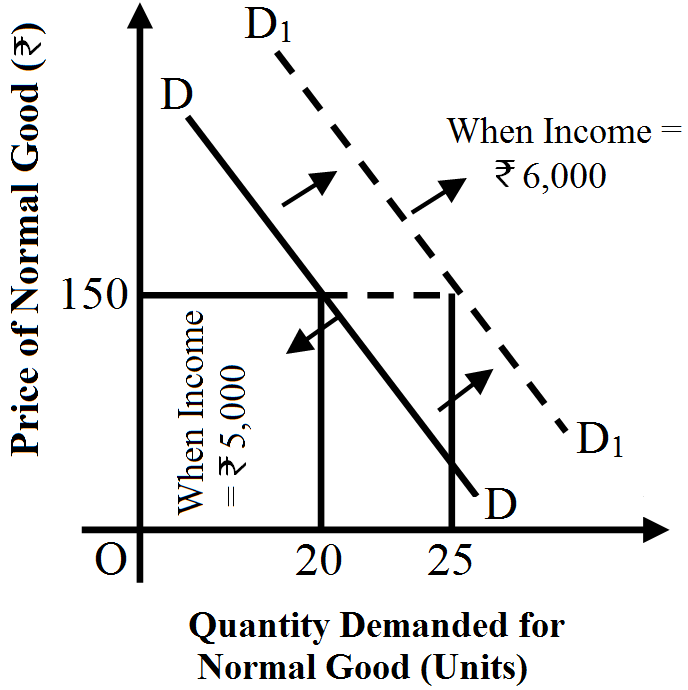 | 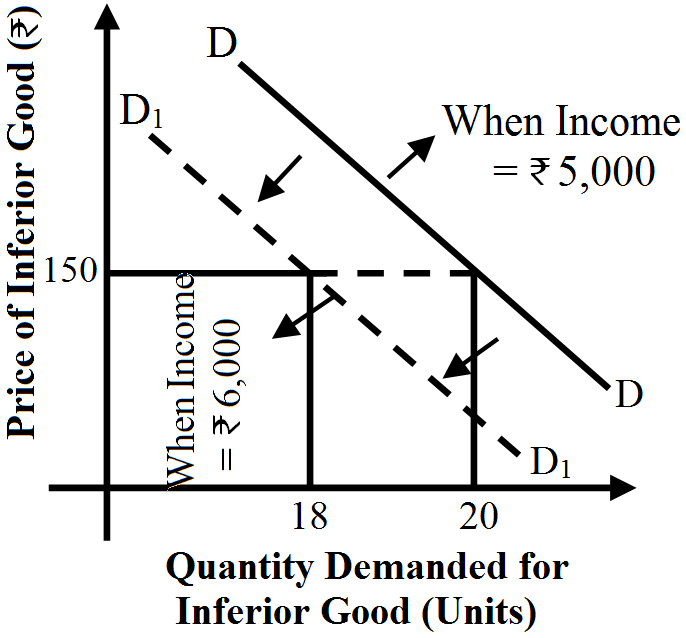 | ||||
Generate a complete, print-ready paper with questions like this in minutes — across 16+ boards, with answer keys.
| Total Output (Units) | Total Cost (Rs) |
| 0 | 120 |
| 1 | 180 |
| 2 | 200 |
| 3 | 210 |
| 4 | 230 |
| 5 | 270 |
| 6 | 360 |
| Output (Units) | Average Variable Cost (₹) | Total Cost (₹) | Marginal Cost (₹) |
| 1 | - | 60 | 20 |
| 2 | 18 | - | - |
| 3 | - | - | 18 |
| 4 | 20 | 120 | - |
| 5 | 22 | - | - |
OR
Explain ‘large number of buyers and sellers' feature of perfect competition.| Price (₹) | Output (units) | Total Revenue (₹) | Marginal Revenue (₹) |
| 7 | - | 7 | - |
| - | 2 | 10 | - |
| - | 3 | - | -1 |
| 1 | - | - | -5 |