Question
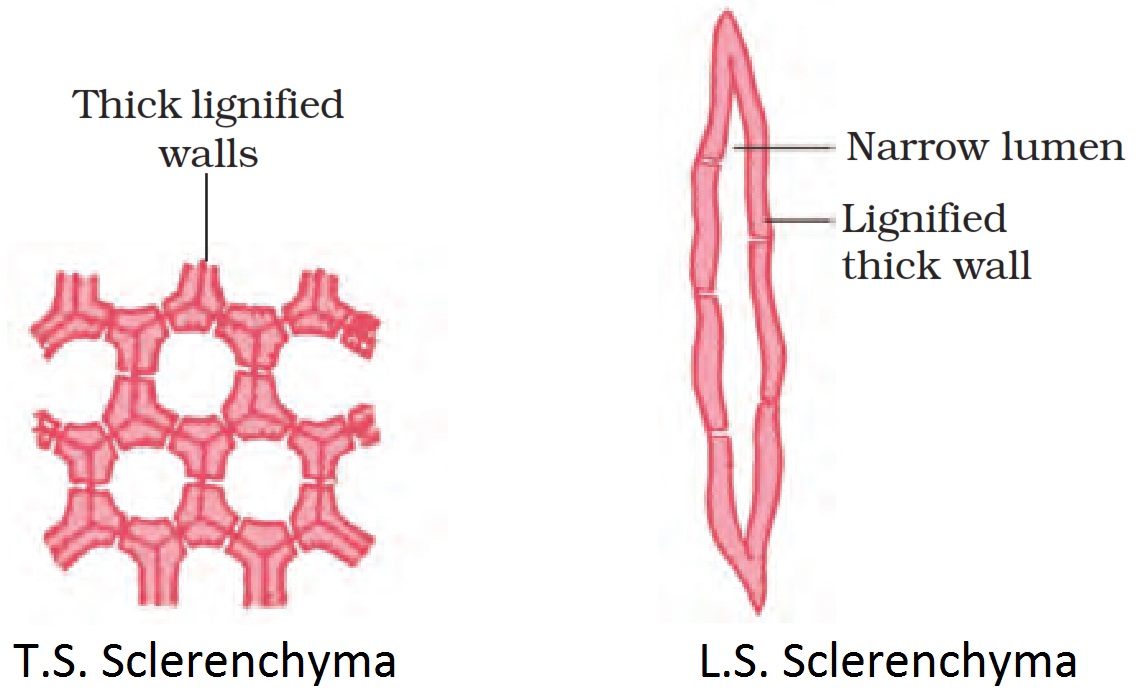
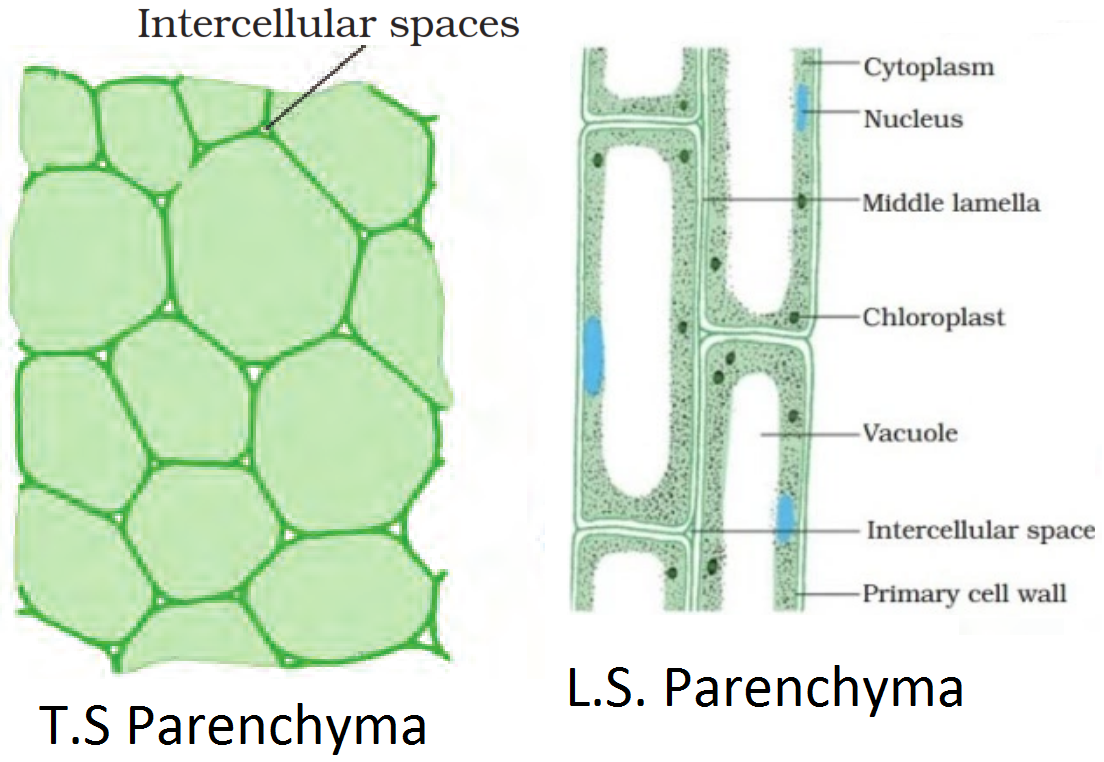
Differentiate between sclerenchyma and parenchyma tissue. Draw well labelled diagram.

Answer

 
Parenchyma
 
Sclerenchyma
1.
Cells are thin walled and unspecialized.
1.
Cells are thick walled and lignifieg.
2.
These are living cells.
2.
Tissues are made up of dead cells.
3.
Cells are usually loosely packed with large intercellular space.
3.
No intercellular apaces between the calls are found.
4.
Stores nutrient and water in stem and roots.
4.
Provides strength to the plant parts.
5.
Some cells contain chlorophyll called chlorenchyma and photosynthesis. other cells have large air which provid buoyancy to the hydrophytic plants.
5.
The cells are long and narrow. make the plant hard and stiff. The tissue is present in the stem around of leaves and seeds and nuts.

Need a full question paper?

Generate a complete, print-ready paper with questions like this in minutes — across 16+ boards, with answer keys.
Start Generating Free

Similar questions

You are provided with a mixture containing sand, iron filings, ammonium chloride and sodium chloride. Describe the procedures you would use to separate these constituents from the mixture?
Do you agree that the severity of disease manifestations indirectly depends on the number of microbes in the body? Answer simply Yes or No?
A boy walks from his classroom to the bookshop along a straight corridor towards North. He covers a distance of 20m in 25 seconds to reach the bookshop. After buying a book, he travels the same distance in the same time to reach back in the classroom. Find (a) average speed, and (b) average velocity, of the boy.
Write an activity to show that water can be made to boil even at a temperate below its normal boiling point $(100^\circ\ C)$.
All the living organisms are basically made up of $C, N, S, P, H$ and $O$. How do they enter the living forms? Discuss.
If the back of your hand is moistened with alcohol, you will find that it rapidly becomes dry. Why is it that while it is drying, your hand feels cool?
What is the difference between a compression and a rarefaction in a sound wave? Illustrate your answer with a sketch.
A girl walks along a straight path to drop a letter in the letterbox and comes back to her initial position. Her displacement–time graph is shown in Plot a velocity–time graph for the same.


There are three substances $X, Y$ and $Z$. The substance $X$ does not have a fixed melting point or boiling point and it still shows the individual properties of its constituents. The substance $Y$ is a pure substance which occurs in nature as such. The substance $Y$ has a fixed melting point and boiling point but it cannot be broken down into simpler substances by any chemical means. The substance $Z$ is also a pure substance whose properties are entirely different from those of its constituents. The substance $Z$ can, however, be divided by electrolysis into two substances which belong to the same class of substances as $Y$.
  1. What type of substance could $X$ be? Name one substance like $X$.
  2. What type of substance could $Y$ be? Name one substance like $Y$.
  3. What type of substance could $Z$ be? Name one substance like $Z$.
  4. Whish process involves absorption or release of an appreciable amount of energy: formation of substance $X$ or formation of substance $Z$?
  5. Name the three groups into which all the substances like $Y$ are divided on the basis of their properties.
A mixture contains water, kerosene and sand. How will you separate this mixture?