Question
Differentiate between substitute goods and complementary goods.

Answer

S. No. Basis Substitute Goods Complementary Goods
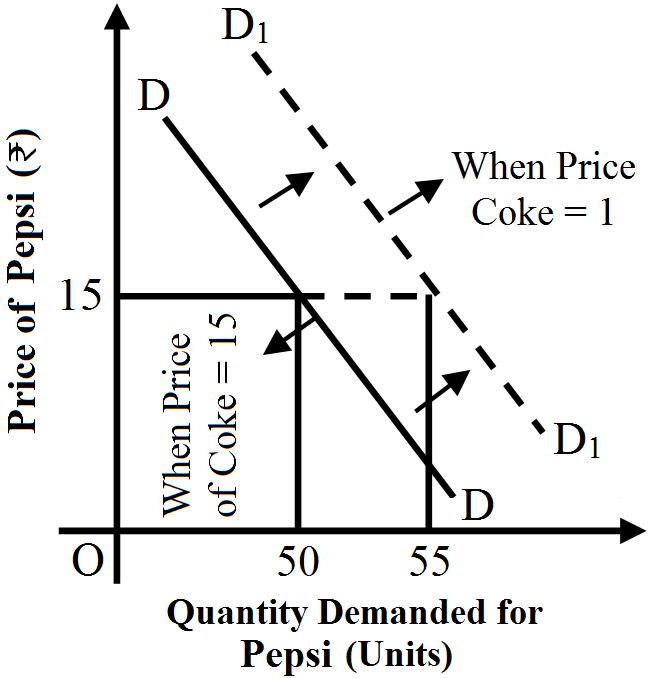
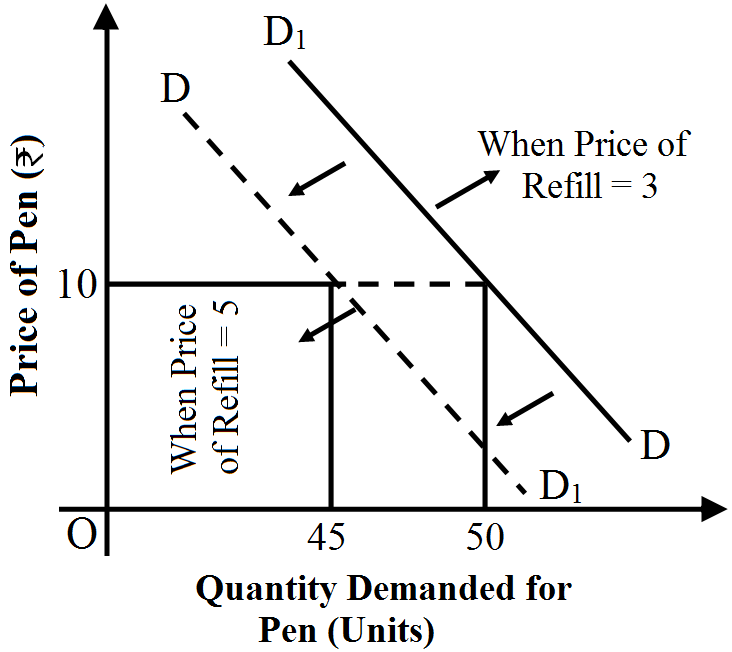
1. Meaning Substitute goods are those which can be used in place of another goods and gives the same satisfaction to a consumer. Complementary goods are those which are useless in the absence of other goods and which are demanded jointly.
2. Relation ship There always exists a positive direct relationship between the price of substitute goods and demand of a given commodity. There always exists an inverse ship relationship between the price of complementary goods and demand of given commodity.
3. Schedule
Price of Pepsi Given Commodity] * [per unit] Quantity Demanded of Pepsi when Price of Coke Substitute good) = * 15 [units] Quantity Demanded of Pepsi when Price of Coke [Substitute good) = * 18 [units]
15 50 55
16 45 52
Price of Pen [Given Commodity] * [per unit] Quantity Demanded of Pen when Price of Refill [Complimentary good] = *3 [units] Quantity Demanded of Pen when Price of Refill [Complimentary good) = *5 [units]
10 50 45
20 45 40
4. Diagram

Need a full question paper?

Generate a complete, print-ready paper with questions like this in minutes — across 16+ boards, with answer keys.

Start Generating Free

Similar questions

Explain the conditions of producer's equilibrium under perfect competition.
The following table shows the marginal cost at different levels of output of a firm. Its total fixed cost is ₹ 120.
Find its average total cost and average variable cost at each level of output.
Output (Units)
1
2
3
MC ()
40
30
26
State and discuss four characteristics of perfect competition.
OR
Explain ‘large number of buyers and sellers' feature of perfect competition.
A consumer wants to consume two goods. The prices of the two goods are Rs $4$ and Rs $5$ respectively. The consumer’s income is Rs $20$.
  1. Write down the equation of the budget line.
  2. How much of good $1$ can the consumer consume if she spends her entire income on that good?
  3. How much of good $2$ can she consume if she spends her entire income on that good?
  4. What is the slope of the budget line?
Explain the implications of the following features of monopolistic competition.
  1. Product differentiation.
  2. Free entry or exit of firms.
Explain any two factors that affect the price elasticity of demand. Give suitable examples.
A producer supplies 80 units of a good at a price of Rs. 10 per unit. Price elasticity of supply is 4. How much will he supply at Rs. 9 per unit?
A consumer spends ₹ $80$ on a commodity when price is ₹ $1$ per unit. If the price increases by ₹ $1$, his expenditure becomes ₹ $96$. Comment on $PED.$
What is perfectly elastic supply? When price falls by ₹ 2 per unit, supply falls from 100 units to 80 units. Price elasticity of supply is 2. What was the price per unit before change? Calculate.
Explain the concept of a production function.