Question
Differentiate between the following:
  1. Polygenic inheritance and Pleiotropy.
  2. Dominance, Codominance and Incomplete dominance.

Answer

  1. Pleiotropy:
  • In this, a single gene controls more than one phenotype.
  • The F, resembles one of the parents, i.e., dominant parent.
  • There is no gradation in the phenotype.
  1. Dominance:
  • It is the phenomenon in which one allele of a gene expresses itself and suppresses the expression of the other (recessive) allele of the same gene, when they are present together in a hybrid
  • The hybrid resembles one of the parents.
  1. Codominance:
  • It is the phenomenon in which two alleles of a gene are equally dominant and express themselves in the presence of the other.
  • The hybrid shows characters of both the parents.
  1. Incomplete dominance:
  • It is the phenomenon in which neither of the two alleles of a gene is completely dominant over the other.
  • The hybrid is intermediate between the two parents.

Need a full question paper?

Generate a complete, print-ready paper with questions like this in minutes — across 16+ boards, with answer keys.

Start Generating Free

Similar questions

Explain the process of divergent evolution in detail. Also, write down the driving force behind it.
  1. Explain the process of microsporogenesis in angiosperms.
  2. Draw a labelled diagram of a mature pollen grain.
“Microbes play a dual role when used for sewage treatment as they not only help to retrieve usable water but also generate fuel”. Explain.
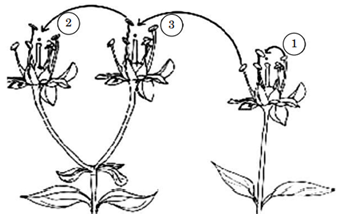
Study the diagram given below showing the modes of pollination. Answer the questions that follow.
Image
i. The given diagram shows three methods of pollen transfer in plants. What are the technical terms used for pollen transfer methods 1, 2 and 3?
ii. How do the following plants achieve pollination successfully?
1. Water lily
2. Vallisneria
iii. Flowering plants have developed many devices to avoid inbreeding depression. Explain one hereditary and one physiological device which helps plants to achieve this target.
Give details of different types of immune globulins in humans.
What are ecological pyramids? Mention its limitations.
Your school’s athletic team along with the athletic teams from different schools reach the venue two days before the inter district school athletic event was to be held. A day before the competition, a team of officials from an agency arrive and ask for blood and urine samples from all the participating athletes.
  1. Would you support or object to this sample collection? Provide explanation to your answer.
  2. Write a note that you would like to read out to your team-mates to explain the purpose of this visit of these officials.
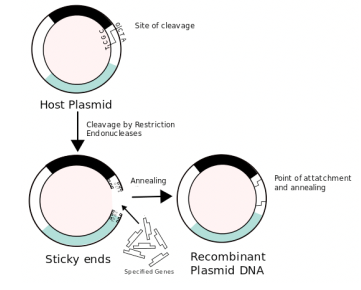
Recombinant DNA vectors are typically attenuated viruses or bacteria that are unrelated to the pathogen of interest.
These vectors can penetrate human cells and often replicate within them, but do not cause disease in the host.

Image
i. A recombinant vector with a gene of interest inserted within the gene of a-galactosidase enzyme, is introduced into a bacterium. Explain the method that would help in selection of recombinant colonies from non-recombinant ones.
ii. Why is this method of selection referred to as insertional inactivation?
About 8% of human male population suffers from colourblindness whereas only about 0.4% of human female population suffers from this disease. Write an explanation to show how it is possible.
Read the following and answer any four questions from (i) to (v) given below:
Transgenic animals can serve as factories that in some cases, may produce large amount of proteins more efficiently. Transgenic mice have been engineered to express human antibodies by introducing large segment of human DNA encoding human immunoglobulin genes. In transgenic large animals such as cow or sheep proteins of pharmaceutical value can be produced in large quantities in milk which is later purified. Transgenesis can be used to alter many phenotypic properties including growth rate, fat composition, milk production, hair texture, etc.
  1. The production of transgenic animals includes
  1. Identification and separation of desired gene.
  2. Combining the desired gene with appropriate vector.
  3. Introduction of vector in cells, tissues or embryos.
  4. All of these.
  1. In transgenic animals, i.e., cow and sheep proteins of pharmaceutical value are produced in large quantities in the
  1. Blood.
  2. Accumulated fat.
  3. Mammary glands.
  4. None of these.
  1. Mouse is mostly preferred animal for studies on gene transfer because.
  1. Short oestrous cycle.
  2. Long gestation period.
  3. Short generation time.
  4. Production of one or two offspring per pregnancy.
  1. Both (A) and (C)
  2. Both (A) and (B)
  3. Only D
  4. Both (C) and (D).
  1. Transgenic genes alter many phenotypic properties including:
  1. Growth rate.
  2. Fat composition.
  3. Milk production.
  4. All of these.
  1. Assertion: Transgenic mice have been engineered to express human antibodies.
Reason: Large segment of human DNA encoding human immunoglobulin have been transferred to mice.
  1. Both assertion and reason are true and reason is the correct explanation of assertion.
  2. Both assertion and reason are true but reason is not the correct explanation of assertion.
  3. Assertion is true but reason is false.
  4. Both assertion and reason are false.