Question
Differentiate between Uniform linear motion and Uniform circular motion.

Answer

Uniform linear motion

Uniform circular motion

The body moves along a straight line. The body moves along a circular path.
Speed and direction both remain constant. Speed is constant, but direction changes continuously.
It is not an accelerated motion. It is an accelerated motion.

Need a full question paper?

Generate a complete, print-ready paper with questions like this in minutes — across 16+ boards, with answer keys.

Start Generating Free

Similar questions

How do bats avoid obstacles in their way, when in flight?
Name the three classes of levers and distinguish between them. Give two examples of each class.
A uniform metre rule of mass 100g is balanced on a fulcrum at mark 40cm by suspending an unknown mass m at the mark 20cm.

How can it be balanced by another mass 50 g ?
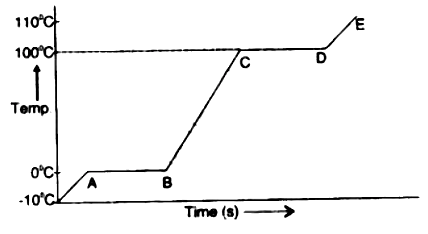
A piece of ice is heated at a constant rate. The variation of temperature with heat input is shown in the graph below:

(i) What are represented by AB and CD?
(ii) What conclusion can you draw regarding the 110°c nature of ice from the above graph?
What are ‘dual switches’? Mention their one main use.
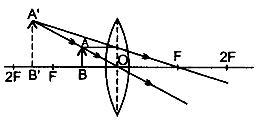
Draw a ray diagram to illustrate the formation of an enlarged and upright image of an object by a lens. Name the lens used. Where should the object be placed relative to the lens? Will the image be real or virtual? Name a device where this action of lens is used.
State two advantages of ‘the ring system of house wiring’.
What happens to the atomic number of element when (i) An $\alpha$-particle, (ii) $A \beta$-particle 1 and (iii) $\gamma$-radiation is emitted?
What do you mean by the state of equilibrium? What are the conditions for stable equilibrium?
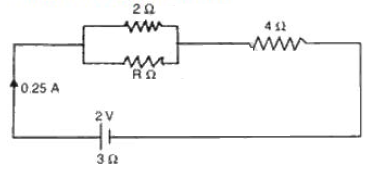
The circuit diagram (Fig .) shows three resistors 2 Ω, 4 Ω and RΩ connected to a battery of e.m.f. 2 V and internal resistance 3 Ω. A main current of 0 .25
A flows through the circuit.

Image

(i ) What is the p.d . across the 4 Ω resistor?
(ii ) Calculate the p.d . across the in ternal resistance of the cell.
(iii ) What is the p.d . across the R Ω or 2 Ω resistors?
(iv) Calculate the value of R.