Question
Differentiate between: A balanced and an unbalanced chemical equation.

Answer

  • Balanced chemical:
    A balanced chemical reaction is one in which the number of atoms of each element on the reactant side is equal to the number of atoms of that element on the product side.
    Example: $\ce{H_2 + Cl_2 → 2HCl}$
  • Unbalanced chemical:
    The number of elements on the reactant side is not equal to the number of elements on the product side.
    Example: $\ce{H_2 + Cl_2 → HCl}$

Need a full question paper?

Generate a complete, print-ready paper with questions like this in minutes — across 16+ boards, with answer keys.

Start Generating Free

Similar questions

What are isotopes? How does the existence of isotopes contradict Dalton’s atomic theory?
Certain thermal decomposition reactions, result in formation of oxides. Give balanced equations for the thermal decomposition of the following, which result in formation of a metallic oxide,
$(a)$ Limestone
$(b)$ Lead carbonate
$(c)$ Calcium nitrate
$(d)$ Calcium hydroxide.
Match the statements in Column $A$ with those in Column $B.$
Column $A$ Column $B$
$1.$ A metal which reacts with cold water to from hydrogen. $1.$ Reduction
$2.$ A gas which is inflammable and non$-$supporter of combustion $2.$ Hydrogenation
$3.$ A process in which vanspati ghee is prepared from vegitable oils $3.$ oxidation
$4.$ The removal ofhydrogen or addition of oxygen $4.$ sodium
$5.$ The addition of hydrogen or removal of oxygen $5.$ Hydrogen
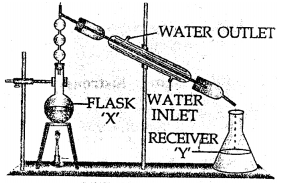
The diagram represents fractional distillation for separation mixtures. Answer the following
Image
$1.$ Can two immiscible liquids be separated by this process.
$2.$ Separation of liquids by this process is based on which physical property?
$3.$ If methyl alcohol $\&$ water are to be separated, which liquid would remain in flask ‘$X$’ after condensation.
$4.$ Give a reason for the above answer.
$5.$ State the purpose of the fractionating column in the apparatus.
How do the following help in bringing about a chemical change? catalyst .
With reference to the discovery of the structure of an atom, explain in brief $-$ William Crookes experiment for the discovery of cathode rays, followed by $-$ J.J. Thomsons experiment pertaining to the constituents of the cathode rays. State which sub$-$atomic particle was discovered from his experiment.
Differentiate between: Reactants and products.
Mention briefly the salient features of Dalton’s atomic theory $($five points$)$
What are $(i)$ positive catalysts and $(ii)$ negative catalysts? Support your answer with one example for each of them.
State the mass number, the atomic number, number of neutrons and electronic configuration of the following atoms.
${ }_6^{12} \mathrm{C},{ }_8^{16} \mathrm{O},{ }_9^{19} \mathrm{~F},{ }_{10}^{20} \mathrm{Ne},{ }_{13} \mathrm{Al}^{27},{ }_{17} \mathrm{Cl}^{35}$
Also, draw atomic diagrams for them.