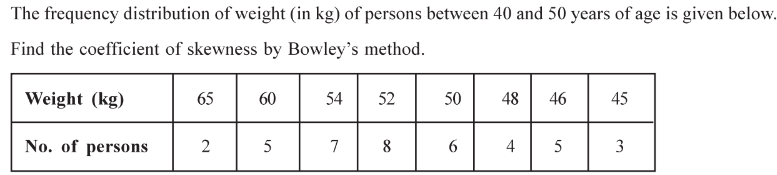
Question
Differentiate : Karl Pearson’s and Bowley’s method for coefficient of skewness.
| Karl pearson’s method | Bowley’s method | ||
| $1.$ | In a skewed frequency distribution ‘the values of mean, median and mode are not equal’. This base is used to obtain the measure of skewness. | $1.$ | In a skewed frequency distribution 'the values of mean, median and mode are not equal'. This base is used to obtain the measure of skewness. |
| $2.$ | Value of median always lies between mean and mode. Hence, the skewness is found by the formula $S _{ k }=\bar{x}- M _0$. Dividing this measure by standard deviation s, Karl Pearson's coefficient of skewness is obtained by following formula : $j =\frac{\bar{x}- M _0}{s}$ When, the mode is undefined $j =\frac{3(\bar{x}-M)}{s}$ | $2.$ | $Q_3$ and $Q_1$ are not equidistant from median $M$. Hence, skewness is obtained by the formula $S_k=$ $\left(Q_3-M\right)-\left(M-Q_1\right)=Q_3+Q_1-2 M$. Dividing the measure by sum of differences Bowley's coefficient of skewness is obtained by the following formula : j $=\frac{\left(Q_3-M\right)-\left(M-Q_1\right)}{\left(Q_3-M\right)+\left(M-Q_1\right)}=\frac{Q_8+Q_1-2 M}{Q_3-Q_1}$ |
| $3.$ | Usually, the value of coefficient of skewness j lies between $-1$ and $+1.$ But when $M_0$ is undefined, the value of j lies between $-3$ and $+3.$ | $3.$ | The value of coefficient of skewness lies between $-1$ and $+1.$ |
| $4.$ | The Value of coefficient of skewness obtained by this method is more reliable. | $4.$ | The value of coefficient of skewness, obtained by this method is less reliable than the value of coefficient of skewness obtained by Karl Pearson’s method. |
| $5.$ | In this method all observations of the data are used to find the coefficient of skewness. | $5.$ | All observations of the data are not used to find the coefficient of skewness in this method. But, the observations, related only to $Q _1, Q _3$ and M are used. |
| $6.$ | The coefficient of skewness cannot be obtained by this method for frequency distribution with Open - ended classes. |
$6.$ | This method is more appropriate to find the skewness and coefficient of skewness for frequency distribution with open - ended classes. |
Generate a complete, print-ready paper with questions like this in minutes — across 16+ boards, with answer keys.
| Marks | $12 – 16$ | $17 – 21$ | $22 – 26$ | $27 – 31$ | $32 – 36$ |
| No. of students | $2$ | $3$ | $14$ | $8$ | $3$ |
| Marks | $10$ | $20$ | $30$ | $40$ | $20$ | $60$ |
| No. of students | $4$ | $7$ | $15$ | $8$ | $7$ | $2$ |