Question
Differentiate the following from first principle:$\frac{1}{\sqrt{\text{x}}}$

Answer

We have,$\because\text{f}'\text{(x)}=\lim\limits_{\text{h}\rightarrow0}\frac{\text{f(x+h)}-\text{f(x)}}{\text{h}}$
$=\lim\limits_{\text{h}\rightarrow0}\frac{\frac{1}{\sqrt{\text{x+h}}}-\frac{1}{\sqrt{\text{x}}}}{\text{h}}$
$=\lim\limits_{\text{h}\rightarrow0}\frac{\sqrt{\text{x}}-\sqrt{\text{x+h}}}{\sqrt{\text{x}}\sqrt{\text{x+h}}.\text{h}}$
$=\lim\limits_{\text{h}\rightarrow0}\frac{\sqrt{\text{x}}-\sqrt{\text{x+h}}}{\sqrt{\text{x}}\sqrt{\text{x+h}}.\text{h}}\times\frac{\sqrt{\text{x}}+\sqrt{\text{x+h}}}{\sqrt{\text{x}}+\sqrt{\text{x+h}}.\text{h}}$
$$$=\lim\limits_{\text{h}\rightarrow0}\frac{\text{x}-\text{(x+h)}}{\sqrt{\text{x}}\sqrt{\text{x+h}}.\text{h}\big(\sqrt{\text{x}}+\sqrt{\text{x+h}}\big)}$
$=\lim\limits_{\text{h}\rightarrow0}\frac{-\text{h}}{\sqrt{\text{x}}\sqrt{\text{x+h}}.\text{h}\big(\sqrt{\text{x}}+\sqrt{\text{x+h}}\big)}$
$=\lim\limits_{\text{h}\rightarrow0}\frac{-1}{\text{x}\sqrt{\text{x+h}}+\sqrt{\text{x}}\big(\sqrt{\text{x+h}}\big)}$
$=\lim\limits_{\text{h}\rightarrow0}\frac{-1}{2\text{x}\sqrt{\text{x}}}$
$=\frac{-1}{2}\text{x}^{-\frac{3}{2}}$$$

Need a full question paper?

Generate a complete, print-ready paper with questions like this in minutes — across 16+ boards, with answer keys.
Start Generating Free

Similar questions

Find the number of diagonals of:
  1. A hexagon.
  2. A polygon of $16$ sides.
The length of the perpendicular from the origin to a line is 7 and the line makes an angle of 150° with the positive direction of Y-axis. Find the equation of the line.
Prove that: $\frac{\cos11^\circ+\sin11^\circ}{\cos11^\circ-\sin11^\circ}=\tan56^\circ$$ $
Let $A, B, C$ be the feet of perpendiculars from a point $P$ on the $xy, yz$ and $zx-$planes respectively. Find the coordinates of $A, B, C$ in each of the following where the point $P$ is:
  1. $(3, 4, 5).$
  2. $(-5, 3, 7).$
  3. $(4, -3, -5).$
Find the ratio in which the line Segment joining the points (2, -1, 3) and (-1, 2, 1) is divided by the plane x + y + z =5.
If $\text{f(x)}=(\text{a}-\text{x}^\text{n})^{\frac{1}{\text{n}}},\text{a}>0$ and $\text{n}\in\text{N},$ then prove that f(f(x)) = x for all x.
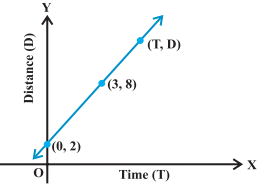
In Fig., time and distance graph of a linear motion is given. Two positions of time and distance are recorded as, when T = 0, D = 2 and when T = 3, D = 8. Using the concept of slope, find law of motion, i.e., how distance depends upon time.

Find the derivative of function $2 \tan x - 7 \sec x$
Let R be a relation from N to N defined by $\text{R}=\{(\text{a, b}):\text{a, b}\in\text{N and a}=\text{b}^2\}.$ Are the following statement true?
$(\text{a, b})\in\text{R and (b, c)}\in\text{R}\Rightarrow \text{(a, c)}\in\text{R}$
Coefficient of variation of two distributions are 60% and 70% and their standard deviations are 21 and 16 respectively. What are their arithmetic means?