Question
Differentiate the following functions with respect to x:
$\log\Big(\frac{\text{x}^2+\text{x}+1}{\text{x}^3-\text{x}+1}\Big)$

Answer

Let, $\text{y}=\log\Big(\frac{\text{x}^2+\text{x}+1}{\text{x}^3-\text{x}+1}\Big)$
Differentiate with respect to x we get,
$\frac{\text{dy}}{\text{dx}}=\frac{\text{d}}{\text{dx}}\Big[\log\Big(\frac{\text{x}^2+\text{x}+1}{\text{x}^3-\text{x}+1}\Big)\Big]$
$=\frac{1}{\Big(\frac{\text{x}^2+\text{x}+1}{\text{x}^2-\text{x}+1}\Big)}\frac{\text{d}}{\text{dx}}\Big(\frac{\text{x}^2+\text{x}+1}{\text{x}^2-\text{x}+1}\Big)$
[Using chain rule and quotient rule]
$=\Big(\frac{\text{x}^2+\text{x}+1}{\text{x}^3-\text{x}+1}\Big)\bigg[\frac{\text{x}^2-\text{x}+1\frac{\text{d}}{\text{dx}}(\text{x}^2+\text{x}+1)-(\text{x}^2+\text{x}+1)\frac{\text{d}}{\text{dx}}(\text{x}^2-\text{x}+1)}{(\text{x}^2-\text{x}+1)^2}\bigg]$
$=\Big(\frac{\text{x}^2+\text{x}+1}{\text{x}^3-\text{x}+1}\Big)\bigg[\frac{(\text{x}^2-\text{x}+1)(2\text{x}+1)-(\text{x}^2+\text{x}+1)(2\text{x}-1)}{(\text{x}^2-\text{x}+1)^2}\bigg]$
$=\Big(\frac{\text{x}^2+\text{x}+1}{\text{x}^3-\text{x}+1}\Big)\bigg[\frac{2\text{x}^3-2\text{x}^2+2\text{x}+\text{x}^3-\text{x}+1-2\text{x}^3-2\text{x}^2-2\text{x}+\text{x}^2+\text{x}+1}{(\text{x}^2-\text{x}+1)^2}\bigg]$
$=\frac{-4\text{x}^2+2\text{x}^3+2}{(\text{x}^2+\text{x}+1)(\text{x}^2+\text{x}+1)}$
$=\frac{-4\text{x}^2+2\text{x}^3+2}{(\text{x}^2+1)^2-(\text{x})^2}$
$=\frac{-2(\text{x}^2-1)}{\text{x}^4+1+2\text{x}^2-\text{x}^2}$
$=\frac{-2(\text{x}^2-1)}{\text{x}^4+\text{x}^2+1}$
So,
$\frac{\text{d}}{\text{dx}}\Big\{\log\Big(\frac{\text{x}^2+\text{x}+1}{\text{x}^2-\text{x}+1}\Big)\Big\}=\frac{-2(\text{x}^2-1)}{\text{x}^4+\text{x}^2+1}$

Need a full question paper?

Generate a complete, print-ready paper with questions like this in minutes — across 16+ boards, with answer keys.
Start Generating Free

Similar questions

Solve the following system of equations by matrix method:
$6x - 12y + 25z = 4$
$4x + 15y - 20z = 3$
$2x + 18y + 15z = 10$
Using vectors find the area of the triangle with vertices, A(2, 3, 5), B(3, 5, 8) and C(2, 7, 8).
Two cards are drawn simultaneosly from a well shuffled deck of 52 cards. Find the probability distribution of the number of the successes, when getting a spade is considered a success.
Prove that the points having position vectors $\hat{\text{i}}+2\hat{\text{j}}+3\hat{\text{k}},\ 3\hat{\text{i}}+4\hat{\text{j}}+7\hat{\text{k}}$ and $-3\hat{\text{i}}-2\hat{\text{j}}-5\hat{\text{k}}$ are collinear.
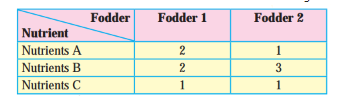
In a cattle breading firm, it is prescribed that the food ration for one animal must contain 14, 22 and 1 units of nutrients A, B and C respectively. Two different kinds of fodder are available. Each unit of these two contains the following amounts of these three nutrients :

Image

The cost of fodder 1 is ₹3 per unit and that of fodder ₹ 2, Formulate the L.P.P. to minimize the cost.

A rectangle is inscribed in a semi-circle of radius r with one of its sides on diameter of semi-circle. Find the dimension of the rectangle so that its area is maximum. Find also the area.
If $\text{x}=2\cos\theta-\cot2\theta$ and $\text{y}=2\sin\theta-\sin2\theta,$ prove that $\frac{\text{dy}}{\text{dx}}=\tan\big(\frac{3\theta}{2}\big)$
Find the approximate change in the surface area of a cube of side x metres caused by decreasing the side by $1\%.$
Solve the following differential equation:
$(\text{x}-\text{y})\frac{\text{dy}}{\text{dx}}=\text{x + 2y}$
Evaluate the following intregals:
$\int\frac{3}{(1-\text{x})(1+\text{x}^2)}\ \text{dx}$