Question
Differentiate the following:
  1. Wave velocity and particle velocity.
  2. Harmonics and overtones.

Answer

  1.  
Wave velocity
Particle velocity
The velocity of wave motion through a particular medium is constant. It depends only on the nature of the medium, does not depends upon its frequency or wavelength or intensity.
Velocity of the particles during their vibration is different at different position.
  1.  
Harmonics
Overtones
Harmonics are the notes/ seconds of frequency equal to or an integral multiple of fundamental frequency (n). Thus, first, second, third, ... harmonics have frequencies n, 2n, 3n, ... respectively.
Overtones are the notes/ seconds of frequency twice/ thrice/ four times ... the fundamental frequency (n). Thus, first, second, third, ... overtones have frequencies 2n, 3n, 4n, ... respectively and so on.

Need a full question paper?

Generate a complete, print-ready paper with questions like this in minutes — across 16+ boards, with answer keys.
Start Generating Free

Similar questions

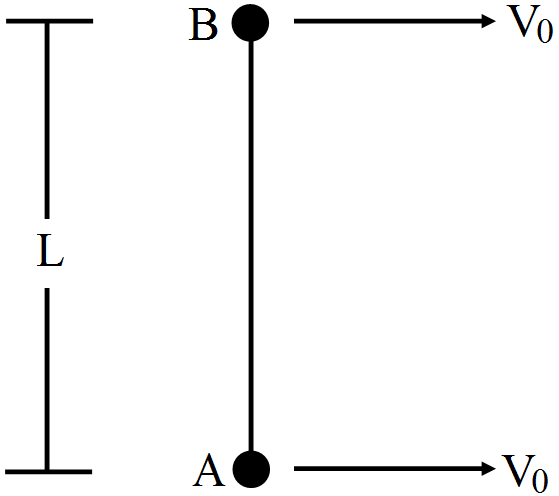
Two small balls A and B, each of mass m, are joined rigidly to the ends of a light rod of lengh L (figure). The system translates on a frictionless horizontal surface with a velocity vo in a direction perpendicular to the rod. A particle P of mass m kept at rest on the surface sticks to the ball A as the ball collides with it. Find:
  1. The linear speeds of the balls A and B after the collision.
  2. The velocity of the centre of mass C of the system A + B + P.
  3. The angular speed of the system about C after the collision.

[Hint: The light rod will exert a force on the ball B only along its length.]
Standing waves of frequency 5.0kHz are produced in a tube filled with oxygen at 300K. The separation between the consecutive nodes is 3.3cm. Calculate the specific heat capacities Cp and Cof the gas.
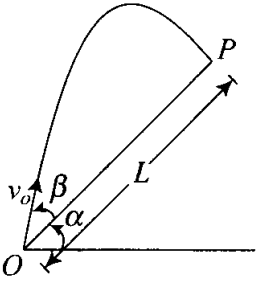
A particle is projected in air at an angle $\beta$ to a surface which itself is inclined at an angle $\alpha$ to the horizontal (Fig.).

  1. Time of flight.
(Hint: This problem can be solved in two different ways:

  1. Point P at which particle hits the plane can be seen as intersection of its trajectory (parobola) and straight line. Remember particle is projected at an angle $(\alpha+\beta)$ w.r.t. horizontal.
  2. We can take x-direction along the plane and y-direction perpendicular to the plane. In that case resolve g (acceleration due to gravity) in two differrent components, gx along the plane and gy perpendicular to the plane. Now the problem can be solved as two independent motions in x and y directions respectively with time as a common parameter.)
A square-shaped copper coil has edges of length 50cm and contains 50 turns. It is placed perpendicular to a 1.0T magnetic field. It is removed from the magnetic field in 0·25s and restored in its original place in the next 0·25s. Find the magnitude of the average emf induced in the loop during:
  1. Its removal.
  2. Its restoration.
  3. Its motion.
The acceleration due to gravity on the surface of moon is 1.7m s-2. What is the time period of a simple pendulum on the surface of moon if its time period on the surface of earth is 3.5 s? (g on the surface of earth is 9.8m s-2)
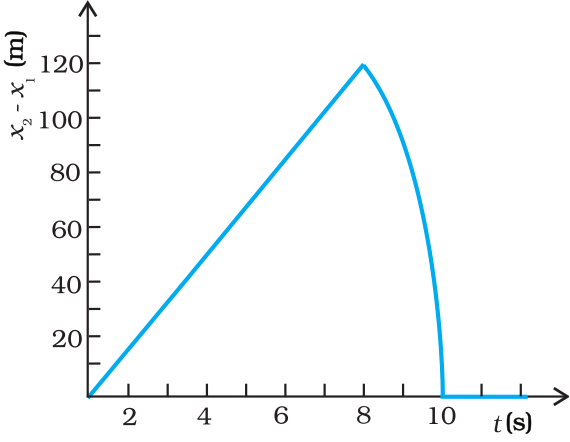
Two stones are thrown up simultaneously from the edge of a cliff 200m high with initial speeds of 15m s–1 and 30m s–1. Verify that the graph shown in correctly represents the time variation of the relative position of the second stone with respect to the first. Neglect air resistance and assume that the stones do not rebound after hitting the ground. Take g = 10m s–2. Give the equations for the linear and curved parts of the plot.

Show that if n equal rain droplets falling through air with equal steady velocity of 10cm s-1 coalesce, the resultant drop attains a new terminal velocity of 10n2/3cm s-1.
Find the wavelength of the radiation emitted by hydrogen in the transitions (a) n = 3 to n= 2, (b) n = 5 to n = 4 and (c) n = 10 to n = 9.
In the previous problem, if 15.0cm of water and spirit each are further poured into the respective arms of the tube, what is the difference in the levels of mercury in the two arms? (Specific gravity of mercury = 13.6)
A block of mass M is kept on a rough horizontal surface. The coefficient of static friction between the block and the surface is $\mu.$ The block is to be pulled by applying a force to it. What minimum force is needed to slide the block? In which direction should this force act?