Question
Differentiate the following w.r.t. x:

$\sqrt[3]{\frac{4 x-1}{(2 x+3)(5-2 x)^2}}$

Answer

Get the step-by-step solution for this question inside the Vidyadip app.

Get the answer in the app

Need a full question paper?

Generate a complete, print-ready paper with questions like this in minutes — across 16+ boards, with answer keys.
Start Generating Free

Similar questions

Evaluate: $\int_0^\pi x \cdot \sin x \cdot \cos ^2 x \cdot d x$
Find the area of the region lying between the parabolas $4y^2 = 9x$ and $3x^2 = 16y$
Using vector method, find the incentre of the triangle whose vertices are $P(0,4,0), Q(0,0,3)$ and $R(0,4,3)$.
If $y=f(x)$ is a differentiable function of $x$ such that inverse function $x=f^{-1}(y)$ exists, then prove that $x$ is a differentlable function of $y$ and $\frac{d x}{d y}=\frac{1}{\frac{d y}{d x}}$ where $\frac{d y}{d x} \neq 0$. Hence find $\frac{d}{d x}\left(\tan ^{-1} x\right)$
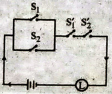
Find the symbolic form of the glven switching circuit. Construct its switching table and interpret your result.
Image
Find the volume of the solid generated, when the area between ellipse $4 x^2+9 y^2=36$ and the chord $A B$, with $A =(3,0), B =(0,2)$; is revolved about $X$-axis.
The sum of three members is $6$ . When second number is subtracted from thrice the sum of first and we get number $10.$ Four times the sum of third number is subtracted from five times the sum of first and second number, the result is $3$ . Using above information, find these three numbers by matrix method.
If the population of a town increases at a rate proportional to the population at that time. If the population increases from 40 thousand to 60 thousand in 40 years, what will be the population in another 20 years? $\left(\right.$ Given $\left.\sqrt{\frac{3}{2}}=1.2247\right)$
Solve the differential equation : $x+y \frac{d y}{d x}=\sec \left(x^2+y^2\right)$. Also find the particular solution if $x=y=0$
Find the second order derivatives of the following:

$2 x^5-4 x^3-\frac{2}{x^2}-9$