Question
Differentiate the functions given in Exercise:
$(\text{x}+3)^2.(\text{x}+4)^3.(\text{x}+5)^4$

Answer

Let $\text{y}=(\text{x}+3)^2.(\text{x}+4)^3.(\text{x}+5)^4\ \dots\text{(i)}$
Taking logs on both sides, we have
$\log\text{y}=2\log(\text{x}+3)+3\log(\text{x}+4)+4\log(\text{x}+5)^4$
$\therefore\ \frac{\text{d}}{\text{dx}}\log\text{y}=2\frac{\text{d}}{\text{dx}}\log(\text{x}+3)+3\frac{\text{d}}{\text{dx}}\log(\text{x}+4)+4\frac{\text{d}}{\text{dx}}\log(\text{x}+5)$
$\Rightarrow\ \frac{1}{\text{y}}\frac{\text{dy}}{\text{dx}}=2\frac{1}{\text{x}+3}\frac{\text{d}}{\text{dx}}(\text{x}+3)+3\frac{1}{\text{x}+4}\frac{\text{d}}{\text{dx}}(\text{x}+4)+4\frac{1}{\text{x}+5}\frac{\text{d}}{\text{dx}}(\text{x}+5)$
$\Rightarrow\ \frac{1}{\text{y}}\frac{\text{dy}}{\text{dx}}=\frac{2}{\text{x}+3}+\frac{3}{\text{x}+4}+\frac{4}{\text{x}+5}$
$\Rightarrow\ \frac{\text{dy}}{\text{dx}}=\text{y}\Big(\frac{2}{\text{x}+3}+\frac{3}{\text{x}+4}+\frac{4}{\text{x}+5}\Big)$
$\Rightarrow\ \frac{\text{dy}}{\text{dx}}=(\text{x}+3)^2(\text{x}+4)^3(\text{x}+5)^4\Big(\frac{2}{\text{x}+3}+\frac{3}{\text{x}+4}+\frac{4}{\text{x}+5}\Big)\ \text{[From eq.(i)]}$

Need a full question paper?

Generate a complete, print-ready paper with questions like this in minutes — across 16+ boards, with answer keys.
Start Generating Free

Similar questions

$\text{Find}\ |\vec{a}|\ \text{and}\ \big|\vec{b}\big|,\text{if}\ (\vec{a}+\vec{b})\cdot(\vec{a}-\vec{b})=8\ \text{and}\ |\vec{a}|=8|\vec{b}|.$
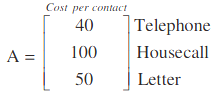
In a legislative assembly election, a political group hired a public relations firm to promote its candidate in three ways: telephone, house calls, and letters. The cost per contact (in paise) is given in matrix A as

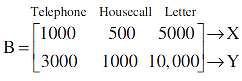
The number of contacts of each type made in two cities X and Y is given by

Find the total amount spent by the group in the two cities X and Y.
Find the integral value of x, if $\begin{vmatrix}\text{x}^2&\text{x}&1\\0&2&1\\3&1&4 \end{vmatrix}=28.$
Find the value of k, for which $\text{f}(\text{x}) = $ $ \begin{matrix} \frac{\sqrt{1 + \text{kx}} - \sqrt{1 - \text{kx}}}{\text{x}} , \text{if} - 1\leq\text{x} < 0\\ \frac{2\text{x} + 1}{\text{x} - 1} , \text{ if}0\leq\text{x}< 1 \end{matrix} $ is continuous at x = 0.
The mean of a binomial distribution is 20 and the standard deviation 4. Calculate the parameters of the binomial distribution.
Solve for $x:2 \tan^{-1}(\cos x) = \tan^{-1} (2 cosec x).$
Prove that $f(x) = ax + b,$ where $a, b$ are constants and $a < 0$ is an decreasing function on $R.$
Evaluate the following integrals:
$\int^\limits{2}_{-2}|\text{x}+1|\text{dx}$
Find an angle $\theta$
Which increases twice as fast as its cosine.
The line $\vec{\text{r}}=\hat{\text{i}}+\lambda(2\hat{\text{i}}-\text{m}\hat{\text{j}}-3\hat{\text{k}})$ is parallel to the plane $\vec{\text{r}}\cdot(\text{m}\hat{\text{i}}+3\hat{\text{j}}+\hat{\text{k}})=4.$ Find m.