MCQ
Dimension of $\frac{1}{\mu_0 \varepsilon_0}$ should be equal to
  • A
    $T ^2 / L ^2$
  • B
    $L / T$
  • $L ^2 / T ^2$
  • D
    $T / L$

Answer

Correct option: C.
$L ^2 / T ^2$
c
$\frac{1}{\mu_0 \in_0}=c^2 \Rightarrow\left[\frac{1}{\mu_0 \in_0}\right]=\left[ c ^2\right]=\left[ L ^2 T ^{-2}\right]$

Need a full question paper?

Generate a complete, print-ready paper with questions like this in minutes — across 16+ boards, with answer keys.

Start Generating Free

Similar questions

If the current is doubled, the deflection is also doubled in:
  1. A tangent galvanometer.
  2. A moving-coil galvanometer.
  3. Both.
  4. None.
A simple pendulum has time period T1. The point of suspension is now moved upwards according to relation, y=kt2. (k = 1ms-2), where y is the vertical displacement. The time period now becomes T2. The ratio of $\frac{\text{T}^2_1}{\text{T}^2_2}$ is (g = 10ms2)
The velocity of kerosene oil in a horizontal pipe is $5 m/s.$  If $g = 10m/{s^2}$ then the velocity head of oil will be ....... $m$
A ball is dropped from the top of a $100\; m$ high tower on a planet. In the last $\frac{1}{2}\;s $ before hitting the ground, it covers a distance of $19\; \mathrm{m}$. Acceleration due to gravity (in $\mathrm{ms}^{-2}$ ) near the surface on that planet is
A car is moving with high velocity when it has a turn. A force acts on it outwardly because of
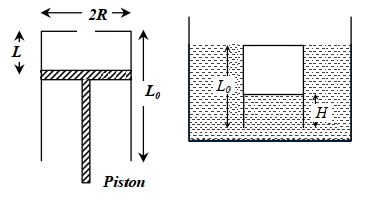
A fixed thermally conducting cylinder has a radius $\mathrm{R}$ and height $\mathrm{L}_0$. The cylinder is open at its bottom and has a small hole at its top. A piston of mass $M$ is held at a distance $L$ from the top surface, as shown in the figure. The atmospheric pressure is $\mathrm{P}_0$.

$1.$  The piston is now pulled out slowly and held at a distance $2 \mathrm{~L}$ from the top. The pressure in the cylinder between its top and the piston will then be

$(A)$ $\mathrm{P}_0$ $(B)$ $\frac{\mathrm{P}_0}{2}$  $(C)$ $\frac{P_0}{2}+\frac{M g}{\pi R^2}$  $(D)$ $\frac{\mathrm{P}_0}{2}-\frac{\mathrm{Mg}}{\pi \mathrm{R}^2}$

$2.$  While the piston is at a distance $2 \mathrm{~L}$ from the top, the hole at the top is sealed. The piston is then released, to a position where it can stay in equilibrium. In this condition, the distance of the piston from the top is

$(A)$ $\left(\frac{2 \mathrm{P}_0 \pi \mathrm{R}^2}{\pi \mathrm{R}^2 \mathrm{P}_0+\mathrm{Mg}}\right)(2 \mathrm{~L})$  $(B)$ $\left(\frac{\mathrm{P}_0 \pi R^2-\mathrm{Mg}}{\pi R^2 \mathrm{P}_0}\right)(2 \mathrm{~L})$ 

$(C)$ $\left(\frac{\mathrm{P}_0 \pi \mathrm{R}^2+\mathrm{Mg}}{\pi \mathrm{R}^2 \mathrm{P}_0}\right)(2 \mathrm{~L})$  $(D)$ $\left(\frac{\mathrm{P}_0 \pi \mathrm{R}^2}{\pi \mathrm{R}^2 \mathrm{P}_0-\mathrm{Mg}}\right)(2 \mathrm{~L})$

$3.$  The piston is taken completely out of the cylinder. The hole at the top is sealed. A water tank is brought below the cylinder and put in a position so that the water surface in the tank is at the same level as the top of the cylinder as shown in the figure. The density of the water is $\rho$. In equilibrium, the height $\mathrm{H}$ of the water column in the cylinder satisfies

$(A)$ $\rho g\left(\mathrm{~L}_0-\mathrm{H}\right)^2+\mathrm{P}_0\left(\mathrm{~L}_0-\mathrm{H}\right)+\mathrm{L}_0 \mathrm{P}_0=0$

$(B)$ $\rho \mathrm{g}\left(\mathrm{L}_0-\mathrm{H}\right)^2-\mathrm{P}_0\left(\mathrm{~L}_0-\mathrm{H}\right)-\mathrm{L}_0 \mathrm{P}_0=0$

$(C)$ $\rho g\left(\mathrm{~L}_0-\mathrm{H}\right)^2+\mathrm{P}_0\left(\mathrm{~L}_0-\mathrm{H}\right)-\mathrm{L}_0 \mathrm{P}_0=0$

$(D)$ $\rho \mathrm{g}\left(\mathrm{L}_0-\mathrm{H}\right)^2-\mathrm{P}_0\left(\mathrm{~L}_0-\mathrm{H}\right)+\mathrm{L}_0 \mathrm{P}_0=0$

Give the answer question $1,2$ and $3.$
The equation of state of $n$ moles of a non-ideal gas can be approximated by the equation $\left(p+\frac{n^2 \alpha }{V^2}\right)(V-n b)=n R T$ where $a$ and $b$ are constant characteristics of the gas. Which of the following can represent the equation of a quasistatic adiabat for this gas (assume that, $C_V$ is the molar heat capacity at constant volume is independent of temperature)?
An oscillator of mass $M$  is at rest in its equilibrium position in a potential $V\, = \,\frac{1}{2}\,k{(x - X)^2}.$ A particle of mass $m$  comes from right with speed $u$  and collides completely inelastically with $M$ and sticks to it . This process repeats every time the oscillator crosses its equilibrium position .The amplitude of oscillations after $13$  collisions is: $(M = 10,\, m = 5,\, u = 1,\, k = 1 ).$ 
When a body is placed on a rough plane inclined at an angle $\theta $ to the horizontal, its acceleration is
A $1.00 \times {10^{ - 20}}kg$ particle is vibrating with simple harmonic motion with a period of $1.00 \times {10^{ - 5}}sec$ and a maximum speed of $1.00 \times {10^3}m/s$. The maximum displacement of the particle is