MCQ
Dimensional formula of capacitance is
  • $ {M^{ - 1}}{L^{ - 2}}{T^4}{A^2}$
  • B
    $M{L^2}{T^4}{A^{ - 2}}$
  • C
    $ML{T^{ - 4}}{A^2}$
  • D
    ${M^{ - 1}}{L^{ - 2}}{T^{ - 4}}{A^{ - 2}}$

Answer

Correct option: A.
$ {M^{ - 1}}{L^{ - 2}}{T^4}{A^2}$
a
(a) $[C] =$ $\left( {\frac{Q}{V}} \right) $ $ = \left( {\frac{{{Q^2}}}{W}} \right) $ $= \left[ {\frac{{{A^2}{T^2}}}{{M{L^2}{T^{ - 2}}}}} \right]$ $ = [{M^{ - 1}}{L^{ - 2}}{T^4}{A^2}]$

Need a full question paper?

Generate a complete, print-ready paper with questions like this in minutes — across 16+ boards, with answer keys.

Start Generating Free

Similar questions

A ground to ground projectile is at point $A$ at $t=\frac{T}{3}$, is at point $B$ at $t=\frac{5 T}{6}$ and reaches the ground at $t=T$. The difference in heights between points $A$ and $B$ is
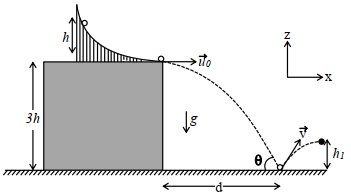
A slide with a frictionless curved surface, which becomes horizontal at its lower end,, is fixed on the terrace of a building of height $3 h$ from the ground, as shown in the figure. A spherical ball of mass $\mathrm{m}$ is released on the slide from rest at a height $h$ from the top of the terrace. The ball leaves the slide with a velocity $\vec{u}_0=u_0 \hat{x}$ and falls on the ground at a distance $d$ from the building making an angle $\theta$ with the horizontal. It bounces off with a velocity $\overrightarrow{\mathrm{v}}$ and reaches a maximum height $h_l$. The acceleration due to gravity is $g$ and the coefficient of restitution of the ground is $1 / \sqrt{3}$. Which of the following statement($s$) is(are) correct?

($AV$) $\vec{u}_0=\sqrt{2 g h} \hat{x}$ ($B$) $\vec{v}=\sqrt{2 g h}(\hat{x}-\hat{z})$  ($C$) $\theta=60^{\circ}$  ($D$) $d / h_1=2 \sqrt{3}$
The velocity at the maximum height of a projectile is half of its initial velocity $u$. Its range on the horizontal plane is
Consider the two statements related to circular motion in usual notations

$A$. In uniform circular motion $\vec{\omega}, \vec{v}$ and $\vec{a}$ are always mutually perpendicular

$B$. In non-uniform circular motion, $\vec{\omega}, \vec{v}$ and $\vec{a}$ are always mutually perpendicular
A body has its centre of mass at the origin. The x-coordinates of the particles:
A dancer on ice spins faster when she folds her arms. This is due to:
A $ U$ tube of uniform bore of cross-sectional area $A$ has been set up vertically with open ends facing up. Now $m$ gm of a liquid of density $d$ is poured into it. The column of liquid in this tube will oscillate with a period $T$ such that
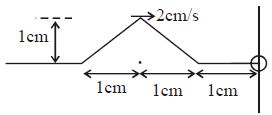
A trianguler pulse moving at $2\ cm/s$ on a rope approches an end at which it is free to slide on vertical pole. What is the particle speed at the free end at $\frac{3}{4}\  sec$  from the instant shown ...... $cm/s$
In the density measurement of a cube, the mass and edge length are measured as $(10.00 \pm 0.10)\,\,kg\,$ and $(0.10 \pm 0.01)\,\,m\,$ respectively. The error in the measurement of density is
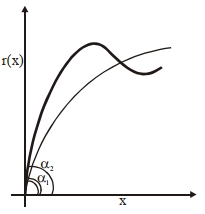
A projectile is launched from the origin in the $xy$ plane ( $x$ is the horizontal and $y$ is the vertically up direction) making an angle $\alpha$ from the $x$-axis. If its distance. $r =\sqrt{ x ^2+ y ^2}$ from the origin is plotted against $x$, the resulting curves show different behaviours for launch angles $\alpha_1$ and $\alpha_2$ as shown in the figure below. For $\alpha_1, r ( x )$ keeps increasing with $x$ while for $\alpha_2$, $r(x)$ increases and reaches a maximum, then decreases and goes through a minimum before increasing again. The switch between these two cases takes place at an angle $\alpha_c\left(\alpha_1 < \alpha_c < \alpha_2\right)$. The value of $\alpha_c$ is [ignore where $v_0$ is the initial speed of the projectile and $g$ is the acceleration due to gravity]