MCQ
Dimensions of $\frac{1}{(\mu_0\in_0)}$ is:
  • A
    $\frac{\text{L}}{\text{T}}$
  • B
    $\frac{\text{T}}{\text{L}}$
  • $\frac{\text{L}^2}{\text{T}^2}$
  • D
    $\frac{\text{T}^2}{\text{L}^2}$

Answer

Correct option: C.
$\frac{\text{L}^2}{\text{T}^2}$

The speed of light, $\text{C}=\frac{1}{\sqrt{\mu_0\in_0}}$
The dimensions of $\frac{1}{\sqrt{\mu_0\in_0}}$ are of velocity, i.e., $\frac{\text{L}}{\text{T}}$
Therefore, $\frac{1}{\in_0\mu_0}$ will have dimensions $\frac{\text{L}^2}{\text{T}^2}$

Need a full question paper?

Generate a complete, print-ready paper with questions like this in minutes — across 16+ boards, with answer keys.

Start Generating Free

Similar questions

The de-Broglie wavelength λ associated with an electron having kinetic energy E is given by the expression
A metal target with atomic number $Z=46$ is bombarded with a high energy electron beam. The emission of $X$-rays from the target is analyzed. The ratio $r$ of the wavelengths of the $K_\alpha$-line and the cut-off is found to be $r=2$. If the same electron beam bombards another metal target with $Z=41$, the value of $r$ will be
Using the Heisenberg uncertainty principle, arrange the following particles in the order of increasing lowest energy possible.

$(I)$ An electron in $H _{2}$ molecule

$(II)$ A hydrogen atom in a $H _{2}$ molecule

$(III)$ A proton in the carbon nucleus

$(IV)$ $A H _{2}$ molecule within a nanotube
The number of turns of primary and secondary coils of a transformer are 5 and 10 respectively and the mutual inductance of the transformer is 25 henry. Now the number of turns in the primary and secondary of the transformer are made 10 and 5 respectively. The mutual inductance of the transformer in henry will be
A $LC$ circuit is in the state of resonance. If $C = 0.1\mu F$ and $L = 0.25$ henry. Neglecting ohmic resistance of circuit what is the frequency of oscillations.........$Hz$
$X−$ray falling on a material.
Let $n_r$ and $n_b$ be the number of photons emitted by a red bulb and a blue bulb, respectively, of equal power in a given time:
Two identical conducting spheres $A$  and $B,$  carry equal charge. They are separated by a distance much larger than their diameter, and the force between them is $F$ . A third identical conducting sphere, $C,$  is uncharged. Sphere $C$  is first touched to $A,$ then to $B,$  and then removed. As a result, the force between $A$  and $B$  would be equal to
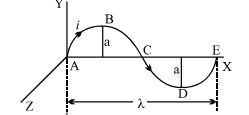
A conductor $ABCDE$, shaped as shown, carries a current i. It is placed in the $xy$ plane with the ends $A$ and $E$ on the $x$-axis. $A$ uniform magnetic field of magnitude $B$ exists in the region. The force acting on it will be
In the Boolean algebra, the following one is wrong: