MCQ
Dimensions of $C R$ are those of
  • A
    Frequency
  • B
    Energy
  • Time period
  • D
    Current

Answer

Correct option: C.
Time period
(c)$\text { Capacity } \times \text { Resistance }=\frac{\text { Charge }}{\text { Potential }} \times \frac{\text { Volt }}{\mathrm{amp}} $
$=\frac{\text { amp }\times \text { second } \times \text { Volt }}{\text { Volt } \times \text { amp }}=\text { Second }$

Need a full question paper?

Generate a complete, print-ready paper with questions like this in minutes — across 16+ boards, with answer keys.
Start Generating Free

Similar questions

If in compound microscope $m$ and $m$ be the linear magnification of the objective lens and eye lens respectively, then magnifying power of the compound microscope will be
A bullet fired into a fixed target loses half of its velocity after penetrating $3 cm$. How much further it will penetrate before coming to rest assuming that it faces constant resistance to motion?
Velocity at mean position of a particle executing S.H.M. is $v$, they velocity of the particle at a distance equal to half of the amplitude
A car of mass $1250 \mathrm{~kg}$ is moving at $30 \mathrm{~m} / \mathrm{s}$. Its engine delivers $30 \mathrm{~kW}$ while resistive force due to surface is $750 N$. What max acceleration can be given in the car
A short bar magnet placed with its axis at $30^{\circ}$ with a uniform external magnetic field of $0.16$ Tesla experiences a torque of magnitude $0.032$ Joule. The magnetic moment of the bar magnet will be
A gas mixture consists of $2$ moles of oxygen and $4$ moles argon at temperature $T$. Neglecting all vibrational modes, the total internal energy of the system is
Which of the following is correct in terms of increasing work done for the same initial and final state
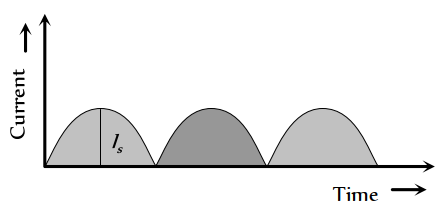
The output current versus time curve of a rectifier is shown in the figure. The average value of the output current in this case is
Image
Among the two interfering monochromatic sources $A$ and $B ; A$ is ahead of $B$ in phase by $66^{\circ}$. If the observation be taken from point $P$, such that $P B-P A=\lambda / 4$. Then the phase difference between the waves from $A$ and $B$ reaching $P$ is
A voltmeter has resistance of $2000 \mathrm{ohms}$ and it can measure upto $2 \mathrm{~V}$. If we want to increase its range to $10 \mathrm{~V}$, then the required resistance in series will be