MCQ
Dimensions of $CR$ are those of
  • A
    Frequency
  • B
    Energy
  • Time period
  • D
    Current

Answer

Correct option: C.
Time period
c
(c) Capacity $ \times $ Resistance = $\frac{{{\rm{Charge}}}}{{{\rm{Potential}}}} \times \frac{{{\rm{Volt}}}}{{{\rm{amp}}}}$

= $\frac{{{\rm{amp}} \times {\rm{second}} \times {\rm{Volt}}}}{{{\rm{Volt}} \times {\rm{amp}}}} = {\rm{Second}}$

Need a full question paper?

Generate a complete, print-ready paper with questions like this in minutes — across 16+ boards, with answer keys.
Start Generating Free

Similar questions

For three vectors $\vec{A}=(-x \hat{i}-6 \hat{j}-2 \hat{k})$, $\vec{B}=(-\hat{i}+4 \hat{j}+3 \hat{k})$ and $\vec{C}=(-8 \hat{i}-\hat{j}+3 \hat{k})$, if $\overrightarrow{\mathrm{A}} \cdot(\overrightarrow{\mathrm{B}} \times \overrightarrow{\mathrm{C}})=0$, them value of $\mathrm{x}$ is. . . . . .. 
A projectile is fired at a speed of $100\, m/sec$ at an angle of $37^o$ above the horizontal. At the highest point, the projectile breaks into two parts of mass ratio $1:3$ , the smaller coming to rest. Then the distance of heavier part from the launching point is ............... $\mathrm{m}$
Unit of moment of inertia in $MKS$ system
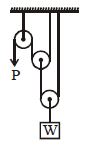
The ideal mechanical advantage of the combination of pulleys shown is
If vectors $\overrightarrow {A} = cos\omega t\hat i + sin\omega t\hat j$ and $\overrightarrow {B} = cos\frac{{\omega t}}{2}\hat i + sin\frac{{\omega t}}{2}\hat j$ are functions of time, then the value of $t$ at which they are orthogonal to each other is 
The displacement of a string is given by $\text{y}(\text{x, t})=0.06\sin(2\pi\text{x}/ 3)\cos(120\pi\text{t})$ where x and y are in m and t in s. The length of the string is 1.5m and its mass is $3.0\times10^{-2}\text{kg}$
  1. It represents a progressive wave of frequency 60Hz.
  2. It represents a stationary wave of frequency 60Hz.
  3. It is the result of superposition of two waves of wavelength 3m, frequency 60Hz each travelling with a speed of 180m/ s in opposite direction.
  4. Amplitude of this wave is constant.
Bernoulli's Principle is based on :
The moon's radius is $1/4$ that of the earth and its mass is $1/80$ times that of the earth. If $g$ represents the acceleration due to gravity on the surface of the earth, that on the surface of the moon is
The harmonics which are present in a pipe open at one end are
The frequency of a tuning fork is $256\, Hz$. The velocity of sound in air is $344\, ms^{-1}$. The distance travelled (in $meters$) by the sound during the time in which the tunning fork complete $32$ vibrations is