MCQ
Dimensions of the following three quantities are the same
  • A
    Work, energy, force
  • B
    Velocity, momentum, impulse
  • C
    Potential energy, kinetic energy, momentum
  • Pressure, stress, coefficient of elasticity

Answer

Correct option: D.
Pressure, stress, coefficient of elasticity
d
(d) [Pressure] = [Stress] = [coefficient of elasticity] = $[M{L^{ - 1}}{T^{ - 2}}]$

Need a full question paper?

Generate a complete, print-ready paper with questions like this in minutes — across 16+ boards, with answer keys.
Start Generating Free

Similar questions

If radius of the earth is $6347\, km ,$ then what will be difference between acceleration of free fall and acceleration due to gravity near the earth's surface ?
Two capillaries made of same material but of different radii are dipped in a liquid. The rise of liquid in one capillary is $2.2\, cm$ and that in the other is $6.6\, cm$. The ratio of their radii is
A body of mass $100\, g$ is sliding from an inclined plane of inclination $30^°$. What is the frictional force experienced if $\mu = 1.7$
A body of mass $0.5 \,kg$ is projected under gravity with a speed of $98 \,m/s$ at an angle of ${30^o}$ with the horizontal. The change in momentum (in magnitude) of the body is ......... $N-s$
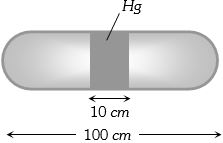
A horizontal uniform glass tube of $100 \,cm$, length sealed at both ends contain $10 \,cm$ mercury column in the middle. The temperature and pressure of air on either side of mercury column are respectively $81°C$ and $76\, cm$ of mercury. If the air column at one end is kept at $0°C$ and the other end at $273°C$, the pressure of air which is at $0°C$ is (in $cm$ of $Hg$)
The internal energy of an ideal gas depends on:
Two point masses of mass $m_1 = fM$ and $m_2 = (1 -f)\,M\,(f < 1 )$ are in outer space ( far from gravitational influence of other objects) at a distance $R$ from each other. They move in circular orbits about their centre of mass with angular vaocities $\omega _1$ for $m_1$ and $\omega _2$ for $m_2.$ In that case
Pressure inside two soap bubbles are $1.01$ and $1.02$ atmosphere, respectively. The ratio of their volumes is
Which of the following quantities related to a lens depend on the wavelength or wavelengths of the incident light?
  1. Power.
  2. Focal length.
  3. Chromatic aberration.
  4. Radii of curvature.
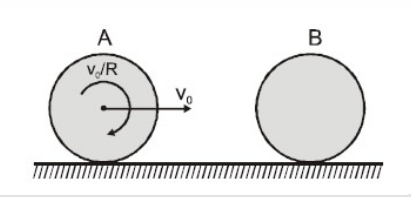
A hollow smooth uniform sphere A of mass m rolls without sliding on a smooth horizontal surface. It collides elastically and head-on with another stationary smooth hollow sphere B of the same mass mm and same radius. The ratio of the kinetic energy of B to that of A just after the collision is: