MCQ
Dimethyl ether and ethyl alcohol are
- ABranched isomer
- BPosition isomer
- ✓Functional isomer
- DTautomer
$(ii)$ Functional isomers have different functional groups
$(iii)$ Homologous are represented by same general formula and two successive
homologous differ by $CH _2$
$(iv)$ Position isomers differ in position of double bond or triple bond or functional group
$\underset{\text { dimethyl ether }}{ CH _3- O - CH _3} \quad CH _3 CH _2 OH$
Dimethyl ether and ethyl alcohol have same formula but different functional groups.
$\therefore$ They are functional isomers.
Generate a complete, print-ready paper with questions like this in minutes — across 16+ boards, with answer keys.
$Zn\,(s)\,\, + \,\,C{u^{2 + }}\,(aq)\, \rightleftharpoons \,Z{n^{2 + \,}}\,(aq)\, + Cu\,(s)$
At $300\,K$ is approximately $(R = 8 \,JK^{-1}\,mol^{-1},\, F = 96000\,C\,mol^{-1})$
$\left[ Ag \left( H _{2} O \right)_{2}\right]\left[ Ag ( CN )_{2}\right]$ is :
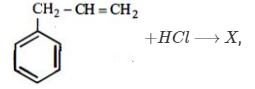
$\begin{array}{*{20}{c}}
{C{H_3} - CH = CH - CH - CH - C{H_3}} \\
{{\mkern 1mu} {\mkern 1mu} {\mkern 1mu} \,\,\,\,\,\,\,\,\,\,\,\,\,\,\,\,\,\,\,\,\,\,\,\,\,\,\,{\mkern 1mu} {\mkern 1mu} |{\mkern 1mu} {\mkern 1mu} {\mkern 1mu} {\mkern 1mu} {\mkern 1mu} {\mkern 1mu} {\mkern 1mu} {\mkern 1mu} {\mkern 1mu} {\mkern 1mu} \,\,\,\,\,\,\,\,\,\,\,{\mkern 1mu} {\mkern 1mu} |{\mkern 1mu} {\mkern 1mu} {\mkern 1mu} {\mkern 1mu} {\mkern 1mu} {\mkern 1mu} {\mkern 1mu} {\mkern 1mu} } \\
{\,\,\,\,\,\,\,\,\,\,\,\,\,\,\,\,\,\,\,\,\,\,\,\,\,\,\,\,\,\,\,OH{\mkern 1mu} {\mkern 1mu} {\mkern 1mu} {\mkern 1mu} \,\,\,\,{\mkern 1mu} {\mkern 1mu} \,\,\,{\mkern 1mu} {\mkern 1mu} OH\,\,}
\end{array}\,$