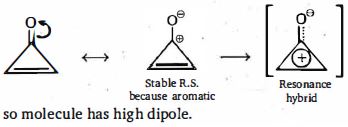
MCQ
Dipole moment of which ketone is maximum ?
  • A

  • B


  • D

Answer

Correct option: C.

c

Need a full question paper?

Generate a complete, print-ready paper with questions like this in minutes — across 16+ boards, with answer keys.

Start Generating Free

Similar questions

Match List$-I$ with List$-II$

List$-I$

(Si-Compounds)

List$-II$

(Si-Polymeric/other products)

$(A)$ $\left( CH _{3}\right)_{4} Si$ $(I)$ Chain silicone
$(B)$ $\left( CH _{3}\right) Si ( OH )_{3}$ $(II)$ Dimeric silicone
$(C)$ $\left( CH _{3}\right)_{2} Si ( OH )_{2}$ $(III)$ Silane
$(D)$ $\left( CH _{3}\right)_{3} Si ( OH )$ $(IV)$ $2 D$ - Silicone

Choose the correct answer from the options given below

$K_{sp}$ for $BaSO_4$ at $25\,^oC$ is $1.1 \times 10^{-10}$. To make the new solubility equal to $1.1 \times 10^{-8}$, it is necessary to use the solution of $Na_2SO_4$ of the following concentration....$M$
How many moles of ${K_2}C{r_2}{O_7}$ can be reduced by $1\, mole$ of $S{n^{2 + }}$
Which of the following compounds can be best prepared by Wurtz reaction?
Enthalpy of neutralization of $HCl$ by $NaOH$ is $-\,55.84\,kJ/mol$ and by $NH_4OH$ is $-\,51.34\,kJ/mol$. The enthalpy of ionization of $NH_4OH$ is .....$kJ$
Given below are two statements:
Statement I: Fluorine has most negative electron gain enthalpy in its group.
Statement II: Oxygen has least negative electron gain enthalpy in its group.
In the light of the above statements, choose the most appropriate from the options given below.<
When oxalic acid reacts with cone. $H_2SO_4,$ two gases produced are of neutral and acidic in nature respectively. Potassium hydroxide absorbs one of the two gases. The product formed during this absorption and the gas which gets absorbed are respectively
${H_2}{O_{\left( g \right)}} + {C_{\left( s \right)}} \to C{O_{\left( g \right)}} + {H_2}\left( g \right)\,;\,\Delta H = 100\,kJ$

$C{O_{\left( g \right)}} + \frac{1}{2}{O_{2\left( g \right)}} \to C{O_{2\left( g \right)}}\,;\,\Delta H =  - 300\,kJ$

${H_2}_{\left( g \right)} + \frac{1}{2}{O_2}_{\left( g \right)} \to {H_2}{O_{\left( g \right)}}\,;\,\Delta H =  - 250\,kJ$

$C_{(s)} + O_{2(g)} \to  CO_{2(g)} ; \Delta H = -x\, kJ$

The value of $x$ will be

Nodal planes of $\pi$ -bond $(s)$ in $CH_2 = C = C = CH_2$ are located in
$IUPAC$ name of :

$\begin{array}{*{20}{c}}
  {C{H_3} - C - CH - C - OC{H_3}} \\ 
  {||\,\,\,\,\,\,\,\,\,|\,\,\,\,\,\,\,\,\,\,\,\,||\,\,\,\,} \\ 
  {\,O\,\,\,\,\,\,C = O\,O\,\,\,\,\,} \\ 
  {|\,\,\,\,\,\,\,\,} \\ 
  {C{H_3}\,\,} 
\end{array}$